Free Shipping (On select items & orders)
  Track My Order


Posted in: Commercial Kitchen Equipment
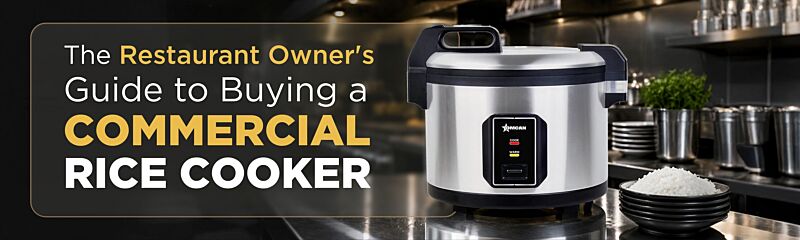
Rice looks simple until you have to make a lot of it. At home you cook two cups and walk away. In a taqueria on a Friday night, you need 60 cups sitting at serving temperature from open to close, cooked in batches that never leave the line short. Same food, completely different machine.
Buy the wrong one and you find out fast. The rice dries at the edges, a cook ends up babysitting a pot instead of working the line, or the unit pops your breaker in the middle of service. None of that is the rice cooker's fault. It usually comes down to a unit that was the wrong size or wired for the wrong outlet.
Most guides just rank a few models and move on. Picking a brand is the easy part. The real questions are how much capacity you need, whether your kitchen can power the thing, and which features are worth paying for. Sort those out and almost any decent cooker will run for years without giving you trouble.
So that is what this covers: sizing (including the measuring-cup detail that catches a lot of first-time buyers), electric versus gas, the features worth the money, the certifications a US health inspector wants to see, and what the whole thing costs once you add up five years of running it.
Quick answer: Most US restaurants are well served by a 120V electric cook-and-hold rice cooker in the 40 to 60 cup cooked range, which runs on a standard outlet with no electrical work. Small céfés, food trucks, and grain-bowl spots usually land around 25 to 30 cups cooked. High-volume Asian restaurants, sushi bars, and caterers go bigger, often running two units or stepping up to gas for constant production. Size the unit to your busiest hour rather than your daily average.
How Big a Rice Cooker Do You Need?
This is where every smart purchase starts, and where a lot of the regrets begin too. Before you look at a single model, pull the numbers from your busiest shifts. A slow Tuesday tells you nothing useful. Count the rice entrées and sides you push during your peak couple of hours, because that window is what the cooker has to survive.
Now the part that trips people up. Capacity gets quoted two ways, and the spec sheet does not always spell out which one you are reading. Raw capacity is how much dry rice the pot holds. Cooked capacity is roughly double that, since rice swells as it soaks up water. Figure one cup of raw rice comes out to about two cups cooked, so a 20-cup raw unit gives you around 40 cups on the plate. A cooker sold as "60 cup" almost always means 60 cooked, which is about 30 raw. Check which number you are looking at before you compare two units, or you can walk away with half the machine you thought you bought.
Common mistake: the cup that comes with a rice cooker is not a regular US measuring cup. The rice-industry cup is 180 mL, a little over three-quarters of a US cup, which is why every commercial unit ships with its own. Let your staff measure with a random coffee mug and your water ratios drift, and the rice turns out gummy or dry. Keep the cup that came with the machine and buy a spare or two.
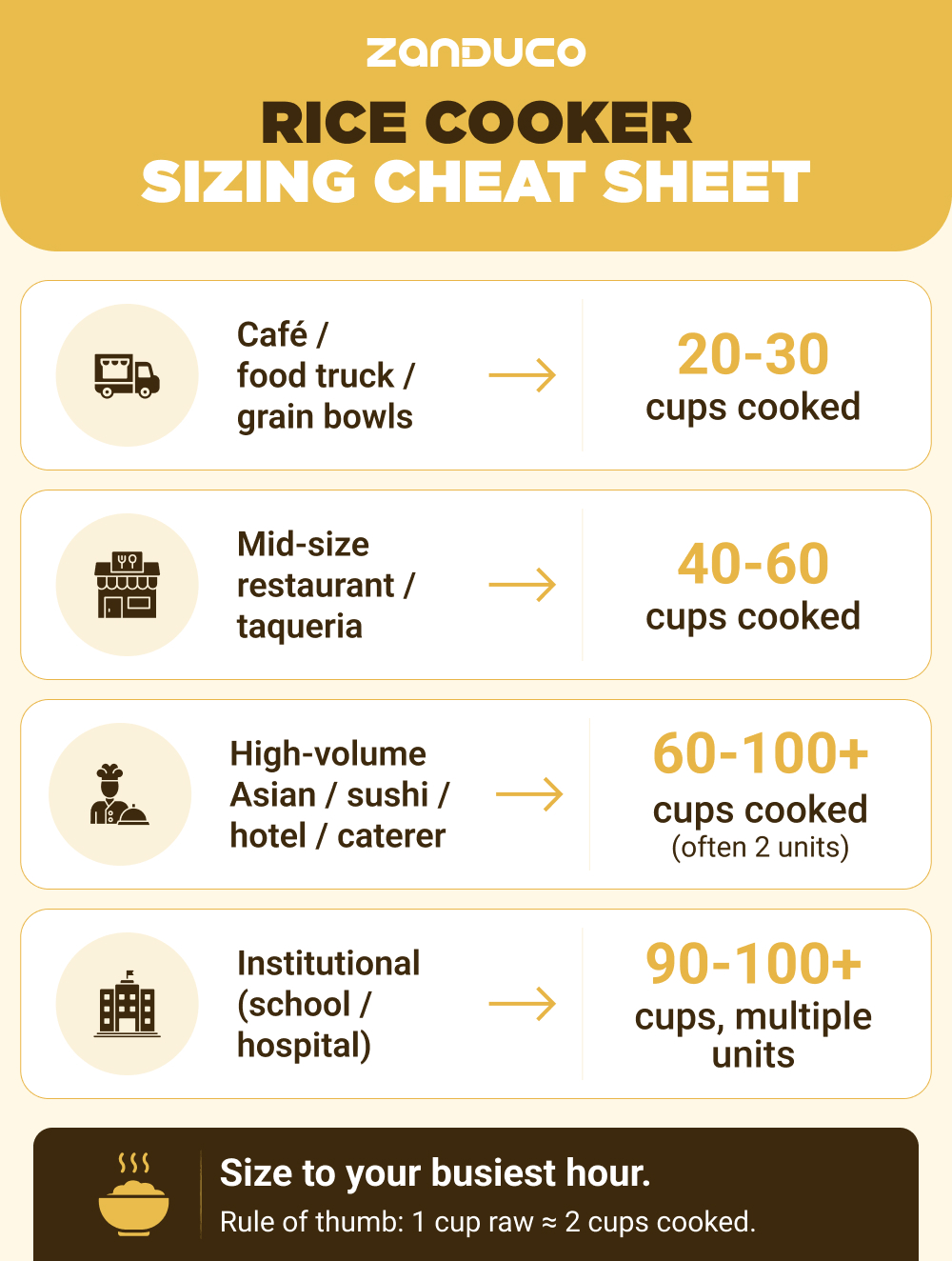
For portions, a rice side runs about three-quarters to a full cup cooked, and a rice bowl or entrée base is closer to a cup and a half. So a 60-cup cooked unit gets you somewhere around 60 to 80 sides per batch. Here is a starting point by setup:
| Your setup | Rough peak rice volume | Cooked capacity to look at | Example tier |
|---|---|---|---|
| Café, food truck, grain-bowl counter | A few dozen portions | 20 to 30 cups cooked | Globe RC1 (25 one-cup servings) |
| Mid-size restaurant, taqueria, diner | Steady all-day rice | 40 to 60 cups cooked | Panasonic SR-42HZP 23-cup or Omcan 64 Cup Electric Cooker |
| High-volume Asian restaurant, sushi bar, hotel kitchen, caterer | Rice on nearly every plate | 60 to 100+ cups cooked, often two units | Large electric or gas, sometimes paired |
| Institutional (school, hospital) | Scheduled bulk service | 90 to 100+ cups, multiple units | Multiple large-capacity units |
Buyer tip: stuck between two sizes? Go up. An undersized cooker forces your crew into extra small batches mid-service, which burns labor and gives you rice that comes out different every time. A little extra capacity just buys you breathing room. The peak-demand math is the same one you would use to size a range, and our guide on choosing the right size commercial range walks through it if you want to run the numbers.
Electric or Gas? Which One Fits Your Line
Nearly every commercial rice cooker sold in the US is electric, and there are good reasons for that. They plug in, hold heat evenly, and come in every size you might want. Gas has its place too, so here is how the two stack up side by side before you commit.
| Electric | Gas | |
|---|---|---|
| Install | Plug into a standard 120V outlet; the biggest units may need a 208V or 240V line | Needs a gas hookup and proper ventilation |
| Heat | Steady and even, with slightly slower recovery on huge back-to-back batches | High-BTU, fast, and holds up under constant heavy loads |
| Running cost | Predictable, tied to your electric bill | Can be cheaper where gas is already plumbed in and inexpensive |
| Upfront cost | Usually lower | Usually higher |
| Best for | Most cafés, restaurants, taquerias, and caterers | Rice-heavy, high-volume kitchens like sushi bars and dim sum houses |
Short version: unless you run a rice-heavy, high-volume operation with gas already at the line, electric is almost certainly your answer. The current electric lineup is on the commercial rice cookers page.
Cook, Hold, or Warm: Which Type Fits Your Kitchen?
People mix these three up all the time, and the difference changes how your line runs.
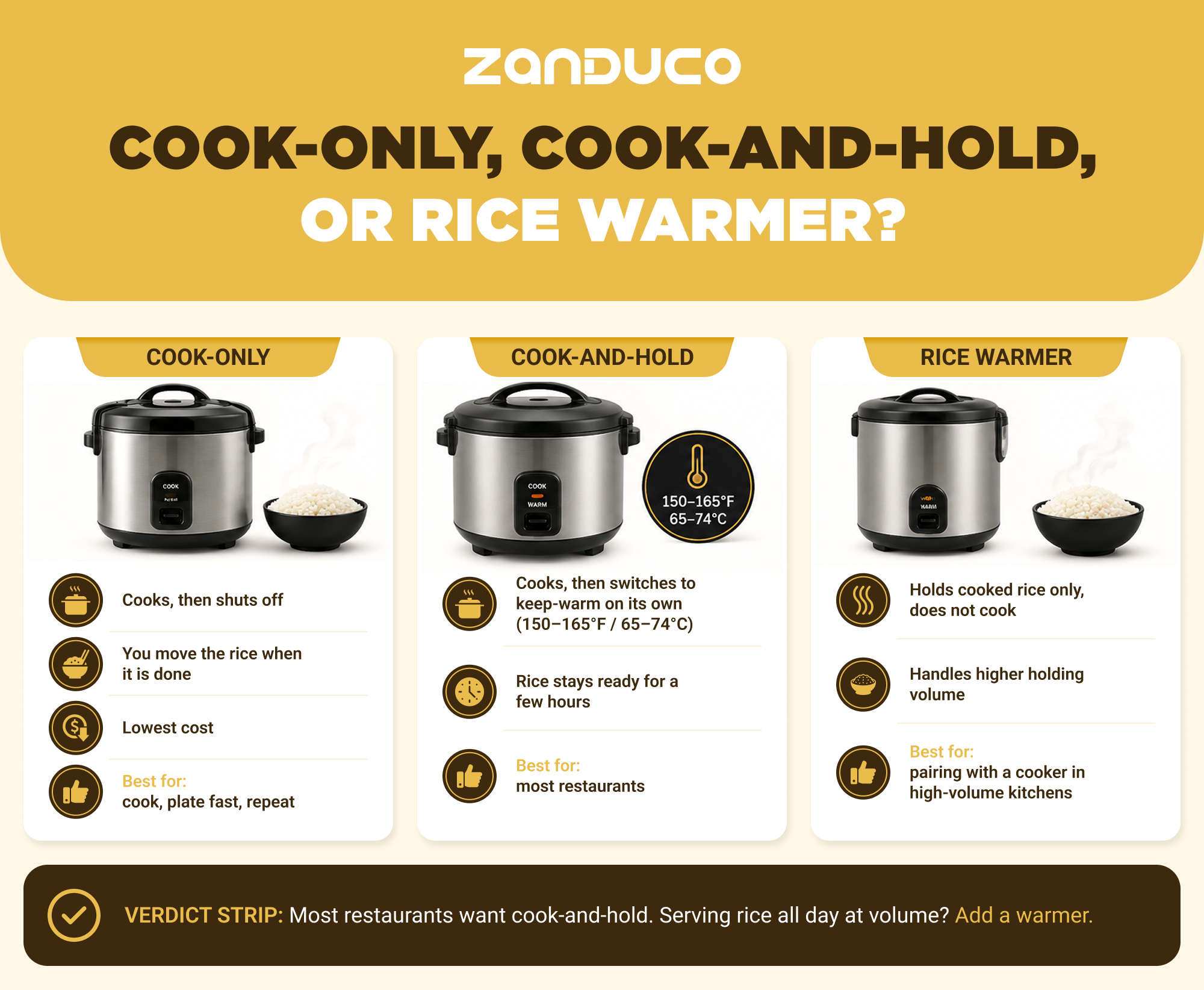
A cook-only unit heats the rice and shuts off. When it finishes, someone has to move the rice or it starts cooling. These are cheaper and fine for a kitchen that cooks a batch, plates it fast, and starts another.
A cook-and-hold unit cooks, then slips into keep-warm on its own and holds rice at serving temperature (usually around 150°F to 165°F / 65°C to 74°C) for a few hours. This is the one most restaurants want. Rice is ready the moment a ticket comes in, and nobody is timing their prep around cook cycles. Most quality models, like the Hamilton Beach Proctor Silex 40-cup, flip to warm automatically once cooking wraps.
A rice warmer does not cook at all. It holds already-cooked rice hot, usually at higher volume than a cooker's warm setting can manage. Plenty of high-volume kitchens run both: cook in the cooker, move it to the warmer, keep the cooker open for the next batch. If rice goes out with almost every order, that combo keeps a cushion ready without slowing you down.
Worth noting: keep-warm is built to hold rice for a few hours at quality, so do not treat it as all-day storage. Rice parked on warm too long dries at the edges, and if it drifts below safe holding temperature you have a food-safety problem on your hands. To hold big volumes all day, budget for a dedicated warmer instead of leaning on the cooker.
The Features Worth Paying For
With size and type sorted, features are what separate a cooker your staff likes from one they curse at. The ones worth caring about:
- Removable non-stick inner pot. The biggest daily win. A pot that lifts out and cleans up quickly saves real time and keeps rice from welding itself to the bottom. Skip this and you will feel it every shift.
- Automatic keep-warm. Covered above, and a must for most kitchens.
- Hinged locking lid. A lid fixed to the base frees up counter space and seals moisture in, so held rice stays fresher longer.
- Water-line markings inside the pot. Clear fill lines turn consistent rice into a training step anyone can follow, so it stops being a guessing game.
- Condensation collector. A little cup that catches the drips running down the side. Sounds trivial until there is a puddle on your prep line, which is both a mess and a slip risk.
- Steamer tray (optional). Some units hold a tray above the rice so you can steam vegetables or dumplings while the rice cooks underneath. Tight on space and got a menu that can use it? That is a second job out of one footprint.
- Included cup and paddle. Both should come in the box. The 180 mL cup keeps your rice consistent, and a proper paddle saves the non-stick coating. They are easy to misplace and cheap to replace, and our rundown of essential smallwares for restaurants covers the prep tools worth stocking spares of.
What you can skip: the fancy programmable menus and fuzzy-logic modes built for home kitchens. In a commercial setting you are cooking the same one or two rice types over and over, so build quality and easy cleaning will do far more for you than a long spec list.
Match the Cooker to What You Serve
Capacity and features cover most of the decision. What you serve nudges the last few choices, and it is worth a minute before you buy.
Sushi bars and Japanese kitchens
Sushi rice is its own texture, and when it goes out with most orders the volume adds up quickly. A lot of sushi spots pair a dependable cooker with a separate holding setup so seasoned rice stays ready without drying out. Busy sushi and dim sum kitchens are also the most common candidates for gas.
Mexican and Tex-Mex
Taquerias put rice on almost every plate, so all-day cook-and-hold capacity matters more than any bell or whistle. A mid to large electric unit with a strong warm mode usually handles it.
Indian and South Asian
Biryani and pulao volumes spike hard around service, and grain length matters, so lean toward even heating and enough capacity to clear the rush in fewer batches.
Poke, grain bowls, and health-forward menus
These often run more than one grain, like white rice, brown rice, and quinoa. Whole grains need more water and longer cook times, so confirm the unit handles them and size for the extra minutes, not just the portions.
Catering and banquets
Demand comes in spikes and usually has to travel. If you are moving hot rice to an offsite event, a warmer next to the cooker earns its spot.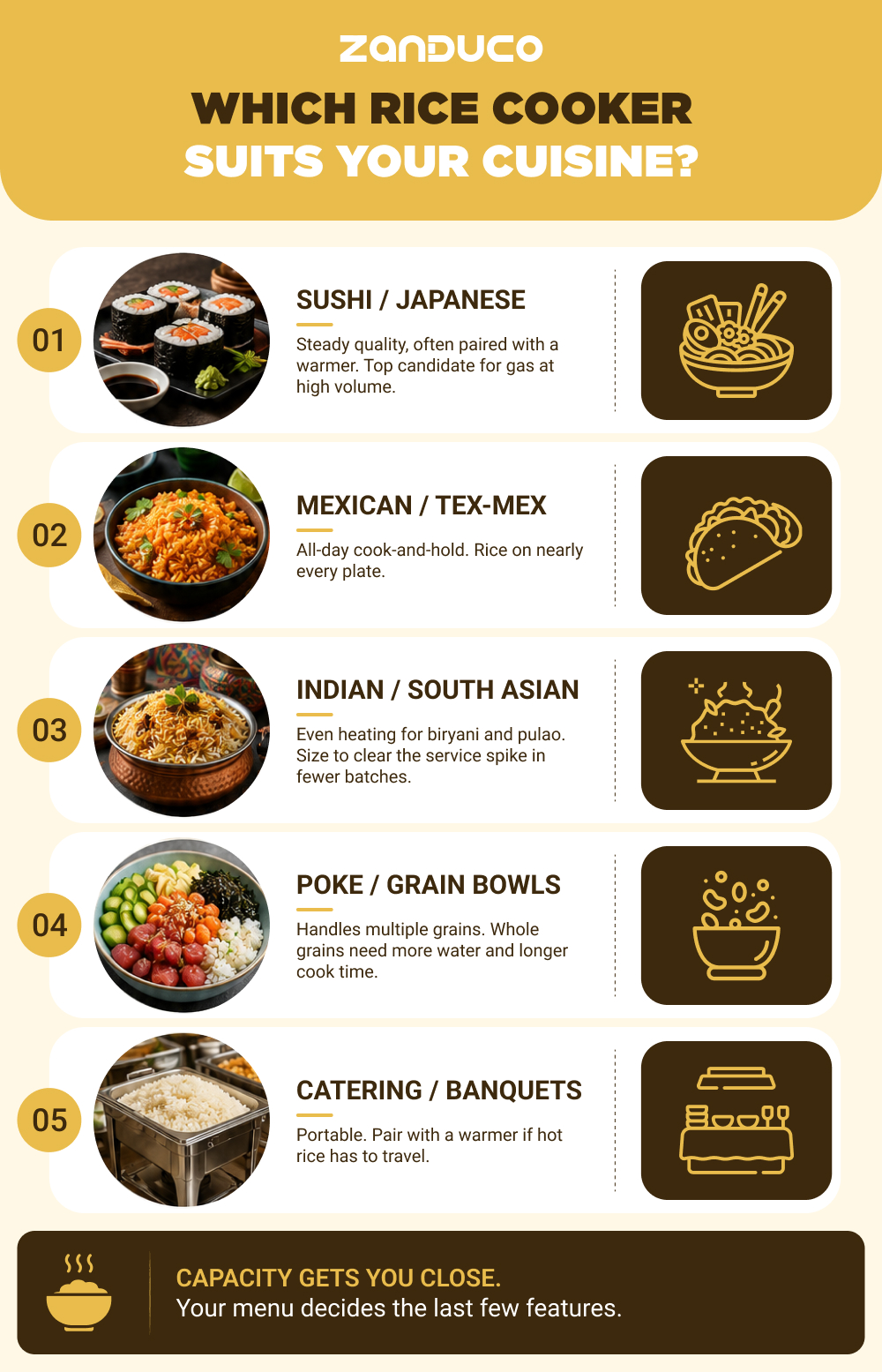
Check Your Outlet Before You Buy
This is the step that turns a great buy into a return. Every cooker has a voltage and wattage rating, and it has to line up with what your kitchen can give it.
Most 120V commercial cookers pull somewhere between 1,000 and 1,600 watts. On a standard 120V, 20-amp circuit that is usually fine by itself. Share that circuit with a few other countertop appliances, though, and a 1,500-watt cooker can tip it over and trip the breaker at the worst possible moment. The big units, roughly 80 cups cooked and up, often need a dedicated 208V or 240V line, so plan for an electrician before the thing can run at all.
Kitchen planning tip: before you order, measure the exact spot the cooker will sit, confirm the right outlet is within reach, and check that circuit's amperage against the unit's draw. Leave room above and around it for airflow and for lifting the lid. Five minutes now beats a delivered machine you cannot plug in. Our commercial kitchen design guide on space planning and code compliance covers outlets, clearances, and workflow if you are laying out or redoing a line.
The Certifications US Inspectors Want to See
For anything that touches food, a US inspector wants to see the right marks, and buying certified from the start beats explaining yourself during an inspection. What matters for a rice cooker:
NSF certification (or an equivalent sanitation mark)
NSF says the unit's design and food-contact materials meet public health standards and that it is built to be cleaned properly. Watch the wording here. "NSF certified" means it was tested and listed. "Meets NSF standards" is just a manufacturer saying so. Look for the real mark. ETL Sanitation and UL EPH certify to the same NSF/ANSI standards, so they count as well.
UL or ETL listing
These cover electrical safety, plus gas safety on gas units. Both are recognized testing labs and carry equal weight for a US install, so an ETL sticker is every bit as valid as a UL one.
FDA Food Code and your local health department
The federal Food Code is the framework most states adopt, but your local health department gets the final word and can add its own rules. Call them before you buy or install.
Energy
ENERGY STAR does not currently rate rice cookers, so there is no label to hunt for. You can still compare wattage and think about running cost, which brings us to the money.
The Real 5-Year Cost of a Commercial Rice Cooker
Sticker price is the smallest number in this whole decision. A bargain unit that quits in eighteen months ends up pricier than a good one that runs for years. Here is a realistic five-year picture for a typical 40 to 60 cup cooked electric cook-and-hold unit on a 120V outlet. Treat these as ballparks, not quotes, because your utility rate and how hard you run it move the numbers a lot.
| Line item | Rough 5-year cost | Notes |
|---|---|---|
| The cooker | ~$150 to $600 | Varies by capacity and brand; larger units and premium brands sit at the top |
| Electrical work | ~$0 to $250 | Usually $0 for 120V units on an existing outlet; a dedicated line for larger units adds cost |
| Electricity | ~$500 to $2,000 | Roughly $100 to $400 per year depending on your local kWh rate and how many batches you run daily |
| Replacement non-stick inner pot | ~$60 to $240 | Figure one or two over five years with heavy use |
| Measuring cup and paddle replacements | ~$10 to $40 | Easy to lose, cheap to replace |
| Approximate 5-year total | ~$720 to $3,100 | Wide range because a small café and a high-volume kitchen live at opposite ends |
Ignore the exact totals for a second and look at the shape of it. Running and upkeep costs over five years usually dwarf what you paid at the register. That is the case for spending a little more on a durable unit that sips power and holds up to constant use, rather than saving fifty bucks on a flimsy one you replace next year.
How to Make Your Rice Cooker Last
A commercial rice cooker gives back years of service for a little daily attention. Two habits handle most of it. Clean the removable pot after every use, and wipe the heating plate and the pot's base once a week so starchy buildup does not insulate the heat. Any grit between the pot and the element cooks unevenly and leaves hot spots.
Make sure the pot sits flat and fully touches the heating element before every cycle, since a gap is the number-one reason rice comes out unevenly cooked. Use the paddle that came with it instead of metal spoons that scratch the coating, because a chewed-up non-stick surface cooks worse and can void the sanitation certification. Watch your water too. In hard-water areas, scale creeps up over time, so descale now and then to keep performance steady. And hang on to the manual, since it lists the correct rice-to-water ratios and the fill lines for your exact model.
So Which One Should You Buy?
Talk to enough owners and you hear the same two regrets over and over: a cooker bought a size too small, and a great cooker that sat in the box because the outlet was wrong. Almost everything else is recoverable. Those two are not, at least not cheaply. So here is the straight recommendation after all of that. For most US restaurants, cafés, and catering kitchens, get a 120V electric cook-and-hold unit sized to your peak rice volume, with a removable non-stick pot and automatic keep-warm. It covers daily service on a standard outlet and leaves your line free to cook everything else. On the fence between sizes? Go up one.
Reach for something bigger, add a second unit, or move to gas only if you genuinely run rice-heavy and high-volume, like a sushi bar, a dim sum house, or a caterer plating banquet counts. Add a separate warmer if you need to hold serious volume all day. And whatever you pick, do the two boring checks that sink more purchases than any feature ever will: confirm the outlet and amperage before you order, and confirm the unit carries a genuine NSF or equivalent mark plus a UL or ETL listing before it goes on your line.
Do that, and rice goes back to being the easy part of the shift.
You Know Your Menu. We Know These Machines.
You know your menu. We know these machines. Put the two together before you buy. Browse the commercial rice cookers page to see your options, or call the Zanduco team and we will match capacity and voltage to your kitchen in a few minutes. One good decision now saves you a year of workarounds.