Free Shipping (On select items & orders)
  Track My Order


Ghost kitchens had their gold-rush moment. Between 2020 and 2022, delivery-only kitchens opened at a sprint, investor money poured in, and it felt like every restaurant group was launching a virtual brand overnight. Then the air came out of the hype. Some of the loudest names pulled back hard. Reef Technology shut down kitchens across several US cities, Wendy's walked back a plan to open hundreds of delivery-only units with Reef down to a few dozen, and Kitchen United, once a poster child for the model, folded and had its assets bought up in 2023 to 2024.
What is left in 2026 is more interesting than the boom. The format did not die, it grew up. Analysts estimate the US ghost kitchen market sat somewhere around $12 to $13 billion in 2024 to 2025, with projections pointing toward the high $20 billions over the next decade. The growth is steadier now, the survivors are more disciplined, and the way owners spend on kitchen equipment looks nothing like it did three years ago.
That shift is the real story. The 2026 trends are not about flashy gadgets. They are about where the money moves, how kitchens are shaped, and what delivery math forces owners to prioritize.
Quick answer: Ghost kitchen equipment spending in 2026 is smaller, sharper, and more delivery-driven than it was during the boom. Kitchens are shrinking and specializing, running several virtual brands off one flexible line, testing concepts through pop-ups and pods, leaning on smart and energy-efficient refrigeration, and increasingly financing or buying gear used rather than paying cash upfront. Front-of-house equipment has all but vanished from the buy list. The exact mix still depends on the menu and whether a brand rents commissary space or builds its own.
First, What do You Mean by a Ghost Kitchen
A ghost kitchen (also called a dark, cloud, or virtual kitchen) is a cooking space built only for delivery and pickup. There is no dining room, no host stand, and no walk-in customers. Orders arrive through apps like DoorDash, Uber Eats, and Grubhub, or through a brand's own website, and food leaves with delivery drivers. Strip away everything a delivery customer never sees, and you are left with a kitchen built purely to cook and dispatch.
Most run in one of three shapes.
A shared commissary kitchen, where a brand rents a small dedicated bay inside a building set up for delivery.
A virtual brand, launched off an existing restaurant's line during slower hours.
Or a dedicated build-out or kitchen pod that the owner outfits from scratch.
Which one a brand picks decides how much equipment it needs, and that choice sits underneath almost every trend below.
After the Boom, Spending Got Disciplined
The early wave ran on optimism. Plenty of owners signed leases and bought gear before they had a tested menu or honest delivery numbers, and the shakeout that followed taught the market a hard lesson about overbuilding.
Industry watchers now describe the era of generic, throw-it-at-the-wall ghost kitchens as fading, with only well-branded, tightly run concepts thriving. The market is still highly fragmented, with no single operator holding more than about 5 percent of it, even as consolidation gathers around a handful of well-funded delivery-kitchen platforms. With third-party delivery commissions often running 15 to 30 percent, independent owners now buy cautiously and judge every piece of equipment on whether it speeds service and protects margins.
Worth Noting: The most telling trend is not what owners are buying, it is what they stopped buying. The discipline that came out of the shakeout shapes today's entire equipment list.
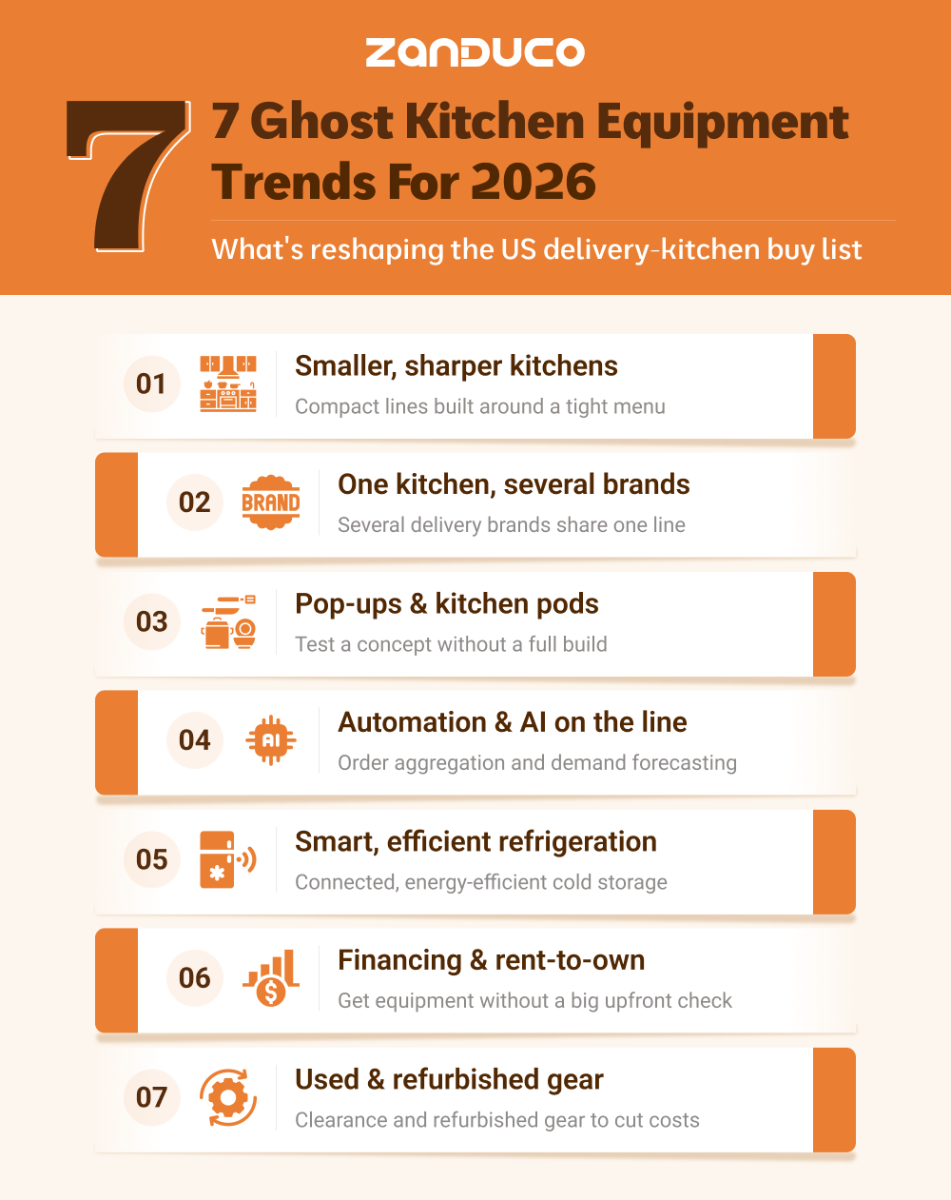
Trend 1: Kitchens Are Getting Smaller and Sharper
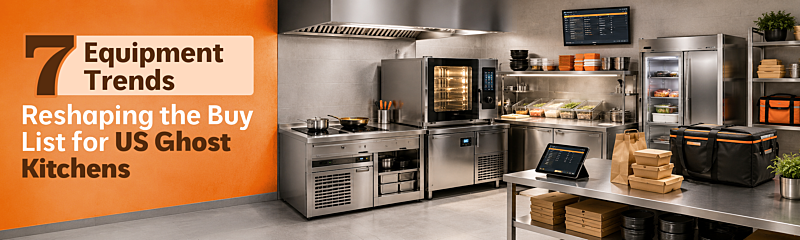
The clearest shift is toward compact, specialized kitchens built around a tight menu, and analysts tie the rising demand for compact, multi-purpose equipment directly to it. In practice the spend goes to a small cooking line sized to the menu, often a countertop gas range or charbroiler with one or two deep fryers, plus space-saving refrigeration like undercounter units, worktop refrigerators, and refrigerated chef bases tucked right under the line. The compressed workflow is why our guide to commercial kitchen design and code compliance has become so relevant to delivery-only builds.
Trend 2: One Kitchen, Several Brands
Multi-brand is the fastest-growing way to run a delivery kitchen, with owners stacking two or three virtual concepts on the same line and refrigeration to spread fixed costs. Delivery-tech firm Franklin Junction has predicted that most restaurants will run multiple brands by mid-decade, with a "host kitchen" model that rents out idle kitchen time normalizing alongside it. That forces equipment to flex across menus, pushing demand toward larger, configurable refrigerated prep tables and reliable reach-in refrigeration, while holding and packaging stations climb the priority list because keeping several brands' orders accurate protects app ratings.
Our buying guide on refrigerated prep tables and salad stations helps match pan capacity to a multi-brand flow.
Trend 3: Pop-Ups and Kitchen Pods for Fast, Low-Risk Testing
Test-before-you-commit has become a format of its own. Pop-up kitchens are among the fastest-growing segments because they let a brand trial a concept for a season or a single market without a long lease or a full build-out, and self-contained kitchen pods do the same inside a movable shell. The equipment angle is portability and minimal install: countertop cooking equipment, plug-in undercounter refrigeration, and gear that can be set up, broken down, or relocated without a contractor. It is the lowest-capital way to find out whether a menu sells before committing to scale it.
Trend 4: Automation and AI Move Onto the Line
The biggest technology trend is the software and automation layer that keeps a busy multi-brand kitchen from falling apart. Order aggregation is now standard, pulling every delivery app onto one screen and cutting the ticket errors that wreck ratings, while AI-driven inventory and demand forecasting spreads fast. Cooking robotics keeps getting cheaper but stays a watch-this-space item for most independents.
The practical takeaway is concrete: kitchens that plan to scale buy refrigeration and prep capacity with room to grow, so adding the next brand does not mean rebuilding the line.
Trend 5: The Cold Side Got Smart and Efficient
Refrigeration is being quietly reshaped by smart, connected units that monitor their own temperature and flag maintenance before a compressor fails, and by regulation. EPA SNAP rules have pushed the industry toward low-impact refrigerants like R290, and DOE energy standards apply whether or not a customer sees the box, which is making efficient ENERGY STAR-rated refrigeration the default rather than the upgrade. NSF certification for food contact and UL or ETL listing for electrical safety remain the baseline a health inspector looks for, in a delivery kitchen exactly as in a dining room.
Our guide to understanding ENERGY STAR labels explains why the efficient cooler usually wins on total cost.
Trend 6: Financing and Rent-to-Own Over Big Upfront Buys
Cash discipline is shaping how gear gets acquired, not just what gets bought. After the shakeout, more owners lean on equipment financing, leasing, and rent-to-own arrangements to get a kitchen running without a large upfront hit, keeping cash free for inventory, staffing, and marketing. Rent-Try-Buy style terms suit new or unproven concepts because they let a brand test equipment and upgrade later, while leasing fits the core line a kitchen knows it will keep. Zanduco offers Rent-Try-Buy on US orders, which lines up with the way cautious delivery brands now stage their spending.
Trend 7: The Used and Refurbished Equipment Market Is Booming
Buying used has gone mainstream for budget-minded delivery kitchens. Sturdy, simple gear like stainless work tables and shelving and basic cooking equipment from reliable brands can run roughly 40 to 60 percent cheaper used, with little real-world compromise. The smart split is buying refrigeration new or near-new for food-safety reasons while sourcing the rugged pieces refurbished, and clearance and scratch-and-dent channels like Zanduco's Clearance Specials have become a regular stop for owners outfitting a first kitchen. Tested, warrantied refurbished equipment stretches a tight launch budget further than almost anything else on this list.
What Is Heating Up and What Is Cooling Down
The clearest way to read the 2026 shift is by direction of travel, and the infographic below lays out the full seven-by-seven picture at a glance. The short version is that money is moving off the dining room and onto the line, the cold chain, and the tech. Compact, energy-efficient refrigeration and flexible prep gear keep gaining ground, while oversized generalist cooking lines and anything a customer would have seen in a dining room keep falling off the list.
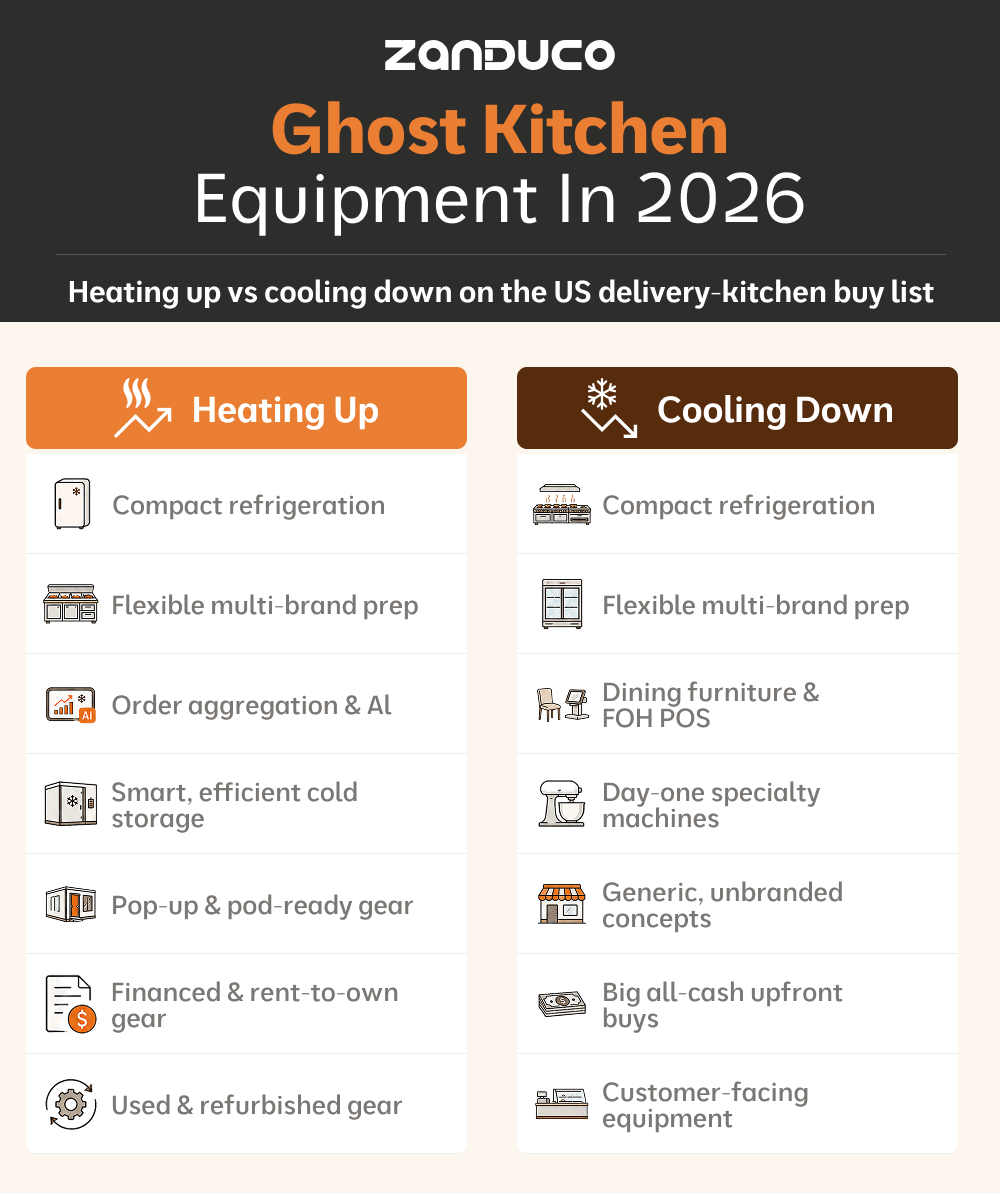
Just as telling is how the gear gets paid for. Owners are acquiring equipment in lighter ways now, renting it, financing it, or sourcing it refurbished, rather than dropping a big upfront check on a full new kitchen. The buy list has not only gotten shorter, it is funded more cautiously.
What to Watch Through 2027
The next stretch looks like more of the same maturation. Expect kitchen robotics to keep getting cheaper and more practical for independents, AI demand forecasting to become close to table stakes rather than a differentiator, and refrigerant and energy rules to keep nudging the cold side toward steady upgrades. Multi-brand stacking will likely deepen, and financed or used equipment will keep gaining ground as owners protect cash.
For owners and chefs tracking this space, the headline is that ghost kitchens have settled into a disciplined, delivery-first format, and the equipment market is following suit. If you are sizing a delivery-only build to these trends, Zanduco's US catalog covers the cooking equipment, commercial refrigeration, and work tables that today's lean kitchens are built around.