Free Shipping (On select items & orders)
  Track My Order



Posted in: Commercial Ice Machines
The health inspector crouches in front of your ice machine, pops the panel off the bin, and runs a gloved finger along the inside wall. Your line cooks suddenly find something to do. Whatever is on that finger decides whether you walk away with a clean report or a write-up that trails you into the next inspection.
Most owners learn this the hard way. To an inspector, that machine is not a refrigerator or a piece of background equipment. It is a food-contact surface, because under federal food-safety rules the ice it makes counts as food. The pink or gray slime that creeps into a neglected bin is a documented health risk, and the kind of finding that shuts kitchens down.
Staying compliant is not complicated or expensive. You need a repeatable schedule, the right cleaner and sanitizer, and a log you can hand an inspector without sweating. The catch is that most advice online gives you a single number, usually "clean it every six months," and stops there. That number is incomplete, and it is not quite what the rules say.
This guide lays out the schedule itself, broken into daily, weekly, monthly, and deep-clean tasks, plus the documentation that turns a clean machine into a compliant one. It also covers when your team can handle the work and when it is worth paying a technician.
Quick answer: A commercial ice machine needs a layered cleaning schedule rather than a single date on the calendar. Wipe exterior surfaces and the scoop daily, sanitize the bin weekly, check the water filter and removable parts monthly, and run a full deep clean and sanitize every three to six months (more often with hard water or heavy use). The FDA Food Code does not hand you a fixed interval. It points you to your manufacturer's frequency, and absent that, to cleaning often enough to prevent soil and mold. Document every cleaning, because the logbook is what an inspector grades.
Your Ice Machine Makes Food, So Inspectors Treat It Like Food
Ice is classified as a food, and that classification drives everything else. The food-contact surfaces inside your machine and bin, the parts that touch the ice your guests will eventually chew, fall under the same sanitation expectations as any prep surface in your kitchen.
Ice machines also happen to be ideal homes for the things that make people sick. They are dark, wet, and held at temperatures that slow bacteria without killing them. Mineral scale builds up from the water. Airborne yeast and mold spores settle in. Over time you get biofilm, that slimy pink or gray film, and once it takes hold it is stubborn. Bacteria like E. coli, Salmonella, and Listeria have all been linked to contaminated ice, and a single bad batch can put your café, bar, or hotel kitchen on the wrong side of a foodborne-illness report.
So when an inspector pulls the panel, they are not being fussy. They are checking a food-contact surface that touches something every guest consumes. A restaurant that nails its cooler temperatures and its hand-washing but ignores the ice machine still has a gap, and inspectors know exactly where to look for it.
So How Often Does the FDA Really Require Cleaning?
This is where most articles get sloppy. The real answer is that the FDA Food Code never hands you a number, and understanding why protects you better than memorizing one someone made up.
Start with the structure. The FDA writes the Food Code as a model. Your state and county health department adopt their own version and enforce it, so your requirements are local, though nearly all of them trace back to the same Food Code language.
The gap between what owners assume and what the Code says is wide:
| The common belief | What the Food Code says |
| The FDA requires cleaning every six months | The Code never names an interval |
| One legal frequency covers every machine | Frequency is set by your manufacturer's manual |
| Twice a year keeps you compliant anywhere | Absent a manufacturer spec, you clean often enough to prevent soil and mold |
So the federal rule for the inside of an ice maker and the ice bin is really two lines:
- If your manufacturer specifies a cleaning frequency, follow it. The manual is your floor.
- If it doesn't, clean often enough to prevent the buildup of soil or mold. The test is the result, whether soil and mold stay down.
The "every six months" and "twice a year" figures you see everywhere are not the law. They come from the equipment makers (Manitowoc, Hoshizaki, Scotsman, and others) and from NSF guidance, and they work as a sensible default you adjust from.
That is why your real frequency rides on conditions. Three things push you to clean more often than the manual's floor:
- Water quality. Hard water lays down scale fast.
- Volume. A machine running near capacity builds residue quicker than one that idles.
- Environment. Heat, grease, and dust near the unit speed up buildup.
A slow café in a soft-water town and a packed sports bar in a hard-water city can own the same model and still need very different schedules.
Worth Noting: Two things in your operation get a stricter, clearer rule than the machine itself. Ice scoops and self-service ice utensils need cleaning and sanitizing at least every 24 hours, and the bin's food-contact surfaces are explicitly the inspector's business. A spotless machine paired with a grimy scoop left sitting in the ice is still a violation.
None of this is permission to relax. Because the bar is "prevent soil and mold," the burden is on you to show your schedule clears it. The schedule below, backed by a log, is how you do that.
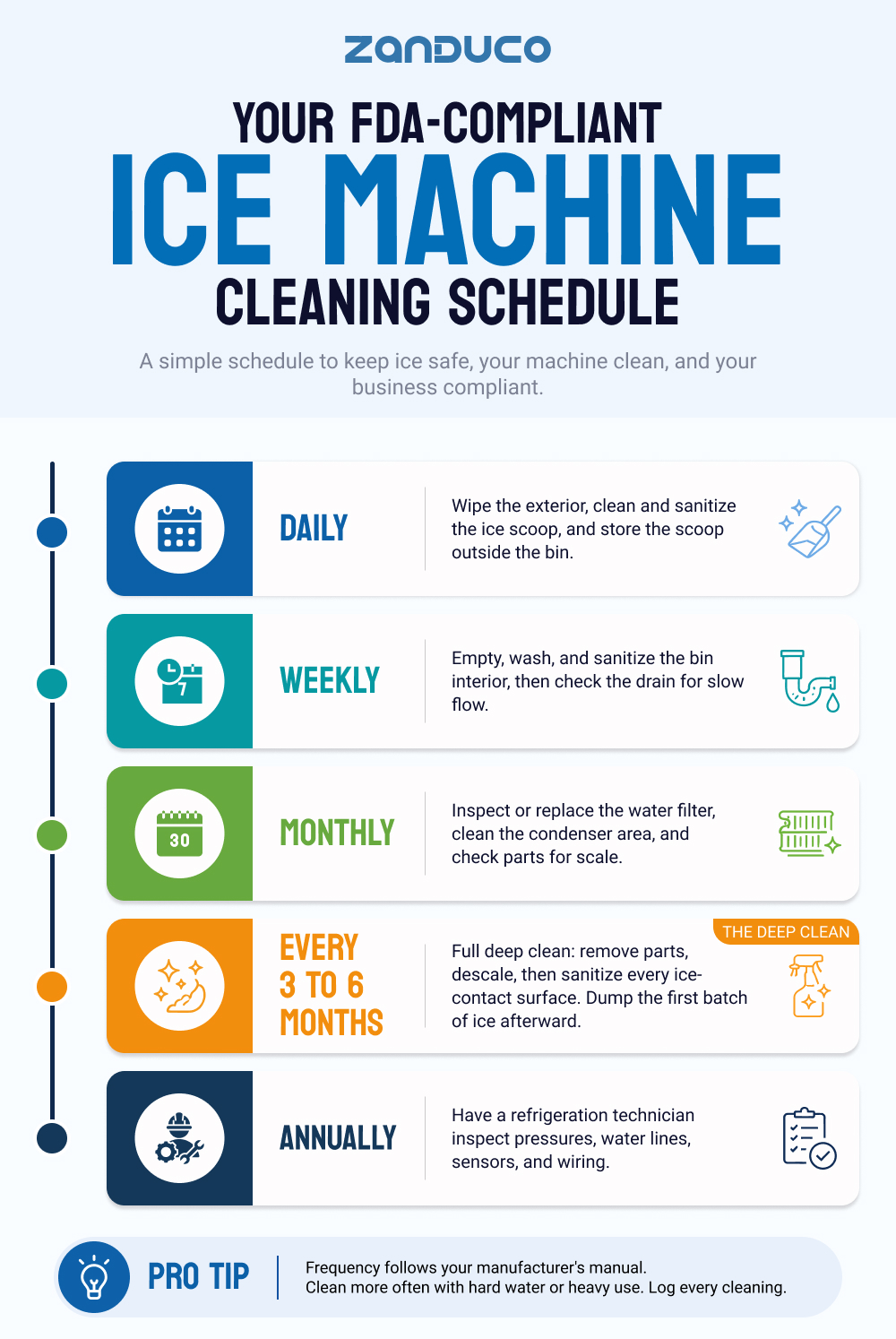
Your Cleaning Schedule, From Daily Wipe-Downs to the Deep Clean
Think in layers. Quick daily habits keep the machine from getting gross between deep cleans. The deep clean is the heavy lift that satisfies the food code and protects the equipment. The schedule below is built to post on the wall and assign by shift.
| Frequency | Tasks | Who usually handles it |
| Daily | Wipe down exterior and door handles. Clean and sanitize the ice scoop, then store it outside the bin in a clean holder, never buried in the ice. Wipe the bin door gasket. Confirm ice looks clear and smells clean. | Closing staff or shift lead |
| Weekly | Empty the bin if practical, then wash and sanitize the interior bin walls and door with a food-safe sanitizer. Check the drain for slow flow or standing water. Clean the area around and under the unit. | Shift lead or kitchen manager |
| Monthly | Inspect and replace the water filter on schedule (or sooner with hard water). Wipe the condenser area and check the air filter on air-cooled units, since a clogged condenser makes the whole machine work harder. Inspect removable parts for early scale or pink film. | Kitchen manager |
| Every 3 to 6 months | Full deep clean: remove parts per the manual, run the descaling/cleaning solution through the system, scrub the food zone, then sanitize every ice-contact surface and air-dry. Dump the first batch of ice afterward. | Trained staff member or service technician |
| Annually | Have a refrigeration technician inspect refrigerant pressures, water lines, sensors, fittings, and electrical connections. Confirm everything the food code calls a non-food-contact surface (exterior, condenser) is also being kept clean. | Refrigeration technician |
The three-to-six-month deep clean is the entry that does the regulatory heavy lifting, and it is the one operations skip when things get busy. Build it into a recurring calendar reminder the same way you schedule hood cleaning or pest control. If you run a high-volume bar or a hotel kitchen pushing the machine near capacity, plan on the quarterly end of that range, or even monthly attention to the bin.
For a wider view of how maintenance habits change across machine types and sizes, our companion guide on choosing an industrial ice machine walks through how production capacity and bin size affect how hard you are running the unit, which directly shapes how often it needs cleaning.
A Clean Cycle, a Deep Clean, and Sanitizing Are Not the Same Job
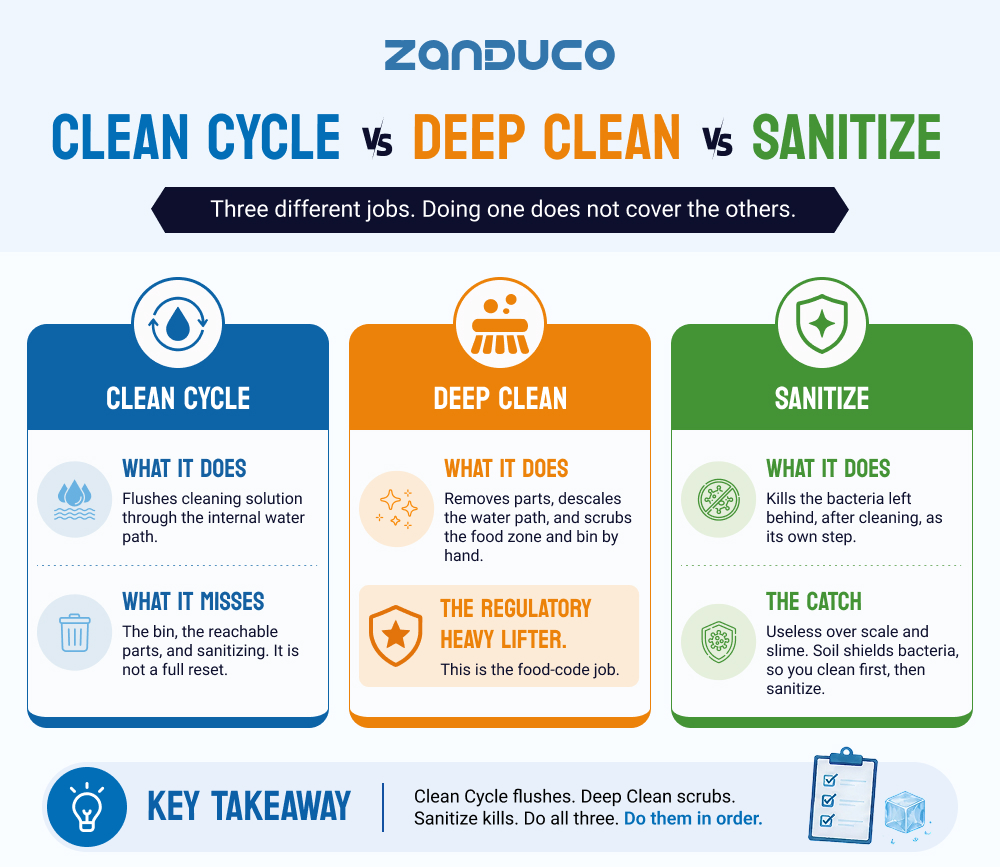
These three things get used as if they mean the same thing. They do not, and treating them as interchangeable is the most common way kitchens fool themselves into thinking they are compliant.
A clean cycle is the automated routine some machines run at the push of a button. It flushes cleaning solution through the internal water path. It is useful, but it is not a full reset. It leaves the bin untouched, skips the parts your hands need to reach, and does no sanitizing.
A deep clean is the hands-on job. You remove the parts the manual tells you to remove, circulate a nickel-safe descaling cleaner to dissolve mineral scale off the evaporator and water path, then physically scrub the food zone, the bin, and the removable components.
Sanitizing comes after cleaning, as its own step. You cannot sanitize over scale and slime, because soil shields the bacteria from the sanitizer. Clean first to strip the gunk, rinse, then apply an approved sanitizer to kill what remains, and let surfaces air-dry.
Common Mistake: Running a clean cycle and calling the machine "deep cleaned." A clean cycle handles the part of the job you cannot see. The bin, the gaskets, the scoop holder, and the parts you can reach still need hands, a brush, a cleaner, and a sanitizer.
On chemicals, your manual wins every argument. Most manufacturers specify a nickel-safe ice machine cleaner for descaling and a food-safe sanitizer, both of which you can stock from a general cleaning and janitorial supplies order. Bleach is a frequent shortcut and a frequent mistake. Some machines tolerate a diluted bleach sanitizing solution, but many do not, and the wrong concentration can corrode internal components. If the manual does not call for bleach, do not improvise with it.
Hard Water and Heavy Use Will Set Your Real Schedule
The single biggest variable in your schedule is the water feeding the machine. Hard water, the kind loaded with calcium and magnesium, lays down scale fast. Scale is what forces more frequent descaling, drags down ice production, and shortens the life of the machine. If your ice looks cloudy or tastes off, your water is often the reason.
A water filtration setup made for ice machines is one of the highest-return upgrades you can make, because it slows scale buildup and stretches the time between deep cleans while improving how the ice looks and tastes. Filtration does not replace cleaning, but it makes the whole schedule easier to keep.
Usage and environment matter too. A machine running near its rated capacity during a packed Friday service is building up residue faster than one in a quiet bakery. A unit tucked next to a fryer or in a hot back corner pulls more airborne grease and dust into its condenser. Heavier conditions mean you move toward the frequent end of every interval above, which is exactly the "clean often enough to prevent soil and mold" logic the food code is asking you to apply.
Buyer Tip: Before you blame the machine for slow production or repeat slime problems, test your water. High mineral content is fixable with filtration. Replacing a machine that was only ever fighting bad water is an expensive way to solve the wrong problem.
What Staying on Schedule Costs, and What Neglect Costs More
Owners screenshot this section, so the ranges below are hedged on purpose. Costs swing with region, machine size, water quality, and local labor rates, so treat them as planning figures rather than quotes. What matters is how the three paths compare across a few years.
| Line item | Typical range | Notes |
| Nickel-safe cleaner + food-safe sanitizer | Around $80 to $160 per year | Assumes 3 to 4 deep cleans annually for one machine |
| Replacement water filter cartridges | Around $60 to $150 per year | Roughly two changes a year, sooner with hard water |
| In-house labor for deep cleans | Roughly 1.5 to 2 hours per clean | Staff time is the real cost here, on top of supplies |
| Professional deep clean (if outsourced) | Around $150 to $350 per visit | Often makes sense quarterly or twice a year |
| Annual technician inspection | Around $100 to $250 per visit | Catches refrigerant and water-line issues early |
Now compare three paths over five years for one machine. A disciplined in-house routine (supplies, filters, and your own labor) usually runs the lowest out of pocket, often a few hundred dollars a year in materials. Outsourcing the deep cleans adds the per-visit service cost but buys consistency and frees up your staff. Skipping maintenance only looks cheap on paper. One emergency service call after a breakdown can run several hundred dollars, a health-code violation brings re-inspection fees and lost goodwill, and a unit that should have lasted around ten years can fail years early. Getting a full decade out of the machine is where the real money shows up, and it makes the cost of cleaner and filters look trivial.
Frame it that way for whoever signs off on the budget. A cleaning schedule sits closer to insurance than to an expense, and it is about the cheapest protection you can buy against a closed kitchen and an early replacement.
The Logbook Is What Inspectors Grade
The detail that separates a clean machine from a compliant one is documentation.
When the inspector checks your ice machine, a clean bin helps but does not finish the job. What proves you are reliably preventing soil and mold, the standard itself, is a record showing the cleaning happened on a repeating schedule. A logbook with dates, initials, and notes turns "we clean it regularly, I promise" into proof.
A workable log does not need software. A laminated sheet by the machine or a shared checklist works, as long as it captures:
- The date of each daily, weekly, and deep-clean task
- Who performed it (initials are enough)
- The cleaner and sanitizer used
- Filter change dates
- Any issue noticed, like scale, slow drainage, or odor, and what was done about it
If you run multiple shifts or multiple managers, the log keeps the deep clean from becoming the job everyone assumes someone else did. It is also your defense. A documented schedule shows good-faith compliance even on a day when the timing of your last deep clean gets questioned.
Keep your sanitizers, gloves, and brushes stocked and within reach as part of your standing facility maintenance and safety supplies, because the schedule only holds up when the tools to follow it are on hand.
Your Ice Will Tell You When You've Waited Too Long
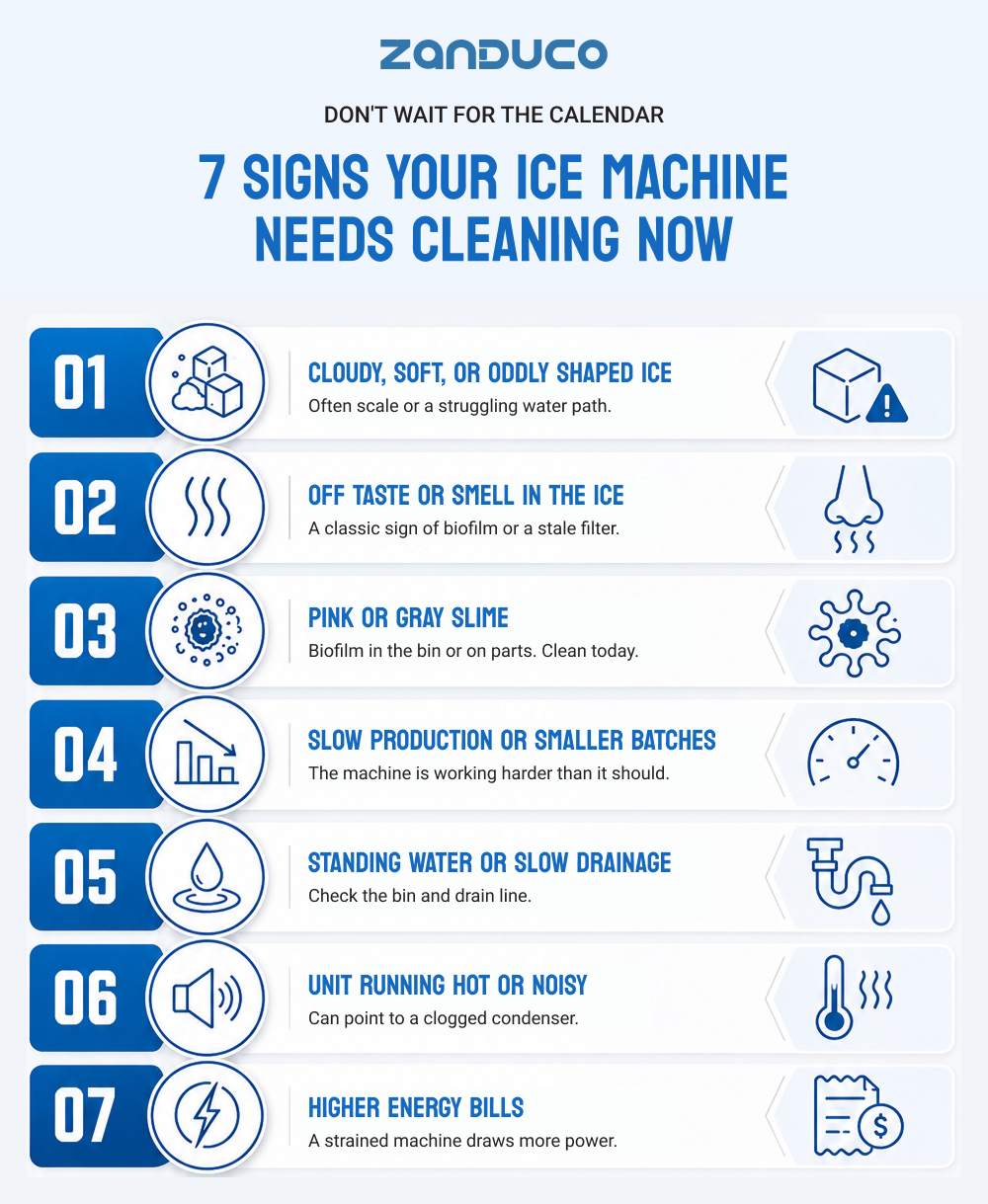
Do not wait for the calendar if the machine is already telling you something. A commercial ice maker usually drops hints before it fails outright. Treat any of these as a signal to clean now and tighten the schedule:
- Cloudy, soft, or oddly shaped ice. Often scale or a struggling water path.
- Off taste or smell in the ice. A classic sign of biofilm or a stale filter.
- Visible pink or gray slime anywhere in the bin or on parts.
- Slow production or smaller batches than the machine is rated for.
- Standing water or sluggish drainage in the bin.
- The unit running hot or noisy, which can point to a clogged condenser.
Some of these mean a cleaning. Some mean a filter change, better airflow around the unit, or a technician. The skill is responding early instead of normalizing the problem until it becomes a breakdown during your busiest service.
Our overview of the latest ice maker technology covers newer features like automated cleaning aids and antimicrobial components that can make some of these warning signs less frequent, which is worth knowing if you are weighing a replacement anyway.
Should You Do It Yourself or Call a Pro?
Weighing cost, risk, and the reality of a busy kitchen, this is where I land.
If you run a single machine and have a reliable manager, do the daily and weekly tasks in-house without question. They are quick, and they prevent the buildup that makes deep cleans painful. For the quarterly deep clean, be honest about your team. If you have someone who will follow the manual carefully and log it, in-house is cheaper and perfectly compliant. If your deep cleans keep slipping because everyone is slammed, a scheduled technician visit two to four times a year is money well spent, and it comes with a paper trail.
Whichever route you choose, do two things without exception. Put a water filter on the machine so you are fighting scale instead of chasing it, and keep the log current. Those two habits protect both your compliance and the lifespan of the unit more than any single deep clean ever will.
And if the machine is fighting you constantly, faulting, producing poorly even after a proper clean, or already past its expected life, cleaning is no longer the answer. Browse current commercial ice machines and matching ice storage bins when it is time to replace rather than keep nursing a unit that is costing you in downtime and bad ice.
Get Your Ice Inspection-Ready This Week
A compliant ice machine comes from a simple, layered routine your team can keep, not from one heroic scrubbing session before the inspector shows up: daily wipe-downs, a weekly bin sanitize, a monthly filter check, and a deep clean every few months, all written down in a log you would be glad to hand over. Get the schedule on the wall and the supplies on the shelf, and the rest takes care of itself. When you need cleaners, sanitizers, filters, or a replacement machine, Zanduco stocks what your kitchen runs on, ready to ship across the US.