Free Shipping (On select items & orders)
  Track My Order


Posted in: Commercial Kitchen Equipment
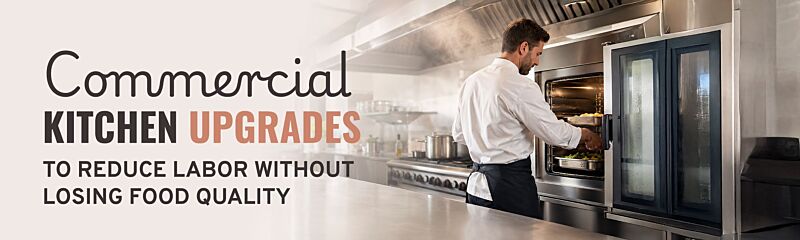
Labor is the line on your P&L that keeps you up at night, and it is also the one you have the least control over on any given Tuesday. The numbers back up the feeling. Full-service labor is now running closer to 35 to 40 percent of sales at many restaurants, up from the old 30 to 33 percent benchmark, with the most disciplined operators holding around 34 percent, according to National Restaurant Association data. Turnover still runs above 70 percent a year, and replacing a single hourly hire commonly costs around $5,000 once you count recruiting, onboarding, and lost productivity. Minimum wages rose in 22 states and Washington, D.C. in 2026, and the Bureau of Labor Statistics reported that food service and drinking places shed roughly 33,000 jobs in June 2026 as owners shifted from hiring toward doing more with the crew they have.
So the temptation is to trim hours anywhere you can. Here is the trap. If you cut hours by asking a smaller crew to do the same volume by hand, quality slips first at the edges (uneven knife cuts, inconsistent portions, a rushed sauté) and then everywhere. Customers notice inconsistency faster than they notice almost anything else, and they vote with their next reservation.
The buyers who are winning right now are not cutting corners. They are buying back the labor hours on tasks where a machine matches or beats a human for consistency, and protecting the human hours on the tasks where the human hand is the quality. That is the whole game. Get the split right and you spend less on labor while your food gets more consistent, not less.
One honest note before the upgrades. This is rarely about firing anyone. In a National Restaurant Association and Workday survey, only about 6 percent of operators said technology had actually let them reduce staff. The realistic win is letting a smaller or newer crew produce the same volume at the same quality, covering a rush without three call-outs sinking the night, and pulling your best people off drudgery so they spend their hours where the craft shows on the plate.
This guide ranks the upgrades that deliver that split, with honest notes on where each one earns its money and where it does not, plus a cost table you can screenshot and take to your next budget meeting.
Quick answer: The upgrades that cut labor without cutting quality are the ones that automate high-volume, repetitive tasks a machine does more consistently than a tired crew: food processors and slicers for prep, combi ovens for batch cooking, blast chillers for cook-chill, high-temp dish machines for warewashing, and heated holding for long service windows. Which ones pay off first depends on your menu, your volume, and where your current bottleneck actually is. Start with the task that eats the most labor hours in your kitchen, not the flashiest machine.
Here is the whole picture in one view before we get into the detail. Find your kitchen type in the "best fit" column, and note that the two fastest-payback upgrades for most kitchens are food prep and warewashing.
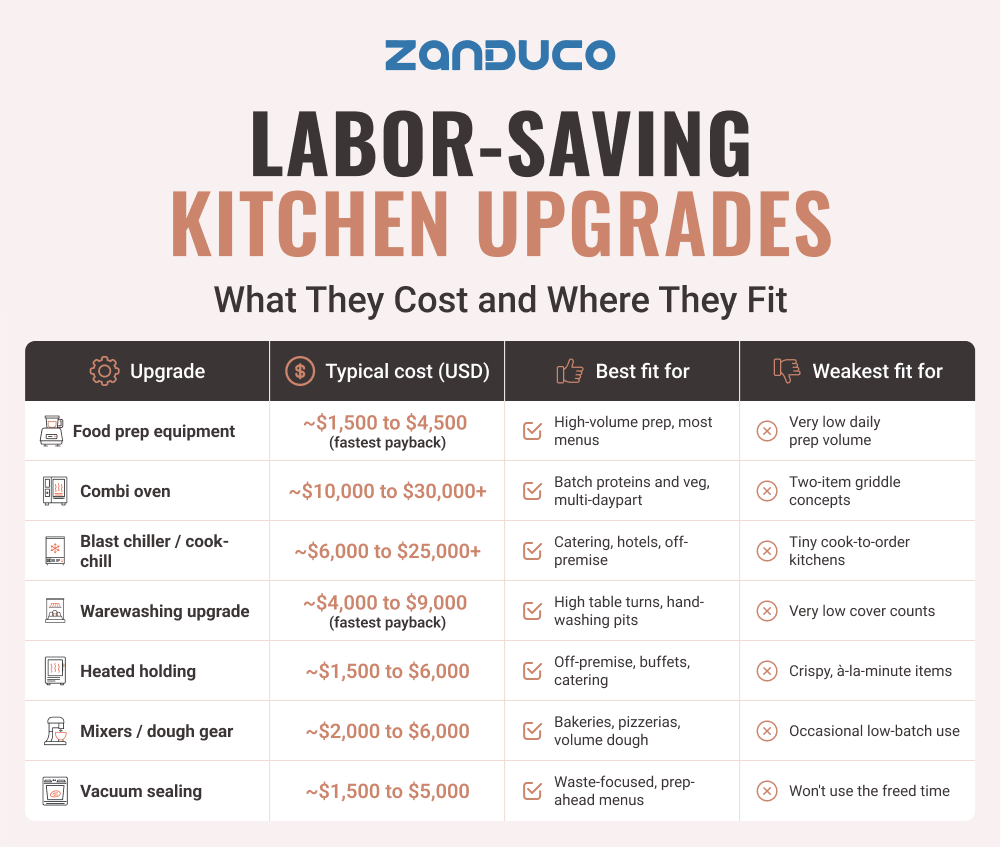
Ranges are ballpark and vary by brand, size, and configuration. Not quotes. The detailed cost breakdown with 3-year ownership notes is further down.
Some Kitchen Tasks Are Built for a Machine, and Some Are Why People Come Back
Before you price anything, sort your kitchen's work into two buckets.
Automate the tasks that are repetitive, high-volume, and rewarded for being identical every time:
- Dicing 40 pounds (18 kg) of onions or shredding cases of cheese
- Portioning stock and slicing deli meat to an exact thickness
- Cooling a hot batch through the danger zone
- Washing racks of dishes
A machine does these faster, more consistently, and without the fatigue drift that shows up in hour six of a shift.
Protect the tasks where judgment and touch are the product:
- Finishing a dish and balancing a sauce
- Plating and presentation
- Reading a steak by feel
These are what your guests are paying a person to do. Automating them is where quality actually drops, and where the cheap-looking labor "savings" costs you the repeat business.
Buyer Tip: Walk your line for one full service with a notepad and mark every task that is repetitive and every task that needs a chef's judgment. Your first equipment purchase should target the biggest repetitive time sink on that list, not the item a sales rep is pushing this quarter.
Once you have that split, the equipment decisions get simple. Our companion guide on space planning and code compliance walks through how to lay these machines out so the labor you save in prep does not get eaten back up by staff crisscrossing the kitchen.
1. A Food Processor Buys Back Your Cheapest Labor Hours First
If you only make one upgrade, make it here. Prep is the most time-consuming work in almost every kitchen, and it is the easiest to hand to a machine without touching quality. In fact, quality usually improves because cuts and textures become consistent.
A continuous-feed food processor turns a morning of hand-dicing, shredding, and slicing into minutes, and every cut comes out the same size, which matters for even cooking and honest portion control. A buffalo chopper or bowl cutter handles the heavy emulsifying and bulk chopping that wrecks a prep cook's afternoon. For delis, sandwich shops, and anyone slicing protein or cheese to spec, an automatic heavy-duty slicer delivers a consistent thickness no hand can match, which also tightens your yield. Butcher-forward menus get the same treatment from dedicated meat processing equipment.
Where it wins:
High-volume, repetitive prep. Fast payback. Low training curve. Consistency actually goes up.
Where it loses:
Low-volume kitchens dicing a few pounds a day rarely justify an electric unit. Below roughly 50 pounds (23 kg) of daily produce prep, a manual chopper and good knife skills are usually enough. Every powered unit also adds a cleaning and sanitation step, so budget the labor you add on the back end.
Worth Noting: The consistency you gain in prep only holds if portioning holds too. Our companion piece on how the right ladle and portioning tools protect food cost covers the smallwares side of the same problem.
2. A Combi Oven Lets Your Newest Cook Match Your Best One
A combi oven is the single biggest lever for kitchens that cook proteins and vegetables in volume. It combines convection and steam, so you can batch-cook large loads with programmable, repeatable results, then hold them without drying out. One programmed cook means a new hire hits the same result as your best cook, which is exactly the labor-and-quality split you want.
The steam control also protects yield. Proteins shrink less, so you get more servings from the same cut, which quietly offsets some of the sticker price. A straight convection oven is the lower-cost step if steam is not central to your menu.
Where it wins:
Menus with roasted proteins, vegetables, and batch items. Multi-day-part operations. Kitchens leaning on newer or thinner crews who need repeatable programs.
Where it loses:
The upfront cost is real, and boiler models add water treatment and maintenance. A two-item griddle concept will not use enough of the oven to justify it. Match the oven to your actual menu, not to its spec sheet.
3. Blast Chillers Let You Cook for the Rush Before It Starts
This is the upgrade quietly reshaping how short-staffed kitchens run in 2026. A blast chiller rapidly pulls hot food down through the temperature danger zone in minutes instead of the hours a walk-in takes. The FDA Food Code sets a two-stage cooling target, from 135°F (57°C) to 70°F (21°C) within two hours and down to 41°F (5°C) within six hours total, and a blast chiller clears that comfortably where a packed walk-in often cannot. That unlocks cook-chill: batch-cook during slow periods with your existing crew, chill safely, and regenerate to order during the rush.
The labor effect is structural. You move production off the frantic peak and onto calmer hours, which means fewer bodies needed at the worst moment of the day. The quality effect is the part buyers underestimate. Rapid chilling forms smaller ice crystals, so texture survives reheating far better than slow-cooled food, and shelf life extends. A unit like the Eurodib 10-tray blast chiller fits mid-size kitchens moving toward this model.
Where it wins:
Catering, banquets, hotel kitchens, ghost and delivery-heavy concepts, and any menu with make-ahead components. Pairs naturally with a combi for a full cook-chill loop.
Where it loses:
A tiny à la carte kitchen cooking everything to order gets less from it. It also asks for discipline: labeling, dating, and rotation have to be tight, or the food-safety advantage turns into a liability.
Common Mistake: Buying a blast chiller and skipping the labeling and rotation system that makes cook-chill safe. The machine is half the solution. The HACCP-friendly workflow around it is the other half.
4. Your Dish Pit Is Quietly Draining More Payroll Than You Think
Dish pit hours add up faster than owners expect, and they are miserable hours to staff. A high-temp door-type or conveyor machine from the commercial dishwashing lineup cuts the labor per rack and sanitizes with heat instead of leaning entirely on chemicals, which health inspectors like. It is not glamorous, but the payback is steady and the quality-of-work-life improvement helps you keep staff.
Where it wins:
Any kitchen running racks by hand or nursing an undersized machine through a rush. High table-turn concepts.
Where it loses:
High-temp machines need a booster heater and the right electrical and venting, so factor installation. Very low-cover operations may not clear the math on the largest units.
5. Heated Holding Keeps Food You Cooked Hours Ago Worth Serving
As delivery, catering, and off-premise orders grow, food sits longer between the pass and the guest. Heated holding and warming cabinets keep batch-cooked and finished food at safe, quality-holding temperatures so you are not re-firing to cover timing gaps. That is a direct labor save (fewer re-cooks, fewer bodies chasing tickets) and a direct quality save (food arrives the way it left the line).
Where it wins:
Off-premise-heavy operations, buffets, cafeterias, hotels, and catering. Anywhere the gap between cook and serve has stretched.
Where it loses:
Delicate, crispy, or à-la-minute items degrade in holding no matter how good the cabinet is. Hold the batch components, finish the delicate elements to order.
6. The Right Mixer Ends the Job Nobody on Your Crew Wants
For bakeries, pizzerias, and any kitchen making dough or batter in volume, a floor planetary mixer removes one of the most physically punishing manual jobs and standardizes the result. A 30-quart floor model with guard and timer covers most mid-volume prep, and dough sheeters and dividers in the same category extend the same logic to shaping and portioning.
Where it wins:
Daily dough or batter production. Consistency-critical baking where hand-mixing drifts.
Where it loses:
Low-batch kitchens are fine on a countertop unit. Buying a floor mixer for occasional use is capital sitting idle.
7. Vacuum Sealing Turns Your Slow Hours Into Prep You Use Later
A chamber vacuum packaging machine supports the same prep-ahead strategy as cook-chill. Seal bulk proteins, produce, and prepped components to extend freshness, cut spoilage, and portion in advance during calm hours. Less waste is money back, and prepped-and-sealed components pull labor out of the rush.
Where it wins:
Kitchens fighting food cost and waste, sous-vide-adjacent menus, and make-ahead operations.
Where it loses:
It adds a prep step, so it earns its place only if you actually use the prep-ahead time it frees up.
What This Costs, and What It Costs Over Time
Sticker price is the wrong number to plan around. The number that matters is total cost over the years you will own the machine, set against the labor hours it reclaims. Below are ballpark US ranges that vary widely by brand, size, and configuration. Treat them as planning figures only.
| Upgrade | Typical purchase range (USD) | Primary labor it targets | 3-year cost-of-ownership note |
|---|---|---|---|
| Continuous-feed food processor | around $1,500 to $4,500 | Bulk dicing, shredding, slicing | Low energy draw; main added cost is cleaning labor |
| Buffalo chopper / bowl cutter | around $2,000 to $6,000 | Heavy chopping, emulsifying | Durable; budget occasional blade service |
| Automatic deli / meat slicer | around $1,500 to $5,000 | Portion-consistent slicing | Blade sharpening and guards factor in |
| Combi oven (mid-size) | around $10,000 to $30,000+ | Batch cooking, repeatable results | Boiler models add water treatment and service |
| Blast chiller (undercounter to reach-in) | around $6,000 to $25,000+ | Rapid cooling for cook-chill | Higher energy; enables off-peak production |
| High-temp door-type dish machine | around $4,000 to $9,000 | Warewashing hours | Add booster heater, venting, install |
| Heated holding cabinet | around $1,500 to $6,000 | Re-cooks, ticket chasing | Low complexity; steady payback |
| Floor planetary mixer (20 to 30 qt) | around $2,000 to $6,000 | Dough and batter production | Long service life; low running cost |
| Chamber vacuum sealer | around $1,500 to $5,000 | Prep-ahead, waste reduction | Bag cost is the recurring line |
Run the payback yourself with your own numbers. As a worked example, if a food processor saves roughly one hour of prep a day at a loaded labor cost of around $16 to $20 an hour, that is roughly $100 to $140 a week, or somewhere near $5,000 to $7,000 a year against a machine that often pays for itself inside the first year. Combi ovens and blast chillers take longer to pay back on labor alone, so weight their yield and consistency gains too.
Kitchen Planning Tip: The tax math got friendlier for 2026. Section 179 lets qualifying US businesses deduct the full cost of equipment in the year you place it in service, up to $2.56 million for 2026. On top of that, the One Big Beautiful Bill Act restored 100 percent bonus depreciation for qualifying equipment placed in service after January 19, 2025, new or used. For most independent restaurants, that can mean writing off a kitchen full of new gear in year one. A taxable-income limit and state rules apply, so confirm with your tax advisor, then stack ENERGY STAR utility rebates on top where they exist.
For a wider view of how the right equipment partner shortens sourcing and installation time, our companion piece on how commercial kitchen equipment helps restaurants save money is worth a read before you buy.
The Trends Pushing These Decisions in 2026
If you walked the NRA Show floor in Chicago this past May, one signal was hard to miss. Smart, connected equipment has moved from pilot project to standard spec, and almost all of it is aimed squarely at the labor-and-quality split above. Four shifts are worth knowing before you buy.
Smart Ovens That Hold The Standard For You
The headline machines now read the food. Rational's iHexagon combines steam, hot air, and microwave energy and automatically balances them to whatever is in the chamber, and object-recognition ovens adjust temperature, humidity, and time to the item so results stay identical run to run. The labor angle is the part buyers underrate: these systems cut new-staff training time sharply, because the oven, not the cook's memory, carries the recipe. That is the cleanest example of reducing labor dependence without touching quality.
Robotics Is Coming For The Repetitive Tasks First
Atosa's six-axis robotic fry cell, built with a ventless hood and fire suppression, was part of the automation story, and several 2026 Kitchen Innovations Award winners, from programmable induction to a new flight-type dishwasher, were designed to cut training time and hold quality regardless of a cook's skill level. You almost certainly do not need a robot yet. The useful takeaway is directional: the industry is automating the most repetitive, lowest-craft production tasks first, which is exactly the automate-versus-protect logic playing out at scale.
Ventless And Multi-Use Equipment Is Surging
Demand for ventless cooking keeps climbing, driven by ghost kitchens, express formats, and spaces where ductwork is impossible or too expensive. Ventless lets you add a hot menu item without a full hood build. One caution: ventless approval depends on the specific unit listing, your menu, and your local adoption of NFPA 96, so verify with your inspector before you count on it.
The Refrigerant Transition Is Quietly Forcing Timing
The federal AIM Act is phasing down HFC refrigerants, which is pushing new refrigeration and blast chillers toward low-GWP options like R-290. Buying now generally means buying into the newer standard, which protects resale value and keeps you clear of future compliance headaches on the machine you are babying along.
The through-line: the equipment that reduces labor is increasingly the same equipment that improves consistency and keeps you on the right side of the newer efficiency and refrigerant rules. You are rarely trading one for the other anymore.
The Compliance Boxes to Check Before You Buy
None of these savings matter if the equipment fails inspection, and a few of the rules moved recently. Run down this list before you commit:
- NSF certification for food-contact sanitation. Non-negotiable on anything that touches food.
- UL or ETL listing for electrical and gas safety.
- ENERGY STAR rating where your utility offers efficiency rebates.
- DOE efficiency standards, which current refrigeration and cooking equipment must meet.
- AIM Act-aligned refrigerants on refrigeration and blast chillers, which is why newer units ship with low-GWP options like R-290.
- FDA Food Code (2022 edition plus 2024 Supplement) for cook-chill and holding, which tightened time-and-temperature and record-keeping rules.
- NFPA 96 (2024 edition) for any ventless cooking, checked against your local code.
- Your state and local health department, which has the final say. Verify local requirements before you buy.
Worth Noting: A machine can carry a valid safety mark and still not be sanitation-certified. NSF listing and an electrical listing (UL or ETL) answer different questions. Check for both when the equipment touches food.
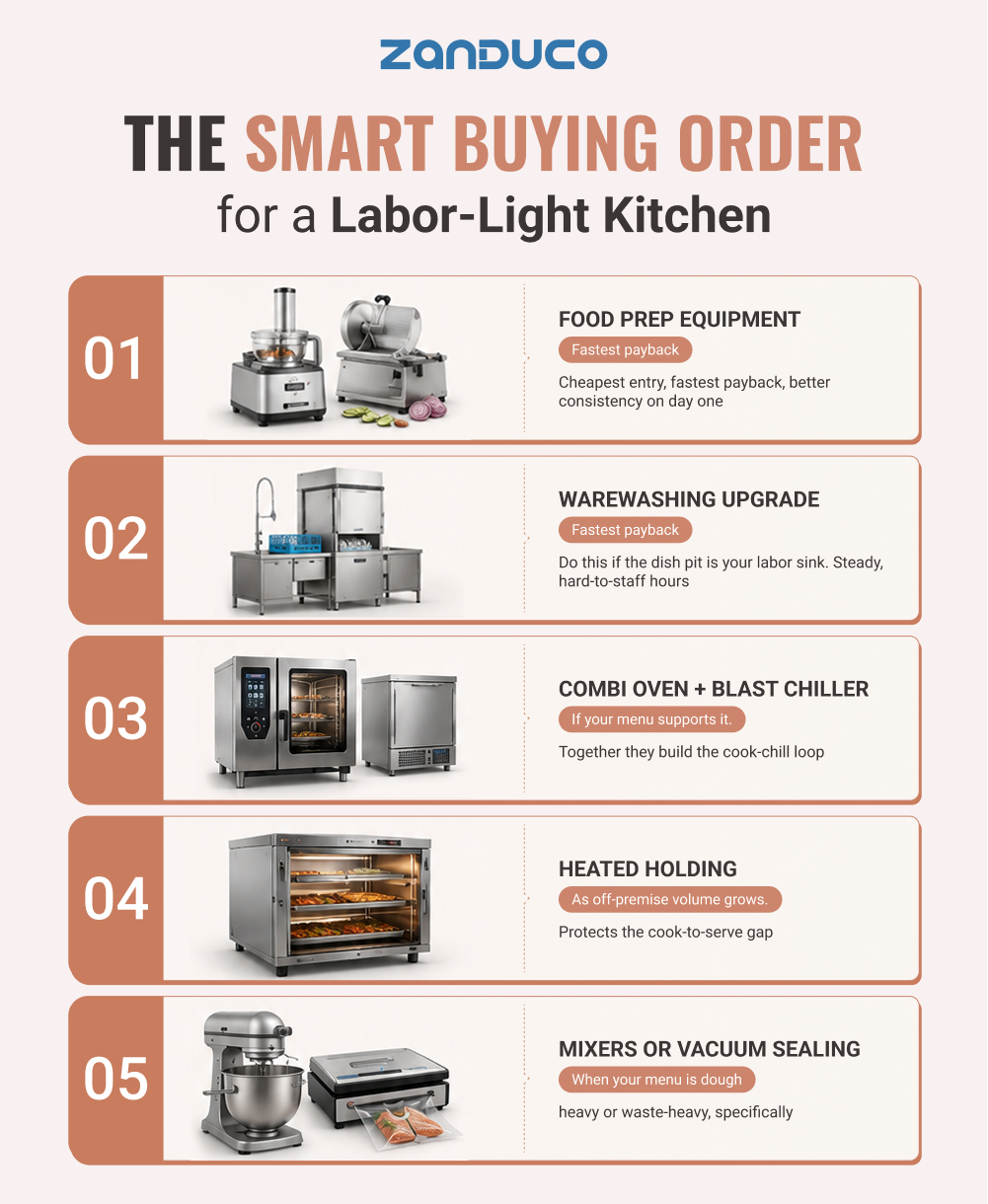
The Smart Order of Operations for a Labor-Light, Quality-First Kitchen
If you are buying in sequence rather than all at once, here is the honest priority for most US kitchens:
- Food prep equipment first. Cheapest entry, fastest payback, and it improves consistency on day one.
- Warewashing next, if the dish pit is your labor sink. Those hours are steady and hard to staff.
- A combi oven and blast chiller together, if your menu supports it. This builds the cook-chill loop that pulls production off your peak.
- Heated holding as off-premise volume grows. Protects quality across the longer gap between cook and serve.
- Mixers or vacuum sealing when your menu calls for it. Dough-heavy or waste-heavy kitchens, specifically.
The mistake to avoid: buying the impressive machine first and the practical one never.
A combi oven is a wonderful thing to own, but if your crew is drowning in hand-prep every morning, a food processor will change your week faster and for a tenth of the price. Buy for your actual bottleneck.
To make it concrete, picture a 45-seat neighborhood spot that just lost its morning prep cook. Rather than rushing to backfill the role, the owner puts in a food processor and a better dish machine first, shifts batch cooking into the quiet mid-afternoon with a combi and a blast chiller, and covers the same seats with one fewer body on the closing shift. Same food, steadier quality, a lower labor line. Scale that logic to your own covers and menu, and the order almost always starts with prep.
The Labor Math Isn't Getting Easier. Start Now.
Ready to price the upgrades that fit your kitchen? Browse the full commercial kitchen equipment range at Zanduco, or call the team at 1-855-926-3826 to talk through your menu, your volume, and where your labor is actually going before you spend a dollar.