Free Shipping (On select items & orders)
  Track My Order


Posted in: Restaurant Management
You have measured the room. Twice, because the first number felt wrong. You have the guest count, you have a browser tab with a full cart, and you have been staring at the same decision for two days. Round folding table vs rectangular table. It should take thirty seconds.
So you search it, and the internet is no help at all. Half the event-rental blogs swear rounds are the space-efficient choice. The other half swear rectangles let you add twenty percent more guests to the same tent. Both sound extremely sure of themselves. Neither one shows you a single calculation.
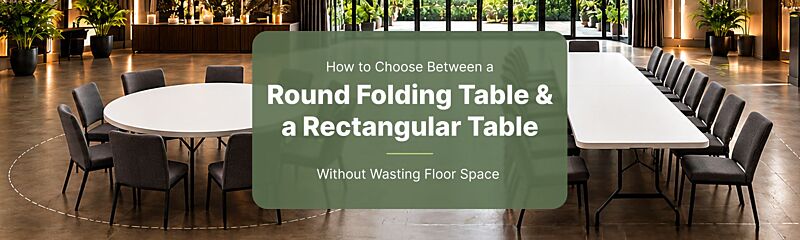
Here is what none of them mention. Shape quietly sets your freight bill, your linen order, your storage closet, and whether your setup crew is cursing your name at six in the morning. And the answer turns on one question about your business: are you selling covers, or are you selling an evening? So let us do the math that the other pages skip. Every number below comes from Zanduco's live folding tables range of commercial folding tables for events, so you can check it against a real cart instead of a stock photo.
Quick answer: Rectangular folding tables seat more guests per square foot and cost less per seat, so they win when capacity is the constraint. Round tables win on conversation, on server access, and in rooms where the guest experience is the product you are selling. It depends on which one you are selling. If you sell covers, buy rectangles. If you sell an evening, buy rounds. If you sell both, buy a mix and skip to the hybrid section.
Round vs Rectangular Banquet Tables, and Why Neither One Is a Clean Win
What rounds are worth the money for
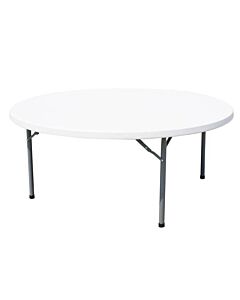
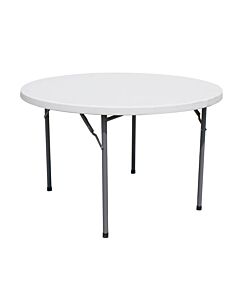
A round table has no head. Nobody at a 59-inch round is stuck in the cheap seats, and nobody is shouting past a floral arrangement at the person three chairs down. Think about the last wedding you sat through. If you could hear everyone at your table, you were at a round. If you spent the night talking to exactly two people while your aunt held court eleven feet away, you were at a long rectangle.
Rounds also make servers faster. One lap of a 59-inch round drops eight covers, and nobody has to lean back. On a long rectangle, that same server walks a corridor, twice.
And rounds soften a hard room. In a hall with square corners, a structural column, and a nine-foot ceiling, a floor of circles reads calmer than a floor of lines. That is not a small thing when guests are paying for the atmosphere rather than the chicken.
Where rounds waste your floor and cash
They eat floor. A 59-inch round needs a ring of clearance around it, and circles do not tile. Push them into a rectangular room and you leave a triangle of dead air in every corner. Every triangle is a seat you did not sell.
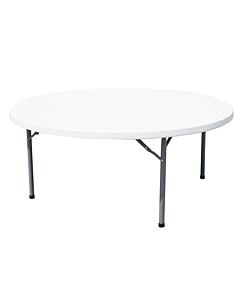
They punish reach. By the time you get to a 71-inch top, the middle of that table is where centerpieces go to be admired and bread baskets go to die. Nobody is passing anything.
And they punish storage. Round tops do not stack flat the way rectangles do. Ask anyone who has tried to lean nine of them against a wall behind the walk-in. You will buy a caddy, and you will surrender a corner of your storeroom to it.
What makes rectangles the value pick
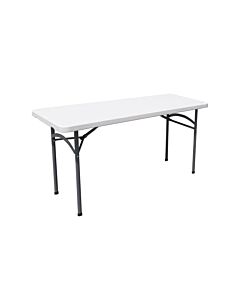
Rectangles tile. Rows, walls, end-to-end runs, U-shapes. The geometry cooperates, which is why every conference, buffet line, and communal dining room in America runs on them.
They are cheaper per seat, and not by a little. A 95-inch rectangular folding table at around $153 seats eight in comfort, which is roughly $19 a seat. A 59-inch round at around $208 seats the same eight at about $26 a seat.
They are also the right answer for everything that is not seating. Buffet runs, gift tables, registration desks, drink stations, cake tables, the prep surface hiding behind a curtain. Every one of those jobs wants a straight edge.
Where rectangles let your guests down
Conversation collapses. A guest halfway down an eight-footer talks to two neighbors and one person across. Fine for a dinner party. Thin for a wedding.
They look plain undressed. A bare rectangle reads as utility, which matters if you were hoping to skip the linen budget on a casual event. Rounds get away with a naked top far more often.
And they trap people. The guest in the middle of a long row has to ask five people to shift so they can reach the bar. At a round, everyone has an exit.
Banquet Table Seating Capacity, and How Many People Really Fit
The working rule is roughly 24 inches of table edge per guest for comfort, and about 18 to 20 inches when you are squeezing. Run the circumference and the answer falls out.
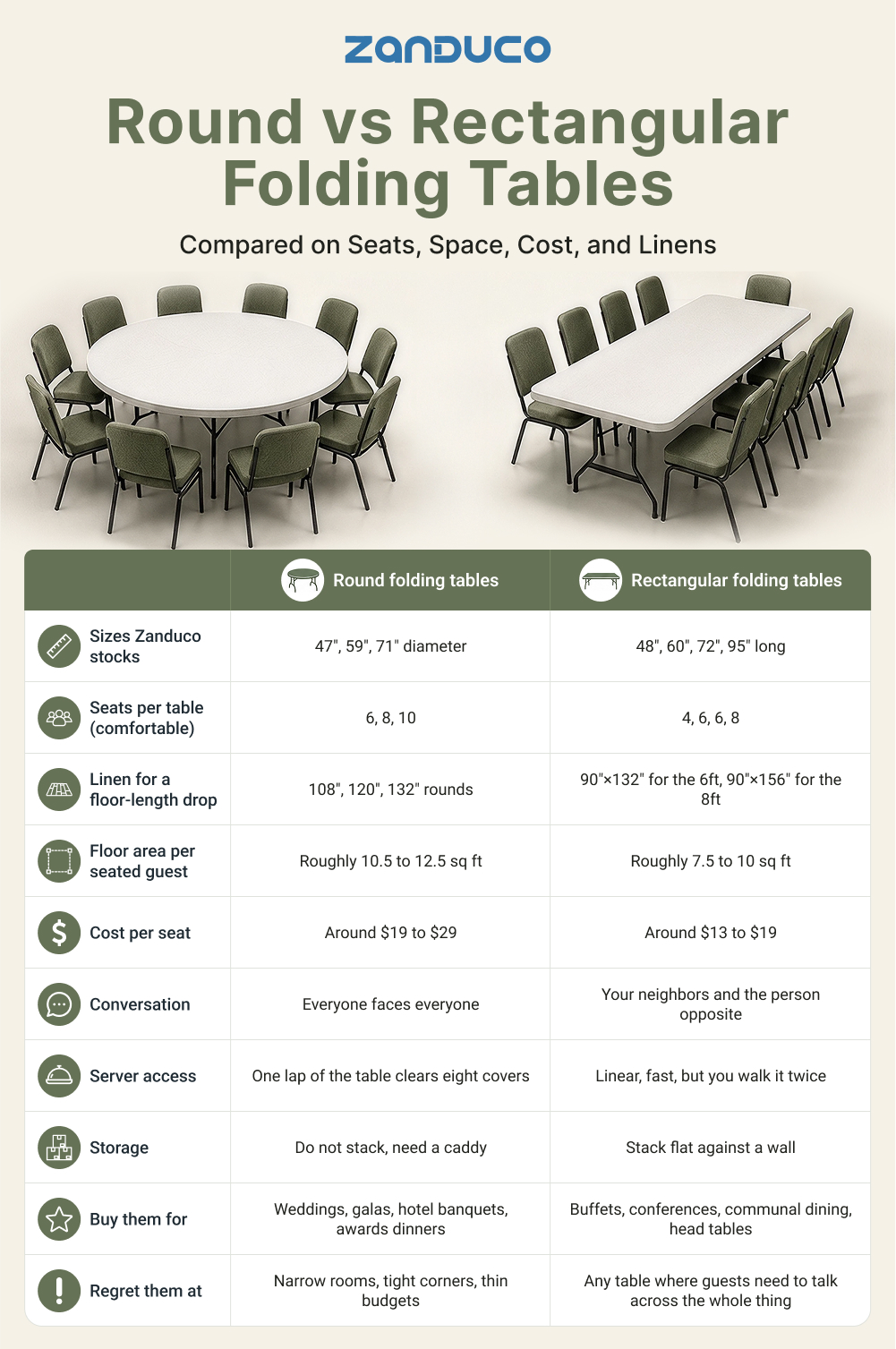
One thing to know before you order anything, and it is the sort of detail that costs money. Zanduco's round tops measure 47, 59, and 71 inches. Not the 48, 60, and 72 you have read everywhere else. They are metric tops (roughly 120, 150, and 180 cm) sold into an imperial market. The seating math barely moves. The linen math, as you will see in a minute, still works out. But if you hand a rental company "sixty-inch rounds" and they hand you back a quote, someone is going to be wrong.
Use this as your folding table size guide:
| Table | Comfortable | Maximum | What it is really for |
|---|---|---|---|
| 47" round | 6 | 8 | Café overflow, small private dining, the kids' table |
| 59" round | 8 | 10 | The workhorse. Weddings, banquets, galas |
| 71" round | 10 | 12 | Large-format banquets, sponsor tables |
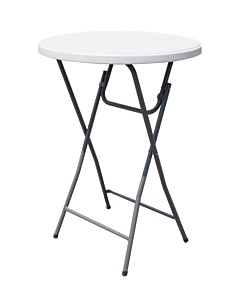
| 32" round, bar height | 3 to 4 standing | 5 | Cocktail hour, standing receptions, trade booths |
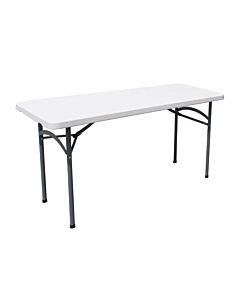
| 48" rectangular | 4 | 6 | Registration, gift table, small buffet |
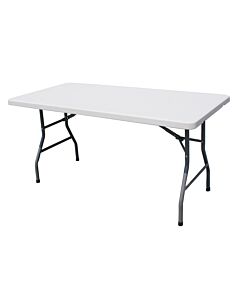
| 60" rectangular | 6 | 6 | The awkward middle child. Usually skip it |
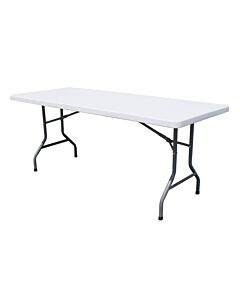
| 72" rectangular | 6 | 8 | The six-foot standard. Buffets, classrooms, breakouts |
| 95" rectangular | 8 | 10 | The eight-foot standard. Communal dining, long rows |
Worth Noting: sale cycles can flip the price ladder upside down. As I write this, the 60-inch rectangular table lists at around $157 while the 72-inch lists at around $108, because the longer table is discounted and the shorter one is not. Longer does not always mean pricier. Check the cart before you assume.
Which Table Shape Saves More Floor Space? Here Is the Math
Planners allow about 60 inches between table edges. That covers two rows of chair backs plus an aisle a server can walk with a full tray. Add the table itself and you get a repeating grid cell. Divide the cell by the seats and you get square feet per guest, which is the only number that lets you compare a circle to a rectangle honestly.
Rounds, 59-inch top, 8 guests. A 59-inch top is near enough 5 feet. Add the 5-foot gap and each table owns a 10-foot by 10-foot cell, about 98 square feet. That is roughly 12.3 square feet per guest. Stagger the rows instead of gridding them, so the circles nest into each other's gaps, and it drops to about 10.6 square feet per guest.
Rectangles, 95-inch tops in continuous rows, 8 guests each. The table is 8 feet by 30 inches. Butt them end to end and each row needs 30 inches of table plus the 5-foot gap, so 7.5 feet of depth. Each table owns 8 feet by 7.5 feet, which is 60 square feet. That is 7.5 square feet per guest.
So rectangles are roughly 20 to 35 percent denser, and staggering your rounds closes some of that gap but not all of it. Both of the warring blog posts were half right, which is why neither of them showed their work.
Applied to a real room, seating 104:
| Layout | Tables | Approx. floor needed |
|---|---|---|
| 59" rounds, gridded | 13 | ~1,275 sq ft |
| 59" rounds, staggered | 13 | ~1,105 sq ft |
| 95" rectangles, continuous rows | 13 | ~780 sq ft |
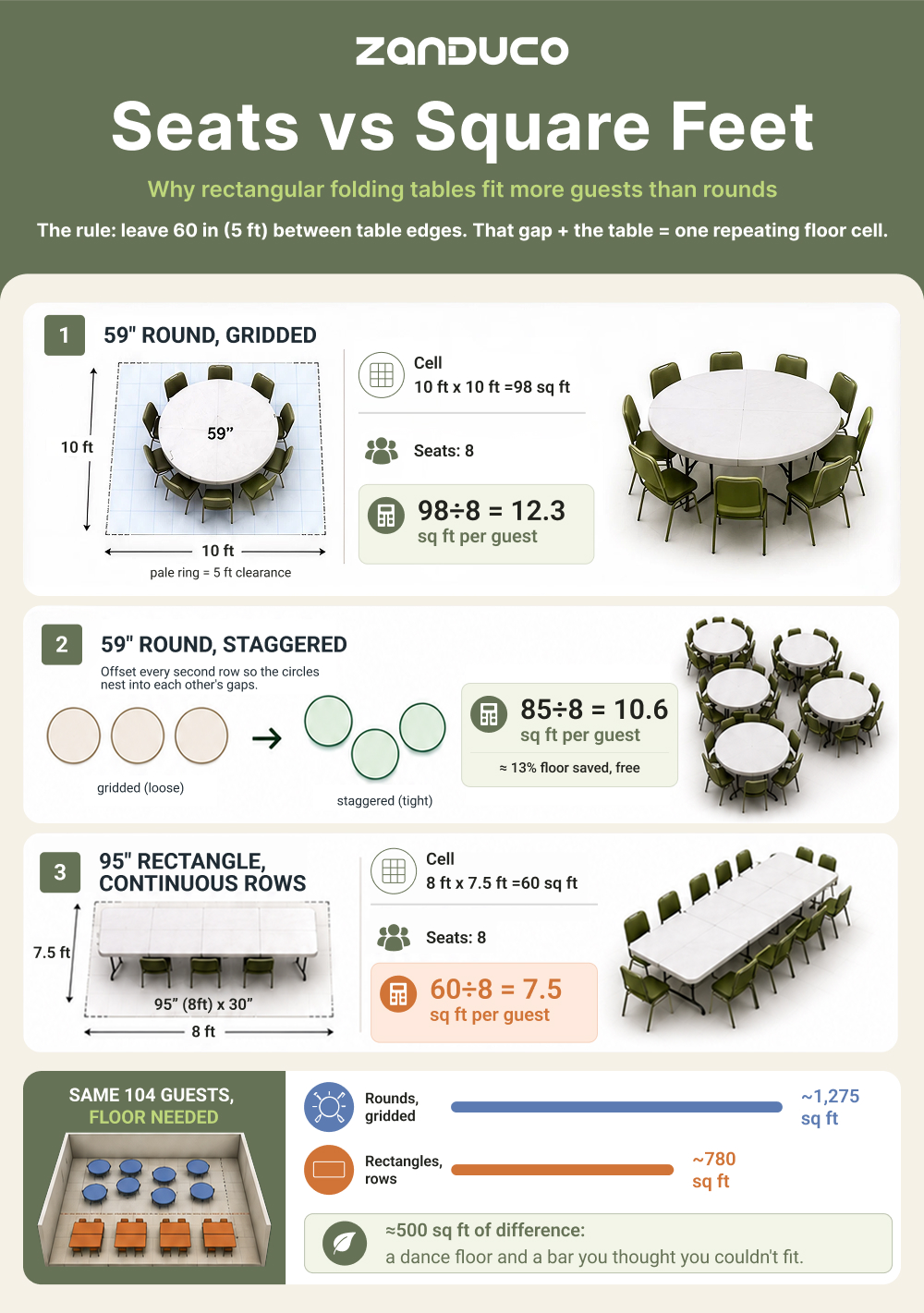
Floor Plan Tip: stagger your rounds. Offset every second row by half a table so the circles nest rather than line up. It costs nothing, it takes one conversation with your setup crew, and it buys back about 13 percent of your floor.
What Each Shape Costs You Per Seat
Sticker price is the least interesting number in the file. Cost per seat is better. Cost per seat over five years is better still, because a plastic top that cracks at the hinge in year two was never cheap.
Cost per seat, at Zanduco US pricing on the day this was written
| Table | Approx. price | Comfortable seats | Approx. cost per seat |
|---|---|---|---|
| 47" round | ~$116 | 6 | ~$19 |
| 59" round | ~$208 | 8 | ~$26 |
| 71" round | ~$291 | 10 | ~$29 |
| 72" rectangular | ~$108 | 6 (8 with ends) | ~$14 to $18 |
| 95" rectangular | ~$153 | 8 (10 with ends) | ~$15 to $19 |
| Folding chair | ~$40 | 1 | ~$40 |
Look at the last row again. The chair costs more than the seat's share of the table. Every single time, on every single size. Buyers spend two days agonizing over shape and then order chairs in ninety seconds. Flip that.
Five-year cost frame, a room set for 100 guests
| Line item | Rounds (13 × 59") | Rectangles (13 × 95") | Notes |
|---|---|---|---|
| Tables | ~$2,700 | ~$1,990 | 104 seats either way |
| Chairs (104) | ~$4,160 | ~$4,160 | Identical either way |
| Linens | Quote locally | Quote locally | 120" rounds vs 90" × 156" rectangles |
| Laundering, 5 yrs | Quote locally | Quote locally | Rounds usually cost more per launder |
| Freight and liftgate | See next section | See next section | Folding tables are excluded from free shipping |
| Storage hardware | Caddy or platform cart | Often nothing | Rounds do not stack |
| Replacement, 5 yrs | Budget 10 to 20% | Budget 10 to 20% | Zanduco lists a 180-day warranty on the 47" round |
| Table line, delivered | Higher | Lower by roughly $700 | Before linens and freight |
Two honesty notes on that table. Zanduco publishes a 180-day warranty on the 47-inch round, so treat these as consumables on a replacement cycle, not capital assets. And the linen and laundering lines are deliberately left open, because anyone who quotes you a five-year laundry figure without knowing your market is guessing.
Why Folding Tables Do Not Ship Free, and How Much The Freight Costs
Read this before you compare shapes at all, because it is where table budgets quietly go wrong.
Folding tables sit on Zanduco's excluded list for free shipping, alongside wire shelves, sinks, worktables, and shopping carts. They move as freight. Check the free shipping policy before you build your model, because the accessorial fees are real money on a small order:
- Commercial liftgate or tailgate delivery: $75 USD, waived if you have a truck-level receiving dock
- Residential liftgate or tailgate delivery: $85 USD, applied automatically
- Delivery appointment, where the driver calls ahead: $35 USD
- All common carrier deliveries are curbside only. Inside delivery is quoted separately and varies with weight, floor count, and door width
Limited-access locations get flagged too, and the definition is broader than most owners expect. Schools, farms, construction sites, and, worth circling, malls and shopping plazas. If your café is in a mall food court, budget for it.
Rectangles help you here. They stack flatter, so a pallet of thirteen eight-footers takes less cube than thirteen 59-inch rounds. One freight shipment instead of two is real money, and it is a saving that appears in exactly zero comparison charts.
Plastic or Stainless Steel? That Is a Different Question From Round or Rectangular
Buyers conflate these two decisions constantly, and it gets expensive.
Blow-molded plastic tables are seating furniture. Light, wipe clean, fold flat, roughly $75 to $300. Every round in Zanduco's range is plastic. Guests sit at them.
Stainless steel folding tables are service and prep furniture. Zanduco's run 24" × 60", 24" × 72", 30" × 60", and 30" × 72", with or without an undershelf, all at a listed height of 30 and 5/8 inches, and roughly $225 to $350. A 30" × 72" stainless folding table with undershelf is a superb off-site prep station, buffet back-of-house surface, or festival service line. It is a poor dining table.
Common Mistake: buying 24-inch-deep stainless folding tables for seated dining. Two people cannot eat opposite each other across 24 inches without their plates introducing themselves. Thirty inches is the practical minimum for face-to-face dining, which is exactly why the plastic banquet rectangles are all 30 inches deep. And an undershelf, useful as it is for staging, takes away the knee room a seated guest needs.
Outfitting a patio rather than a ballroom shifts the calculus again, toward fixed outdoor tables and patio chairs that will not migrate in a gust. Our companion guide to buying patio heaters for your restaurant covers the seasonal side of the same problem, and it pairs naturally with any outdoor table decision.
What Size Linen Fits a 59-Inch Round Table? And Other Event-Day Details
Things you only learn by setting a room and then breaking it down at midnight.
- Linens still work, despite the odd diameters. A 59-inch top at standard banquet height needs a 119-inch circle for a floor-length drop, and the common 120-inch round linen covers it with half an inch to spare. The 71-inch top needs 131 inches, and a 132-inch linen lands almost exactly. The 47-inch top pairs with a 108-inch round. For rectangles, 90" × 132" covers a six-footer and 90" × 156" covers the eight.
- Round tops behave badly on grass and brick. Four legs on uneven ground means one leg is always short. Rectangles wobble too, but shimming a straight rail is faster than chasing a rocking circle while guests watch.
- A floor-length linen on a 71-inch round is a sail. Outdoors, in a breeze, a fully draped large round will lift. Use lap-length drops outside, or clip.
- Cocktail rounds are the cheapest capacity you will ever buy. Swap some seated capacity for 32-inch bar-height rounds at around $61 each. Standing guests need a fraction of the floor that seated ones do.
- Buffet lines want rectangles. No exceptions. Run your chafing dishes and buffetware down straight tables so guests move one direction. A round buffet island photographs beautifully and creates a traffic jam. Our companion piece on essential smallwares for restaurants covers what belongs on that line.
- California buyers, read the label. Zanduco's US product pages carry a California Prop 65 warning link. Read it before you order into that state.
Buyer Tip: measure the table you own, not the table you assume you own. A 120-inch round linen on a 59-inch top drops to the floor. On a genuine 60-inch top it also drops to the floor. On a 63-inch top from a different supplier, it hovers an inch above the carpet and every photo shows table legs.
Are Folding Tables NSF Certified? And Where Does ADA Apply?
Compliance guidance on folding tables is full of confident nonsense. Here is what genuinely matters for a US buyer.
NSF certification applies to food-contact surfaces, not to seating
Using a folding table as a dining surface where guests eat off a plate? NSF/ANSI 2 is not the relevant standard. Using one as a prep surface, staging table, or open buffet line where food touches the top? Then it is. Do not assume either way. Zanduco's folding table listings carry no NSF claim, so ask for the spec sheet before you build a prep line around one. Your state or county health department has the final word, and adoption of the FDA Food Code varies by jurisdiction.
UL and ETL listings do not apply
A folding table has no electrical components. Neither do ENERGY STAR, DOE efficiency standards, or EPA SNAP refrigerant rules. Any supplier waving those around on a table listing is padding the page.
ADA is the one that will bite you
Under the 2010 ADA Standards for Accessible Design:
- At least 5 percent of seating spaces at dining surfaces must be accessible, minimum one (Section 226.1)
- Accessible surfaces must be 28 to 34 inches high (Section 902.3)
- Knee clearance of at least 27 inches high, 30 inches wide, 19 inches deep (Section 306.3.4)
- A 30-inch by 48-inch clear floor space at each accessible seat
- Accessible seating must be dispersed, not clustered in one corner (Section 226.2)
- The accessible route through the room stays at 36 inches clear
Zanduco's stainless folding tables list at 30 and 5/8 inches, comfortably inside the 28-to-34 window. The plastic banquet tables do not publish a height on the product page, so request it in writing before you plan an accessible seat around one. The knee clearance test is where things usually fail: undershelves block it, and center-post pedestal bases block it. A clean X-frame under a flat top is usually fine. Verify the frame position against that 19-inch depth before you commit.
Occupant load is a design number, not a seating cap
IBC Table 1004.5 assigns 15 net square feet per person to unconcentrated assembly with tables and chairs, and 7 net square feet for chairs only. That figure sizes your exits, your door swings, and whether you need panic hardware. That figure is a minimum for design purposes. If your real seat count exceeds the calculated load, the higher number governs. Notice that a staggered round layout at 10.6 square feet per guest sits well under 15, so build your egress plan on real seats rather than on the table. Your local building department is the authority. For the clearances behind the pass, our guide to commercial kitchen design and code compliance covers the aisle widths and workflow zoning underneath all of this.
Can You Mix Round and Rectangular Tables? The Hybrid Layout That Ends the Argument
The best rooms run two shapes at once. This is the pattern experienced venue managers reach for without thinking about it:
- Perimeter and center: 59-inch rounds. This is where guests eat, talk, and stay for three hours. Stagger them.
- One central run: 95-inch rectangles butted end to end. A king's table down the middle. It recovers a dozen seats you would otherwise lose to the dead space between rounds, and it reads as a design decision rather than a capacity grab.
- All service furniture: rectangles. Buffet, bar back, gift, cake, registration, DJ.
- Cocktail hour: 32-inch bar-height rounds. Cleared before dinner service and folded into a corner.
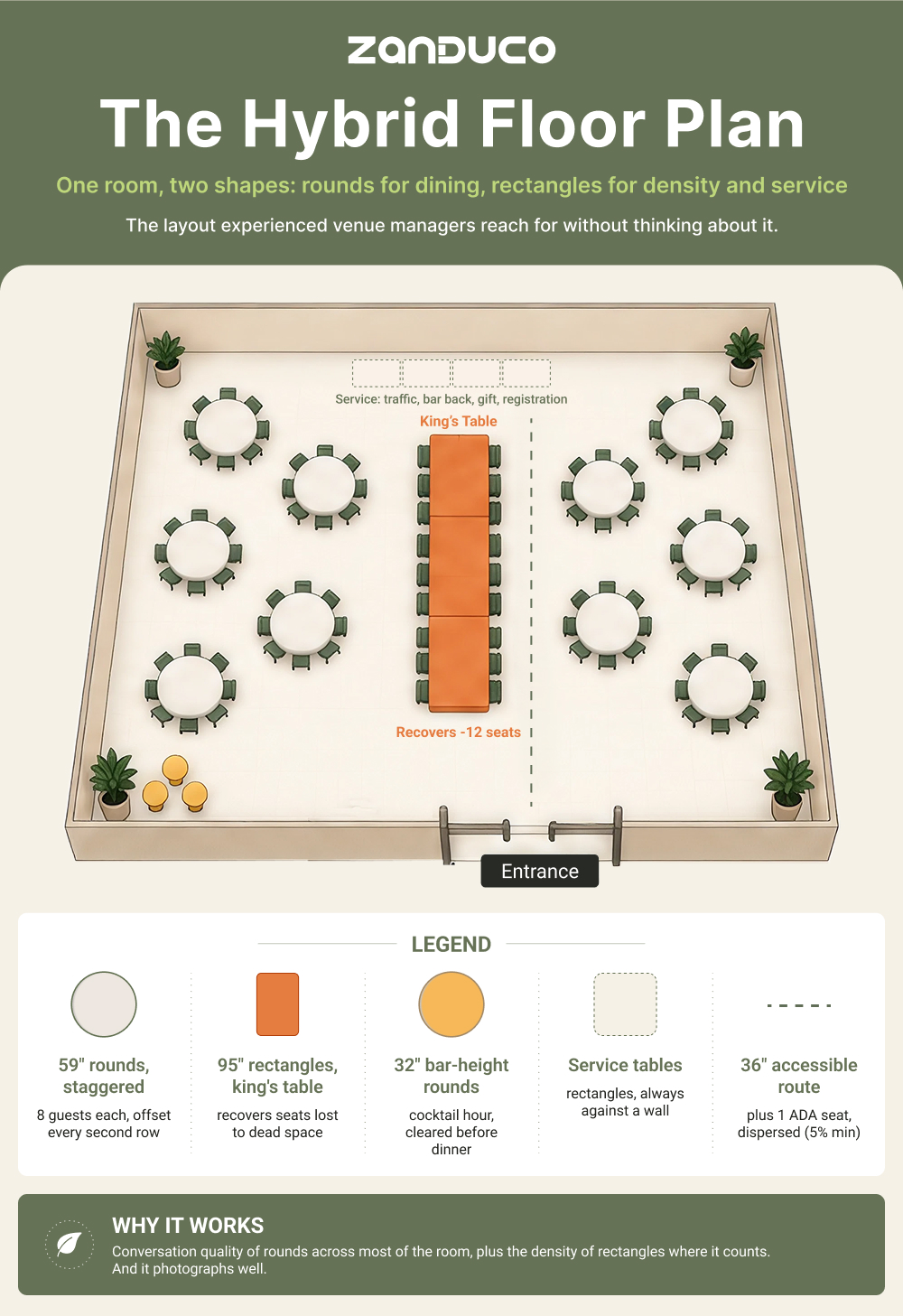
You get the conversation quality of rounds across most of the room, the density of rectangles where it counts, and a floor plan that photographs well. If you run a hotel kitchen or a banquet hall selling the same room to a wedding on Saturday and a corporate breakout on Tuesday, a mixed inventory is the only one that serves both bookings.
What I Would Buy With a $2,500 Table Budget
Opinions, clearly labeled as such, from someone who has watched too many rooms get set badly.
- If you are a caterer or event company: eight 95-inch rectangles (~$1,225) and six 59-inch rounds (~$1,250). The rectangles earn their money on buffets and corporate work every week. The rounds cover the weddings. Buy the rectangles first, because they are the ones you cannot improvise.
- If you are a restaurant or pizzeria buying for occasional private events: skip rounds entirely. Six 72-inch rectangles (~$650) and put the rest into decent chairs. Your dining room already has permanent restaurant tables and chairs. What you need is a surface that appears for a Christmas party and vanishes by Monday lunch.
- If you are a banquet hall or hotel kitchen: rounds, in volume, and do not economize. Buy 59-inch tops, not 71-inch. The 71 seats two more, but the reach across the middle is genuinely unpleasant and the cost per seat is worse. Buy a caddy. Buy two.
- If you are a bakery or café doing markets and pop-ups: the 48-inch rectangle at around $76 is the most useful table in the catalog. Two of them fit a standard 10-foot booth, one person can lift it, and it costs less than a case of flour.
One recommendation I will make without hedging. Whatever shape you pick, draw the room to scale first. Actual scale. With chairs pulled out, with the 36-inch accessible route marked, and with the buffet where it will really stand. Seats that fit on a napkin sketch do not fit on a floor.
Set the Room First, Then Fill the Cart
The round folding table vs rectangular table argument is really a question about what you sell. Sell capacity and you buy rectangles. Sell an evening and you buy rounds. Sell both, which most restaurants, caterers, and banquet halls do, and you buy a working mix and stop apologizing for it.
Zanduco stocks both, in the sizes above, at prices you can check in a cart right now. If you want a second set of eyes on your floor plan before you commit to thirteen tables and a freight bill, our team has been sizing rooms for foodservice buyers for six decades. Browse the folding tables range, or send us your dimensions and guest count and we will tell you honestly which shape your room wants.