Free Shipping (On select items & orders)
  Track My Order


There's a conversation that plays out in commercial kitchens across the US more often than you'd think. A chef wants to make house-made jerky, dried mushrooms, or dehydrated citrus garnishes. Someone on the team says, "just turn the oven down low." And then, after hours of uneven results, rubbery textures, and wasted product, they wonder what went wrong.
The short answer? Conventional ovens and commercial food dehydrators are not the same things. Not even close. They're built for completely different purposes, and confusing the two is one of the most common (and expensive) mistakes in American commercial kitchens today.
Let's break this down properly, because once you understand what's actually happening inside each piece of equipment, you'll never look at your oven the same way again.
So, Low Heat Is Enough? Not Quite.
Most chefs assume that if they can get their convection oven down to 150°F or so, they're basically running a dehydrator. It sounds logical. Heat removes moisture, right?
Yes, but how that heat moves through the chamber is everything.
A commercial oven is designed to cook. Its heating elements, airflow patterns, and chamber design are all optimized to raise the internal temperature of food quickly and evenly. Even at its lowest setting, a conventional oven is fighting its own engineering. It wants to cook, not slowly dry.
A commercial food dehydrator, on the other hand, is engineered from the ground up to remove moisture at precise, low temperatures while maintaining continuous, calibrated airflow across every single tray. It's not just heat. It's controlled evaporation.
Quick fact: Most commercial ovens can't reliably hold temperatures below 150°F, but many foods require dehydration at 90°F to 130°F to preserve enzymes, color, texture, and nutritional value. Your oven physically cannot go there.
What Goes Wrong Inside Your Oven
Here's what most chefs don't realize until they've ruined a batch or two.
When you place food in a conventional oven at low heat, a few things happen almost immediately.
The outside dries faster than the inside. Without the even, horizontal airflow of a dedicated dehydrator, the surface of your food forms a dry crust while the interior stays moist. The result? Jerky that looks done but goes bad quickly. Fruit slices that are crispy on the edges but soft in the middle. Herbs that brown and lose potency instead of drying cleanly.
Moisture has nowhere to go. An oven's sealed environment traps steam. Even with the door slightly propped open (a workaround you'll see in plenty of busy kitchens), the humidity inside climbs and slows the drying process dramatically. You end up running the oven for far longer, burning more energy, and still not hitting consistent results.
You lose the clean-label advantage. One of the biggest reasons US restaurants and cafés are turning to dehydration right now is the clean-label movement. Diners are reading ingredient lists. They want to know exactly what's in their food with no artificial preservatives in sight. But if your "dehydrated" product is partially cooked due to oven temperatures, it doesn't carry the same nutritional profile or shelf stability. You've essentially made a different product entirely.
Pro Tip for Caterers and Food Trucks: If you're producing grab-and-go snacks like jerky, veggie chips, or fruit leather, shelf life is your margin. Properly dehydrated food at controlled temperatures can last weeks without refrigeration or preservatives. Oven-dried food? Days at best, and it needs packaging that accounts for residual moisture.
Why Airflow Changes Everything Here
This is the part that gets glossed over in most kitchen conversations, and it's arguably the most important technical distinction of all.
Commercial food dehydrators, particularly horizontal airflow models, use a rear-mounted fan system that pushes warm, dry air horizontally across every tray at the same time. The air temperature is consistent from the top shelf to the bottom. No hot spots. No cold corners. Every piece of food on every tray dries at the same rate.
Compare that to a commercial oven, where airflow is designed to circulate heat for cooking, not to carry moisture away efficiently. Even convection ovens, which do have fans, recirculate air within the chamber rather than consistently exhausting humid air and replacing it with fresh, dry airflow.
The result in a dehydrator? Uniform, consistent, repeatable results every single time. Load your trays, set your temperature and timer, walk away. Come back to perfectly dried product.
The result in a conventional oven doing its best impression of a dehydrator? Rotating trays every hour. Constant monitoring. Inconsistent results that vary batch to batch. And a hot, steamy kitchen that your staff will absolutely not thank you for.
Tip for Restaurant Owners: Consistency is a commercial kitchen's best friend. When you can set exact parameters and walk away, you free up your team for higher-value tasks. That's not just a quality argument. It's a profitability argument.
Running Your Oven for Hours Is Costing You More Than You Think
Running a commercial oven for 6 to 10 hours to "dehydrate" food is an expensive mistake that most commercial kitchen owners don't catch until they look at their utility bill.
A commercial oven draws between 2,000 and 10,000 watts depending on the model. Running it at low heat for an extended dehydration session still consumes serious energy, and it's doing so inefficiently because the oven simply isn't designed for that duration or that task.
A purpose-built commercial dehydrator like the Benchfoods 16-Tray Dehydrator is specifically engineered for extended low-temperature operation. Newer models consume up to 50% less energy than comparable oven-based drying sessions, with precision digital controls that stop you wasting power by overshooting temperatures.
Over the course of a month of regular use, the energy savings alone can offset a significant portion of the equipment investment. That's especially true for cafés and food trucks running dehydration as part of a regular snack or to-go program.
Food Safety You Can't Afford to Skip
This one doesn't get discussed enough in casual kitchen conversations, and it really should.
The FDA has specific guidance on safe internal temperatures for food preservation, particularly for meat products. Jerky, for example, must reach 160°F internally during the drying process to eliminate pathogens, but must also be dried at a temperature low enough to remove moisture effectively without simply cooking the product.
A dedicated commercial dehydrator lets you program precise temperature sequences. Some operators run a brief high-temp phase to hit food-safe internal temperatures, then drop to a lower drying temperature for the remainder of the cycle. The process is controlled, repeatable, and documentable for health inspections.
An oven doing double-duty as a dehydrator doesn't give you that precision. You're adjusting manually and hoping the results hold up. In a commercial kitchen subject to health code inspections, that's not a food safety strategy worth betting on.
Important: If your establishment produces and sells dehydrated meat products like jerky, dried sausage, or meat snacks, you need documented, repeatable temperature logs. A commercial dehydrator with digital controls and a timer gives you that paper trail. A repurposed oven does not.
The Menu Moves You Did Not Know Were on the Table
Here's where it gets genuinely exciting for chefs and operators who haven't fully explored what this equipment can do.
A commercial dehydrator isn't just for jerky. Not even close. Once you have one in your kitchen, it opens up a completely different creative and operational toolkit.
- Dehydrated garnishes like citrus wheels, herb powders, and edible flowers that look stunning on plated dishes and cost almost nothing to produce from trim you'd otherwise toss
- Vegetable chips and fruit snacks for grab-and-go display at your counter or food truck window, with zero preservatives and real margin built in
- Mushroom powders and umami bases made from stems and offcuts that would otherwise go in the bin
- Dried herb blends crafted from your own in-house herbs, with flavor intensity you simply can't buy in a jar
- Fruit leathers for dessert menus or kids' options that carry a genuinely clean ingredient list
- Dehydrated stock components including reduced, dried vegetable or meat bases that reconstitute perfectly and save refrigeration space
The Benchfoods 32-Tray Commercial Dehydrator with its 57 sq. ft. of tray capacity handles the kind of volume production that makes all of the above commercially viable, not just a weekend experiment.
For restaurateurs that need full stainless steel construction suitable for USDA-compliant environments, the Omcan Stainless Steel Food Dehydrator is built to meet those standards with digital controls and LED visibility built right in.
Zero-Waste Angle: Before you toss vegetable trim, citrus peels, mushroom stems, or herb stalks, run them through your dehydrator. Powder them. Use them as seasoning, garnish, or house-made spice mixes. It's real menu differentiation that comes directly from what you were already throwing away.
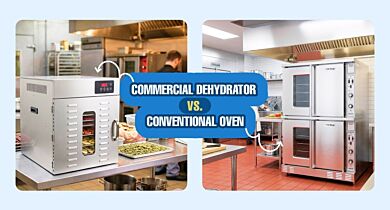
Commercial Dehydrator vs. Conventional Oven - The Real-World Comparison at a Glance

What to Look For When Making the Switch
If you're a restaurant owner, café operator, or food truck running regular food prep volumes, here's what actually matters when choosing a commercial dehydrator.
Match this to your real production volume. The Benchfoods 16-Tray model (28 sq. ft.) suits mid-volume cafés and catering operations well. For high-volume restaurant production, the Benchfoods 32-Tray (57 sq. ft.) handles serious batch sizes without requiring multiple runs.
Stainless steel interior and food-grade 304 stainless mesh trays are non-negotiable for commercial use. They're easy to clean, built to last, and compliant with food safety standards.
A 99-hour timer with temperature memory means your settings are repeatable from one batch to the next. No recalibrating every time.
For commercial kitchens, horizontal airflow ensures every tray dries evenly without needing to rotate anything mid-cycle.
Ready to add a commercial dehydrator to your kitchen setup? Explore Zanduco's full range of commercial smokehouses and dehydrators or talk to the Zanduco team for a personalized quote on the right model for your operation.