 Free Shipping (On select items & orders)
  Track My Order


Imagine it's a Friday night, tickets are stacking up, and your soup station cook is ladling French onion soup into bowls as fast as they can move. Nobody's measuring. Nobody's counting. And nobody's noticing that every bowl is getting closer to five ounces than four.
Multiply that by 120 soup covers in a Friday service, across 50 Fridays a year, and you've just given away 30,000 extra ounces of soup. That's roughly 235 gallons, without a single order of it appearing on a receipt.
This isn't a dramatic scenario. It's Tuesday in most restaurants. Food cost discussions tend to revolve around supplier pricing, protein yields, and menu engineering. But one of the quietest, most consistent leaks in any kitchen is sitting right on the line station: the wrong ladle, or the right ladle being used wrong.
The fix isn't complicated. It doesn't require new software, a consultant, or a menu overhaul. It requires putting the right ladle size at the right station and making sure your team knows why it matters. This guide walks through every practical size in commercial ladle use and what each one is actually designed to do.
Why This Matters Now
Food costs are up across the board. The National Restaurant Association's 2025 State of the Restaurant Industry report put food-and-beverage costs as the number-one operational concern for U.S. operators, ahead of labor, ahead of rent. When margins are squeezed at the supplier end, the only lever you fully control is what leaves the kitchen. Portion discipline is that lever. And ladles are where portion discipline either holds or breaks.
How Much Money Is Leaving Your Kitchen in a Ladle Bowl?
Let's put some numbers on this before diving into sizes. A 4 oz ladle delivers one standard cup serving of soup. If a cook consistently uses a 6 oz ladle at that station instead, either because that's what was stocked, or because it "feels" right, they're over-serving by 50% on every single bowl.
If your house soup costs $0.40 per ounce to produce, that two-ounce overage costs $0.80 per bowl. At 80 bowls per service, that's $64 per night. Over a 300-day year, you've spent an extra $19,200 on soup that was given away, not sold.
That number changes depending on your menu and volume, but the principle is universal: in a commercial kitchen, ounces are dollars. The right ladle at the right station isn't a pedantic detail, it's a financial control.
Now here's the flip side that operators sometimes overlook: under-portioning is also a problem. If guests are consistently served noticeably less than they expect, or less than what's described on your menu, that erodes trust. The goal isn't minimum, it's consistent. Consistent means predictable costs and predictable guest experience. That's the whole game.
Quick Tip for Restaurantaurs restaurateur
Run a 30-second audit on your line right now: pick up the ladle at your soup station and check what it actually holds. Fill it level, pour into a measuring cup. Does it match your recipe spec? If not, that gap is costing you money every single service and it has been for a while.
How Do You Know Which Ladle Size Belongs Where?
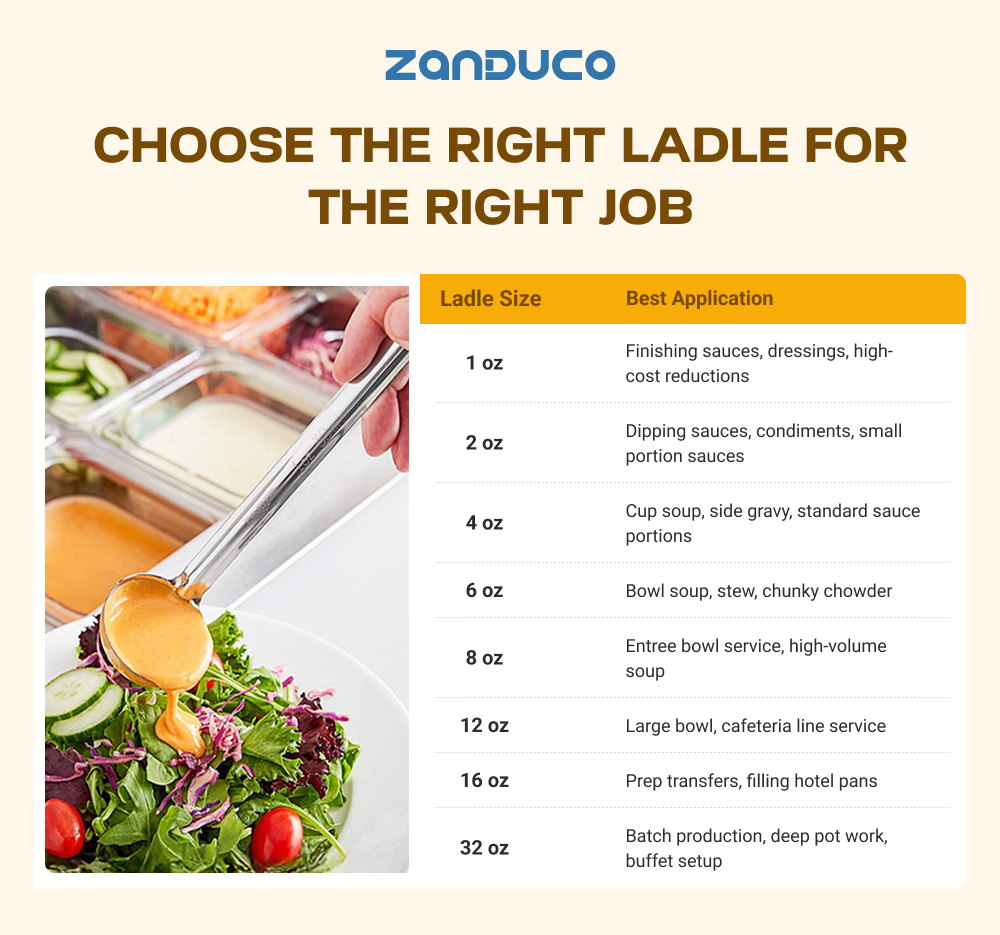
Commercial ladles are sized in fluid ounces, and they run from as small as 1 oz all the way up to 32 oz. Each size exists for a reason, not as an arbitrary catalog decision, but because different applications genuinely need different capacities. Here's how to think about the full range.
1 oz and 2 oz Ladle
These are for applications where accuracy isn't just a preference, it's the dish. Hollandaise on eggs Benedict. A finishing drizzle of beurre blanc. House vinaigrette on a composed salad. Chili oil on a shared plate. High-end reductions and emulsified sauces that cost $8–$12 per quart to produce.
At this scale, an extra half-ounce per plate can quietly destroy your recipe margin. A 1 oz ladle removes the guesswork entirely, your cook fills it level, pours it, done. The dish is consistent. The cost is controlled.
These small ladles also see heavy use in bar programs and craft cocktail-forward concepts for portioning cordials, bitters, and specialty syrups into large-format batched drinks.
FEATURED PRODUCT
Omcan 1 oz Two-Piece Stainless Steel Ladle - 12" Handle
Omcan 2 oz Two-Piece Stainless Steel Ladle - 12" Handle
4 oz and 6 oz Ladle
If there's a standard commercial ladle, it lives here. The 4 oz ladle is the industry baseline for a single serving of soup, filling a 6–8 oz cup with room for garnish and visual headspace. It's also the right tool for side sauce service, gravy portioning on entrees, and any application where you're serving liquid components that are priced and costed per portion.
The 6 oz ladle steps in for heartier bowl servings and chunky soups like beef stew, clam chowder, loaded potato soup, where the denser ingredients mean you need more volume to deliver a satisfying portion. It also works well for cafeteria and institutional service where throughput speed matters and a slightly larger ladle reduces the number of scoops per station.
A common mistake: operators use these two sizes interchangeably because they look similar. They are not interchangeable. Swapping a 4 oz for a 6 oz at a cup soup station is a 50% over-serve every time. Keep them on separate stations, labelled.
Pro Tip: Label Your Ladles by Application
Take a piece of prep tape and write the station and portion spec on the handle of each ladle: '4 oz - Cup Soup,' '6 oz - Bowl Stew.' This takes 30 seconds and eliminates one of the most common line errors during high-volume service. New hires especially will thank you and so will your food cost report.
FEATURED PRODUCT
Omcan 4 oz Two-Piece Stainless Steel Ladle - 14" Handle
Omcan 6 oz Two-Piece Stainless Steel Ladle - 14" Handle
8 oz and 12 oz Ladle
These sizes are where full-service restaurants running soups as a prominent menu category need to live. An 8 oz ladle is ideal for a standard entree soup bowl as it delivers a satisfying fill in a single pour without overflow or mess. A 12 oz ladle handles oversized specialty bowls, family-style service, or any situation where a single generous pour is better than two smaller ones for speed and presentation.
The 12 oz range is also where many cafeteria and buffet operations do their serving work. It's fast enough for line throughput while still being precise enough for documented portion sizes which is important in any institutional setting where nutritional records matter.
Something to watch at this capacity: bowl deformation. Cheaper ladles at 8–12 oz capacity are more likely to have thin-gauge bowls that warp under repeated scooping of thick stews. A warped bowl doesn't hold its rated capacity accurately, meaning your portion control breaks down silently, even when staff are doing everything right. This is one reason commercial-grade construction matters more as capacity increases.
FEATURED PRODUCT
Omcan 8 oz Two-Piece Stainless Steel Ladle - 14" Handle
Omcan 12 oz Two-Piece Stainless Steel Ladle - 14" Handle
16 oz and 32 oz Ladle
At this scale, you're no longer really portioning, you're moving product. These ladles are built for prep work: ladling stock into cooking vessels, transferring soups from prep pots to hotel pans before service, filling chafing dishes at buffet setup, or doing the initial ladle from a 20-quart stock pot to a 6-quart steam table insert.
Speed and durability are the priorities here, not precision. Your cook is making 40 transfers in the first hour of prep, they need a ladle that doesn't flex, doesn't drip from a loose weld, and can be thrown in the dish machine without a second thought.
The extended handle on the 32 oz model deserves specific mention. When you're working over a deep commercial stock pot, a shorter handle means your cook's arm is going into the steam zone on every pour. A 16-inch handle keeps the hand well above the heat source. It's a safety feature as much as it is an ergonomics one.
FEATURED PRODUCT
Omcan 16 oz Two-Piece Stainless Steel Ladle - 14" Handle
Omcan 32 oz Two-Piece Stainless Steel Ladle - 16" Handle
Choose the Right Ladle for the Right Job
If you're outfitting a new station or auditing what you currently have on the line, use this as your baseline guide:
How Many Ladles Does Your Kitchen Actually Need?
This is the question operators ask least often and regret most. The answer isn't "one per station", it's "enough to keep every station equipped through a full service cycle, including cleaning time."
Think about the flow: a ladle on the line during service eventually goes to the dish machine. In a high-volume operation, the dish machine cycle is 2–3 minutes, plus loading, unloading, and drying time. If you only have one 4 oz ladle and it goes to the dish room mid-service, your soup station is offline until it comes back. That's a real operational gap.
A practical baseline for most restaurant kitchens can be two of each active service size, with one spare in a clean drawer for coverage. For sizes you use in high-volume prep (16 oz, 32 oz), three is the right number. Cafeteria and catering operations running multiple simultaneous stations should multiply accordingly.
Stocking Checklist for a Full-Service Restaurant
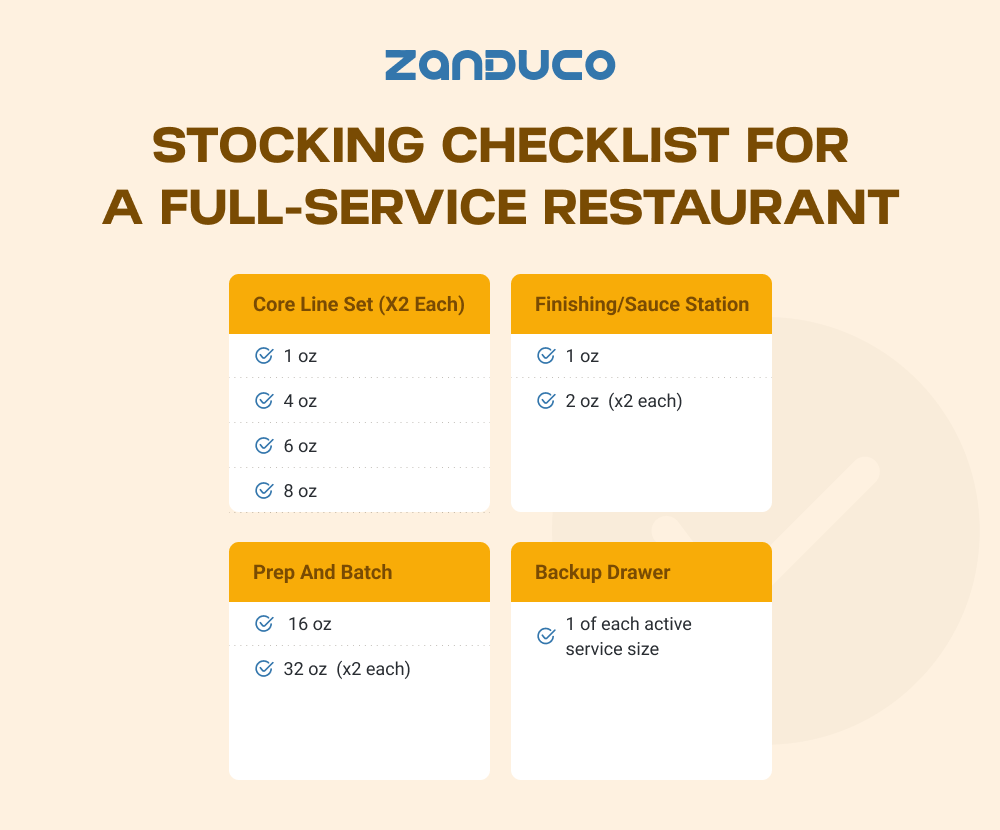
Adjust based on your menu, if you run 4 soups, add a second 8 oz ladle per station.
So, What’s the Bottom Line of this all?
Ladles are one of those pieces of equipment that operators think about once when they first open or restock and then stop thinking about until something goes wrong. The irony is that because they're inexpensive, the cost of getting them wrong is invisible. It doesn't show up as a single large number on a P&L; it shows up as chronic food cost variance that everyone blames on suppliers.
Getting your ladle size right for each station is one of the simplest, fastest changes you can make to tighten food cost control. It doesn't require capital expenditure. It requires the right tools on the line and a team that understands why they're there.
Ready to Audit and Restock Your Ladle Set?
Zanduco carries the complete Omcan stainless steel ladle range from 1 oz to 32 oz, plus Vollrath's Jacob's Pride one-piece series, all with competitive pricing and a Price Match Guarantee.
Browse the full selection right away, and if you need a complete kitchen tools kit, check our full range.


