Free Shipping (On select items & orders)
  Track My Order


Posted in: Commercial Kitchen Equipment
If your pasta station feels smooth at 5:30 pm and chaotic by 7:15 pm, the issue is rarely “the pasta.” It is the method, the handoff, and what your team does when tickets stack up. The best cooking method is the one that matches your kitchen’s real constraints: heat, space, staffing, and whether you cook to order or batch ahead.
This US-focused guide keeps it tight and practical. You will leave with (1) a clear pick based on your kitchen type, (2) the compliance checkpoints that matter most for pasta workflows, and (3) a station setup approach that holds up on a busy night.
Let’s get on the same page…
Here’s what you are actually choosing when you pick steam, induction, or pressure:
Steam cooking
A consistency play. You’re building a repeatable rhythm and reducing variables when the line is busy.
Induction cooking
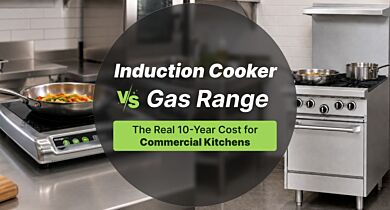
A control play. You get fast response with less ambient heat. The US Department of Energy notes induction can be up to three times more efficient than gas. The Department of Energy's Energy.gov
Pressure cooking
A speed play. Faster cook times, but only if your SOPs and training are tighter than your ticket times.
If you want a simple shortcut, steam rewards process, induction rewards agility, pressure rewards discipline.
The two compliance moments pasta stations fail (and why)
Local requirements vary by state and county, but most US operators run into the same two risk points: holding and cooling. These rules matter because bacteria multiply quickly when food sits in the temperature “danger zone,” roughly 40°F to 140°F.
-
Hot holding is not “keep it warm”
Many health departments align with Food Code concepts of holding hot TCS foods at 135°F or above. This matters for pasta because “parking” product between rushes is a common habit, and it is exactly where operators drift into unsafe temps.
-
Cooling is where good kitchens get in trouble
If you cook ahead, the standard two-stage cooling guidance is:
- 135°F to 70°F within 2 hours
- 70°F to 41°F within 4 more hours (6 hours total)
This is not paperwork. It is a system that prevents a busy night from turning into waste, rework, or worse.
Which kitchen are you running on a Saturday night?
Kitchen Type 1: If your line is hot, cramped, and always in motion
Think food halls, tight urban kitchens, fast casual, small Italian concepts, or any operation where the pasta station lives in a corner and still has to perform.
Best fit: Induction, often paired with a countertop pasta cooker station
Induction wins here because it gives you control without turning the line into a heat trap. If you are fighting HVAC load and staff comfort, induction helps. It is also an efficiency story, and the DOE’s efficiency comparison is one of the clearest ways to explain the “why” to owners.
What makes this setup actually work
Portions are controlled: baskets or measured drops so the station stays consistent when tickets spike.
The handoff is designed: a defined drain zone and a defined sauce finish zone, not “wherever there’s space.”
Common failure points
Cookware chaos: induction needs induction-ready pots, so you standardize, label, and train.
Starch management gets ignored: skim, refresh, and clean on a timer, not only at close.
If you are building a compact, repeatable pasta corner, start with the Zanduco Pasta Cookers category and filter down to the size and configuration that fits your footprint.
Kitchen Type 2: If you run steady volume and need repeatability across shifts
Think classic pasta houses, busy full-service restaurants, and multi-shift kitchens where consistency matters as much as speed.
Best fit:
Steam
Steam is a consistency machine when your workflow is stable. It supports repeatable output across shifts because the process is easier to standardize than “everyone boils pasta their own way.” The kitchens that do best with steam treat the station like a production line: portion, cook, drain, finish, reset.
What makes steam a strong match
You can run a cadence: fewer last-second improvisations.
You can standardize portions: same basket, same timing, same finish routine.
Where steam kitchens get burned
Handoff bottlenecks: pasta comes off heat and waits because sauce, bowls, or plating is behind.
Batching without a holding or cooling plan: this is where compliance problems show up fast.
If steam is your choice, write one short station SOP: “What happens in the first 30 seconds after pasta is done?” That alone improves speed and safety.
Kitchen Type 3: If you batch cook and your risk is in cooling, not boiling
Think caterers, banquet kitchens, campuses, commissaries, and multi outlet concepts where pasta has to be ready in volume, on schedule, without the line cooking every portion from scratch.
Best fit:
Pressure, but only if you can run disciplined cooling and reheat routines
Pressure cooking can be a real throughput win in batch-first kitchens. But it is not a shortcut. The moment you batch pasta, your biggest risk shifts from cooking to what happens next: cooling, storage, and reheating. This is where many operators drift into compliance trouble without realizing it. FDA-style guidance uses the two-step cooling window: 135°F to 70°F within 2 hours, then 70°F to 41°F within 4 more hours.
What makes this setup actually work
Batches are treated like inventory: portioned into shallow pans, labeled, dated, and staged with a plan, not dumped into deep containers “for later.”
One release routine, one SOP: pressure only works when every operator follows the same steps, every time.
Cooling capacity is built in: space, airflow, and containers sized for your largest run so you can hit the cooling window consistently.
Where batch kitchens fail
The walk-in cooler myth: putting hot product into a packed cooler and hoping it chills fast enough. Storage is not the same as active cooling.
Inconsistent reheat and holding: staff “warms it up” without verifying temps, then holds it in the gray zone during service.
If staffing and training are inconsistent, pressure is usually the wrong bet. Steam or a simpler cook and finish workflow tends to hold up better.
Steam, Induction, or Pressure - The decision table
| Your kitchen reality | Best default method | Why it usually wins | Primary watch-out |
|---|---|---|---|
| Hot line, tight space, cook-to-order | Induction cooker | Control with less ambient heat, compact station footprint | Cookware standardization, starch management |
| Predictable volume, multi-shift consistency | pasta cooker | Repeatable cadence, easier training | Handoff bottlenecks, batching shortcuts |
| Batch-first catering or commissary | High Output Pasta Cooker | Throughput potential | Training discipline, cooling control |
If you are buying equipment, here’s what actually matters
This is where “conversion” happens, because readers want to know what to look for without getting sold to.
When evaluating a pasta station (especially a countertop pasta cooker), focus on:
- Throughput you can sustain: baskets, tank capacity, and recovery speed should match peak, not average.
- Drain and overflow realities: where the water goes, how staff drains safely, and how you avoid spills across prep zones.
- Cleaning and access: starch and scale build up. Easy access wins.
- Training simplicity: fewer steps means fewer mistakes.
- Layout fit: a station is not the cooker alone. It is cooker + landing zone + finishing zone + cleaning plan.
Zanduco’s Pasta Cookers category is a practical starting point for comparing station sizes and configurations.
Where fresh pasta production fits
If you are considering fresh pasta, this is the part many operators underestimate! Production changes service rhythm and raises consistency expectations.
- A pasta extruder helps you produce consistent shapes at volume, but it also increases the need for repeatable cooking and holding.
- A pasta sheeter supports lasagna sheets and stuffed-pasta workflows, but it increases flour management and staging needs.
If you invest upstream in production, your cooking method should reduce variability downstream. This is why steam or a well-controlled countertop pasta cooker station often pairs better with fresh pasta programs than “everyone boils their own pot.”
The routine that keeps you compliant and faster
Keep this simple enough that your team will actually follow it:
- Decide your operating model: cook-to-order or batch-first. Mixing both without rules creates drift.
- Lock the handoff: drain, sauce, plate, or cool. No “figure it out” moments.
- Respect the danger zone: avoid leaving perishable foods in 40°F to 140°F conditions, where bacteria multiply quickly.
- Use the core temperature targets: hot holding at 135°F+, and the two-stage cooling window when batching.
- Make cleaning automatic: set a timer-based reset so starch does not quietly kill consistency.
What wins long-term
A pasta method is not a personality choice. It is an operations choice.
When steam, induction, or pressure matches your kitchen type, the station gets calmer. Tickets move. Portions stay consistent. New staff can follow the system without improvising. And the biggest win is the quiet one: you stop relying on “keeping it warm” or cutting corners when the rush hits.
That is what compliance really buys you in the US market. Fewer remakes, less waste, cleaner logs, smoother inspections, and a pasta program you can scale without stress. Speed is good, but repeatable speed is what protects margin.
Ready to make the pasta station easier to run
If your method supports clean holding and cooling habits, service gets faster and inspections get simpler. That is the difference between a pasta program that feels fragile and one that scales.
Build your setup with Zanduco, from the right station pieces, starting with pasta cookers (including countertop pasta cooker options), and expand into fresh production later with a pasta extruder or pasta sheeter when the volume justifies it.
Frequently asked questions:
1. Is steam, induction, or pressure cooking better for pasta?
It depends on how you run the service. Steam favours consistency, induction favours control in tight spaces, and pressure only pays off if your team is very disciplined.
2. When does an induction pasta cooker make sense?
Induction suits hot, cramped lines where ambient heat is already a problem. You get fast response, less heat on the cook, and strong energy efficiency compared to gas.
3. Why do so many high-volume kitchens choose steam pasta cookers?
Steam works well when volume is steady, and you want the same result across shifts. It is easier to standardize baskets, timing, and handoff so every cook follows the same rhythm.
4. How should I set up a pasta station for a small, busy kitchen?
Keep it compact: induction or a small pasta cooker, a clear drain/landing zone, and a defined sauce finish spot. The goal is no guessing when tickets spike - everyone knows the path from pot to plate.
5. Where do pasta extruders and sheeters fit into the setup?
Use a pasta extruder when you are producing fresh shapes at volume and need consistency. A pasta sheeter fits when you are doing sheets and filled pasta and need more space for flour, staging, and careful handling.