Free Shipping (On select items & orders)
  Track My Order



Posted in: Commercial Ice Machines
The range anchors the hot line. It gets specified before almost anything else in the kitchen and replaced long after the rest of the equipment has turned over. Specify it well and it disappears into the background of a smooth service for a decade or more. Specify it on price alone and you feel it in slow recovery between tickets, uneven bakes, and a service call every few months.
This guide compares four commercial range brands Zanduco stocks and ships across the US: Vulcan, Garland, American Range, and the Zanduco house line. Two of them, Vulcan and American Range, are built in the United States, which matters to a lot of operators. A commercial range, also called a commercial stove, pairs open burners with an oven base on one frame. Each brand here sits at a different point on the price and duty curve, so the right answer turns on your volume, your menu, and the line you already run. Here is how an equipment specialist works through the decision.
The quick verdict
- First range or a tight equipment budget: the Zanduco house line gives you a restaurant-grade gas range at the lowest entry price, backed by a price-match guarantee and a Rent-Try-Buy option.
- The premium pick and the US benchmark: Vulcan, built in the United States and the brand many operators default to for a hard-run, high-volume line.
- US-built heavy duty without the top-tier price: American Range, made in California, rugged welded frame, backed by a two-year parts warranty.
- The widest configuration and the most cooktop room: Garland, with high-output Starfire burners and a deep top for staging pots.
The sections below explain the reasoning behind each call.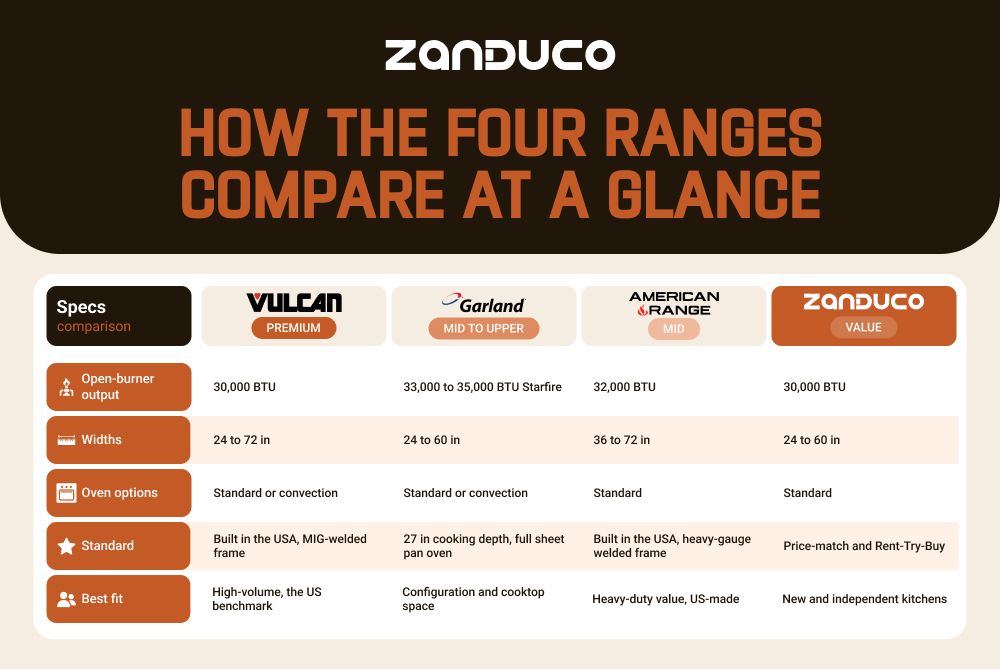
Pricing moves with availability, so confirm current figures on the live product page. Certain brands carry tariff surcharges that are worth raising before you order.
How To Evaluate A Commercial Range
The brand badge matters less than how a range is specified against your service. These are the factors that decide whether a purchase holds up.
Restaurant range or heavy-duty range
Before you compare brands, place the range in one of two classes. A restaurant range, sometimes called standard duty, uses lighter-gauge steel and burners around 28,000 to 33,000 BTU. It suits cafes, independents, and any line with steady rather than relentless volume, and it costs less to buy and run. A heavy-duty range uses thicker steel, higher-output burners, and a deeper frame built for a station that runs at full tilt all day. American Range's AR series and Vulcan's V series sit in this class. The Zanduco house line, Garland's Master and Sunfire series, and Vulcan's Endurance line serve the restaurant-range tier that most operators need. Match the class to your service before you weigh features, because a heavy-duty frame is wasted money on a light line and a standard-duty range wears out fast on a heavy one.
Sizing the cooktop to your covers
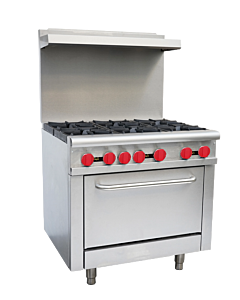
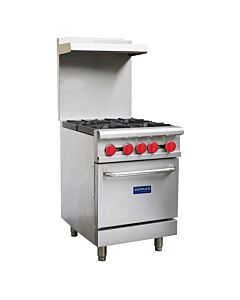
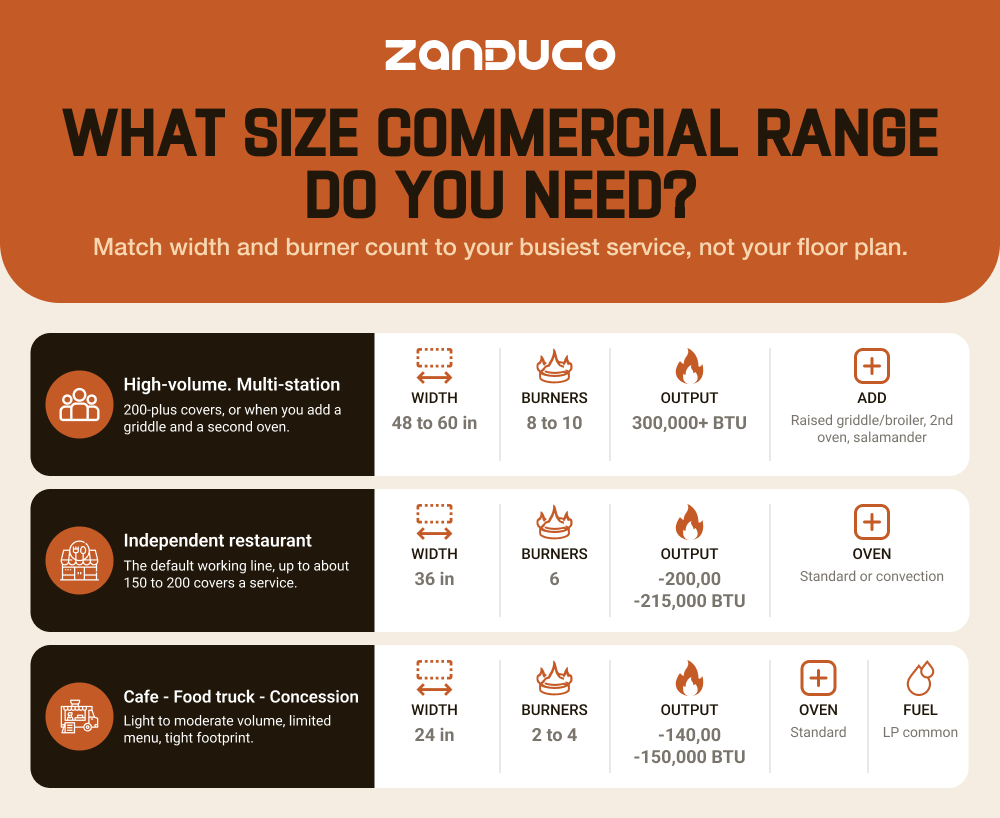
Burner count and width should follow your peak ticket count rather than your floor plan. A 24-inch range with two to four burners covers a cafe, a food truck, or a prep station on a limited menu. The 36-inch six-burner is the workhorse of the independent line, with enough top to hold stocks at the back and run saute at the front through a full rush. Past roughly 150 to 200 covers a service, or when you want a griddle and a second oven on one frame, step up to 48 or 60 inches. Buy for your busiest hour. A range that keeps pace at peak coasts through the rest of the day.
How to read BTU output
BTU per hour measures the heat a burner can produce. What matters in service is recovery, meaning how fast that burner brings a loaded pan back to temperature after cold product hits it. Garland's Starfire burners run 33,000 to 35,000 BTU and recover quickly under a full stockpot. American Range open burners run 32,000 BTU, and Vulcan and the Zanduco line sit near 30,000, which carries most lines without strain. All four put plenty of heat under a pan, so match output to how hard the burner will work in your kitchen, then treat the spec sheet as a guide rather than a verdict.
Cooktop configurations and the menus they suit
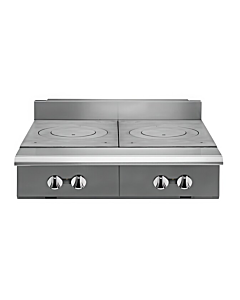
Open burners are the default for saute, sauce, and anything that needs direct flame and quick response. A griddle section suits a menu built on eggs, smash burgers, or flat-top breakfast volume. A hot top, a solid plate heated from below, spreads even heat across the whole surface for high-volume simmering and stockwork. A French top works the same way with a graded heat field that runs hottest at the center, which lets a cook hold several pans at different temperatures at once, the reason scratch and fine-dining kitchens favor it. Vulcan's V series offers a modular French top for exactly that work. Many ranges combine a few open burners with a built-in griddle so you cover two stations on a single frame.
Standard vs. convection ovens
The base oven is easy to overlook and expensive to under-spec. A standard oven handles roasting, holding, and finishing for a line that bakes occasionally. If you proof and bake through service, a convection base moves air for faster, more even results and fewer pan rotations. Garland's oven accepts a full sheet pan in either orientation, and both Garland and Vulcan offer convection bases. When oven demand is heavy enough to bottleneck the range, a dedicated convection oven alongside it usually pays back faster than buying a wider range.
Gas, electric, or induction
Match fuel to the supply already in the building. Natural gas where it is plumbed, liquid propane where it is not, and most models ship in both so you give up no features either way. Before you settle on a width, confirm your exhaust hood and make-up air can clear the total BTU load. A 310,000 BTU ten-burner under a hood sized for a six-burner becomes a heat and code problem from the first service. Verify clearances to combustible surfaces and plan the gas connector and pressure regulator into the install.
The four ranges compared here are gas, which most cook lines still prefer for instant flame and pan control. Electric ranges hold steady, even heat and fit sites with no gas line or where code limits open flame. Induction goes further, heating the pan directly through a magnetic field for fast response, a cooler kitchen, and high energy efficiency, though it needs induction-ready cookware and costs more upfront. Some cities now restrict new gas hookups, so check local code before you lock in fuel type.
Build quality, cleaning, and warranty
Frame and burner hardware separate a five-year range from a fifteen-year one. Look for a welded frame over bolted panels, heavy cast iron grates that sit flat under a loaded pot, lift-off burner heads, and a one-piece crumb tray a closing crew can pull and wipe in seconds. Vulcan uses a MIG-welded aluminized steel frame with lift-off heads, and American Range builds a heavy-gauge welded frame with two-piece lift-off cast iron burners, both signals of a range meant to run for years. Garland's two-piece burners and split grates break down quickly for cleaning. Every range here is built to commercial standards, and the sanitation mark to check is NSF/ANSI 4, the standard that governs cooking equipment cleanability. For how the safety and sanitation marks differ and which ones inspectors accept, see what NSF, UL, ETL, and CSA certifications mean.
Whatever you buy, register the warranty on delivery and read the labor terms, because that is where the real cost of a failure lands.
Total cost of ownership
Purchase price is the smallest number over a range's working life. Fuel draw, install, downtime, and replacement cycle dwarf it. A heavier range at a higher upfront cost that runs ten years without a major service routinely beats a budget unit you nurse along and replace in four. Weigh the sticker against duty rating, warranty, and how central the range is to your menu before you decide where to put the money.
The Four Ranges In Depth
Zanduco
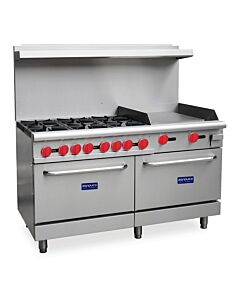
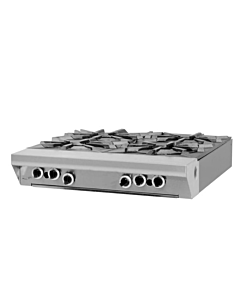
The Zanduco house line covers 24 to 60 inch widths with 30,000 BTU open burners and standard ovens. The 36-inch six-burner produces 211,000 BTU over a 5.58 cubic foot oven, enough top and base for a typical independent line. The 24-inch four-burner suits cafes and trucks, and the 60-inch model pairs six burners with a 24-inch griddle for kitchens that want both surfaces on one frame.
The case for it is total value. Pricing sits below the national brands, select models ship free, and the line carries a price-match guarantee and a Rent-Try-Buy option that lets a new operator spread the outlay. For a first range, a second unit on a growing line, or a moderate-volume kitchen, it delivers restaurant-grade cooking without paying for duty rating the menu will never use.
Step up when you bake through service and want convection, or when the line runs hard enough that frame and burner durability start to drive your annual cost. That is American Range and Vulcan territory.
Shop Zanduco Commercial Ranges
Garland
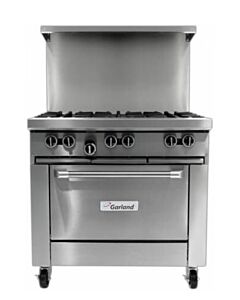
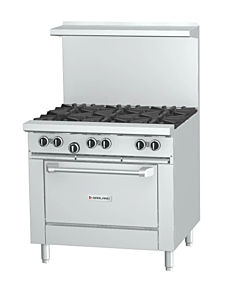
Garland brings more than 160 years of range building and a cooktop designed around the cook. Its Starfire and Starfire Pro burners run 33,000 to 35,000 BTU, the highest open-burner rating in this group, and the deep cooktop, up to 27 inches, gives a line room to stage pots front to back without crowding. The oven takes a full sheet pan in either orientation, which earns its keep in any kitchen baking off the range.
Where Garland stands out is configuration. Modular tops like the M44T drop onto a stand or counter for a custom build, the X, U, and G series span 24 to 60 inches, and hot top, raised griddle, broiler, and salamander options let you spec a range to an exact menu. Ten-burner models carry the highest-volume lines. Garland is the versatility pick rather than the heavy-duty benchmark, and one point worth knowing for buyers who care about sourcing: Garland is a Welbilt brand owned by the Italy-based Ali Group, and its ranges are built in Mississauga, Ontario, Canada, not in the US. Pricing runs mid to upper.
Shop Garland Commercial Ranges
American Range
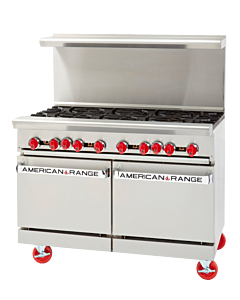
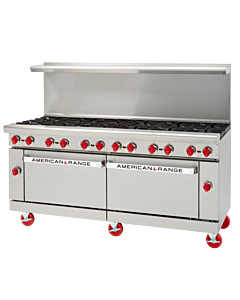
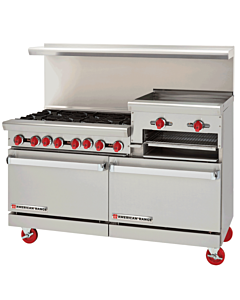
American Range builds every commercial range in the United States, at its plant in Pacoima, California, and has done so for more than 40 years. The brand joined the Hatco family in 2022. The AR restaurant range line is heavy-duty from the ground up: 32,000 BTU lift-off, two-piece cast iron burners, a heavy-gauge welded frame, a porcelain-coated oven interior, and a standing stainless steel pilot for each burner. Widths run from 36 inches up to 72 inches, and the catalog covers griddle combinations, raised griddle-broilers, French tops, and step-up burner layouts. The 60-inch AR-10 runs ten burners at 390,000 BTU over two ovens.
The appeal is a US-built, heavy-duty range at a lower price than the premium tier, backed by a two-year parts warranty on the AR line. For an operator who wants American manufacturing and a rugged frame without paying the top-tier premium, it is the value heavy-duty pick. It runs on standing pilots rather than electronic ignition, which some operators prefer for simplicity and others read as dated.
Shop American Range ranges
Vulcan
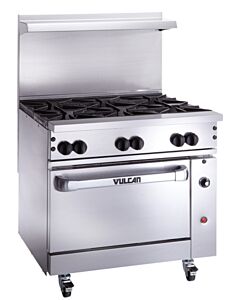
Vulcan is the name many US operators treat as the benchmark, and the reputation is earned over more than 150 years of building cooking equipment in the United States. Its ranges come out of ITW Food Equipment plants in the US, with the company headquartered in Baltimore, and Vulcan has been an ENERGY STAR Partner of the Year for years running. The Endurance Series 36-inch six-burner delivers 215,000 BTU through lift-off burner heads over a MIG-welded aluminized steel frame, paired with a 35,000 BTU convection oven that bakes evenly while the top runs flat out. The V series adds modular French-top and heavy-duty configurations for kitchens that want a graded heat field for sauce and scratch work.
This is the premium tier, and the build and support are the reasons. On a line that bakes and roasts through every service with the range pinned near full output, the frame, the burner hardware, and a nationwide service network return the investment over a long life. It costs more than the others here, which is the trade for buying the brand many kitchens consider the standard. For a light or moderate line, the Zanduco or American Range options put the money to better use.
Shop Vulcan Commercial Ranges
Browse the full lineup on the commercial gas range and commercial electric range pages, or read how to size a commercial range and selecting the ideal commercial range for more depth.
Matching A Range To Your Operation
Cafes, food trucks, and concessions
A 24-inch range with two to four burners on liquid propane fits a limited menu and a tight footprint. Add a compact griddle if breakfast or flat-top items drive the ticket.
Independent full-service restaurants
The 36-inch six-burner is the workhorse of the independent line for good reason. It holds stocks at the back and runs saute at the front through a full rush, and every brand here builds one. Choose a convection base if you bake on the line.
High-volume and multi-station kitchens
Move to 48 or 60 inches and split the top across burners, a raised griddle or broiler, and a second oven base. This is where Garland's configuration catalog, American Range's 60 and 72 inch heavy-duty models, and Vulcan's duty rating earn their cost. Add a salamander or hot top section if the menu calls for it.
Common Mistakes to Avoid
- Buying on sticker price alone. A cheap range that fails in four years costs more than a sturdier one that runs ten. Weigh duty rating and warranty, not just the number on the tag.
- Oversizing the range. A 60-inch unit on a line that needs 36 inches wastes money and floor space, and it overruns a hood sized for less.
- Under-sizing ventilation. Picking the range before checking hood and make-up air capacity is the most common and most expensive miss, because the fix often means a new hood.
- Ignoring cooktop depth and layout. Burner count gets the attention, but a shallow top crowds pots and slows the line. Match the configuration to how your cooks move.
- Skipping the fuel check. Ordering a natural gas range for a propane site, or the reverse, means a conversion or a return. Confirm the supply first.
- Forgetting the extras. A connector kit, casters, and warranty registration are easy to overlook and can hold up the install.
Before You Place The Order
- Confirm natural gas or liquid propane to match your building's supply.
- Size your hood and make-up air to the range's total BTU before choosing a width.
- Verify clearances to combustible surfaces and plan the gas connector and regulator.
- Confirm the range carries an NRTL safety mark and NSF/ANSI 4 sanitation certification for your inspection.
- Ask about current tariff surcharges, which apply to certain brands.
- Arrange freight, liftgate, and inside delivery for a unit that can top 500 pounds.
- Register the manufacturer warranty the day it arrives.
What Else You Will Need
A range rarely goes in alone. Budget for these alongside it:
- Ventilation. A Type I exhaust hood with make-up air, and in most jurisdictions a fire suppression system over any gas cooking line. Size the hood to the range before you buy either.
- Gas connection. A commercial gas connector kit with a quick-disconnect and restraining cable, plus the correct pressure regulator for natural gas or propane.
- A finishing station. Many lines add a cheese melter or salamander broiler above the range for browning, melts, and gratins without tying up the oven.
- Countertop cooking. A countertop griddle or charbroiler extends the line when a full second range is more than you need.
- Casters or legs. Adjustable legs level the unit; heavy-duty casters with front locks make cleaning behind the range easier.
Keep a finishing unit close to the pass so plated food moves in and out in one step.
Talk To A Range Specialist
Specifying a range comes down to volume, menu, and the line you already run. Zanduco has supplied commercial kitchens across the US for 60 years, and the team sells and ships Vulcan, Garland, American Range, and the house line every week. We can match the right duty rating to your kitchen, then sort fuel type, freight, and install before you commit. Browse commercial ranges, request a quote, or call 1-855-926-3826.