Free Shipping (On select items & orders)
  Track My Order


Posted in: Commercial Kitchen Equipment
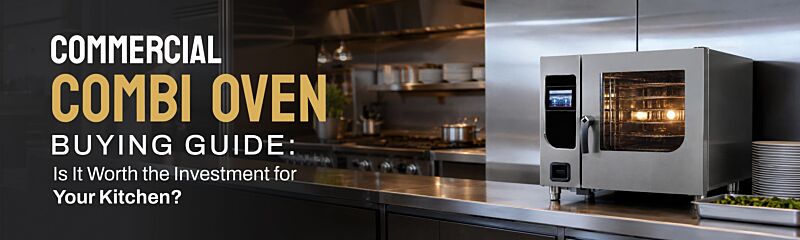
A combi oven is usually the most expensive box in a Canadian kitchen that isn't a walk-in. The sticker gives most owners pause, and it should. You are looking at a number that sits somewhere between a good used car and a small mortgage down payment, and the person selling it is telling you it does the work of three appliances you already own.
In some kitchens, a combi earns that price back and then some. In others, it ends up in the corner at a fraction of its capacity, an expensive convection oven with a steam button nobody touches. The oven is rarely the reason for the gap. What matters is whether the kitchen, the menu, and the budget were a fit before anyone signed the cheque.
This guide covers the calls that decide it: how a combi works, boiler versus boilerless, sizing, gas versus electric, what it costs in Canada with installation and venting counted in, and which rebates you can claim. Straight trade-offs, no sales gloss.
Quick answer: A commercial combi oven is worth it if you run steady volume, cook proteins and baked goods that benefit from humidity control, and want to consolidate a convection oven, steamer, and holding cabinet into one footprint. It is harder to justify for a low-volume café, a fryer-heavy menu, or a kitchen that cannot support the electrical, gas, water, and venting it needs. Expect roughly CAD $14,000 to $30,000 for a 6-pan unit and CAD $45,000 to $80,000 or more for a 20-pan floor model, before installation. Premium brands are quote-based and run higher.
One Box, Three Ways to Cook
A combi oven runs three cooking modes in one chamber: convection (dry circulated air), steam (moist heat), and combination, where you set the humidity level yourself. Combination mode is what people pay for. Holding 40 percent humidity while you roast is what gives you chicken with crisp skin and meat that hasn't dried into the pan.
One combi can roast, bake, steam, braise, poach, proof, and rethermalize. It stands in for a convection oven and a steamer, and at low temperature with high humidity it holds finished food like a holding cabinet. If you are still weighing a straight convection oven against a combi, our rundown on what commercial convection ovens do well is worth reading first.
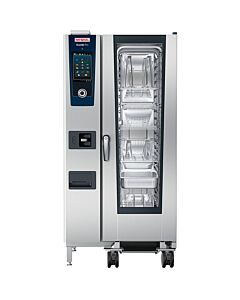
Most units are built around Gastronorm (GN) trays. A GN 1/1 pan measures roughly 530 x 325 mm (about 20 x 12 in), and combis are sold by how many of those trays they hold, from compact 6-pan countertop models up to 20-pan floor units.
Worth noting: humidity control is the reason to spend on a combi. Run a menu that is mostly fried and flat-top items and you are paying for a feature you will barely touch. A solid convection oven and a dedicated fryer would serve that kitchen better.
Does the Math Work for Your Kitchen?
The case for a combi almost never comes down to one dish. It comes down to consolidation, consistency, and yield across a full shift.
Consolidation is the easy one. A single combi replaces two or three separate machines, which buys back floor space. In a cramped downtown Toronto or Vancouver kitchen where every square metre is spoken for, that space can matter as much as the cooking.
Consistency is where a combi earns its price. A line cook loads the pan, selects a saved recipe, and walks away, and the plate that comes out at 8 p.m. on a Saturday matches the one from the tasting. In a market where staffing turns over fast and training time is thin, repeatable output is worth a great deal.
Yield closes the argument. Cooking with steam and convection together holds moisture, so proteins shrink less and you plate more portions from the same case of chicken or beef. Manufacturers cite higher yield and faster cook times, and the direction is right, though the size of the gain depends on your product and your programming. Test it against your own menu before you bank on any single number.
The numbers stop working in a few places. A café doing 40 covers a day. A pizzeria built entirely around its deck oven. A kitchen that would need a costly electrical or gas upgrade before the combi could run at all. In those rooms the payback stretches past the point of sense.
Boiler or Boilerless? Which One Fits Your Menu
This choice drives price, maintenance, and how the oven copes with Canadian water. Worth getting right.
A boiler (steam-generator) model heats water in a dedicated tank and pushes out strong, continuous steam. It suits kitchens that steam hard: seafood houses, high-volume vegetable prep, banquet cooking. The cost is a higher price, more upkeep, and a serious appetite for scale in hard-water areas, since minerals build up fast in the tank.
A boilerless model sprays water onto a hot element to make steam on demand. It costs less, cleans up easier, and forgives more. What you give up is sustained steam output when you are steaming in volume.
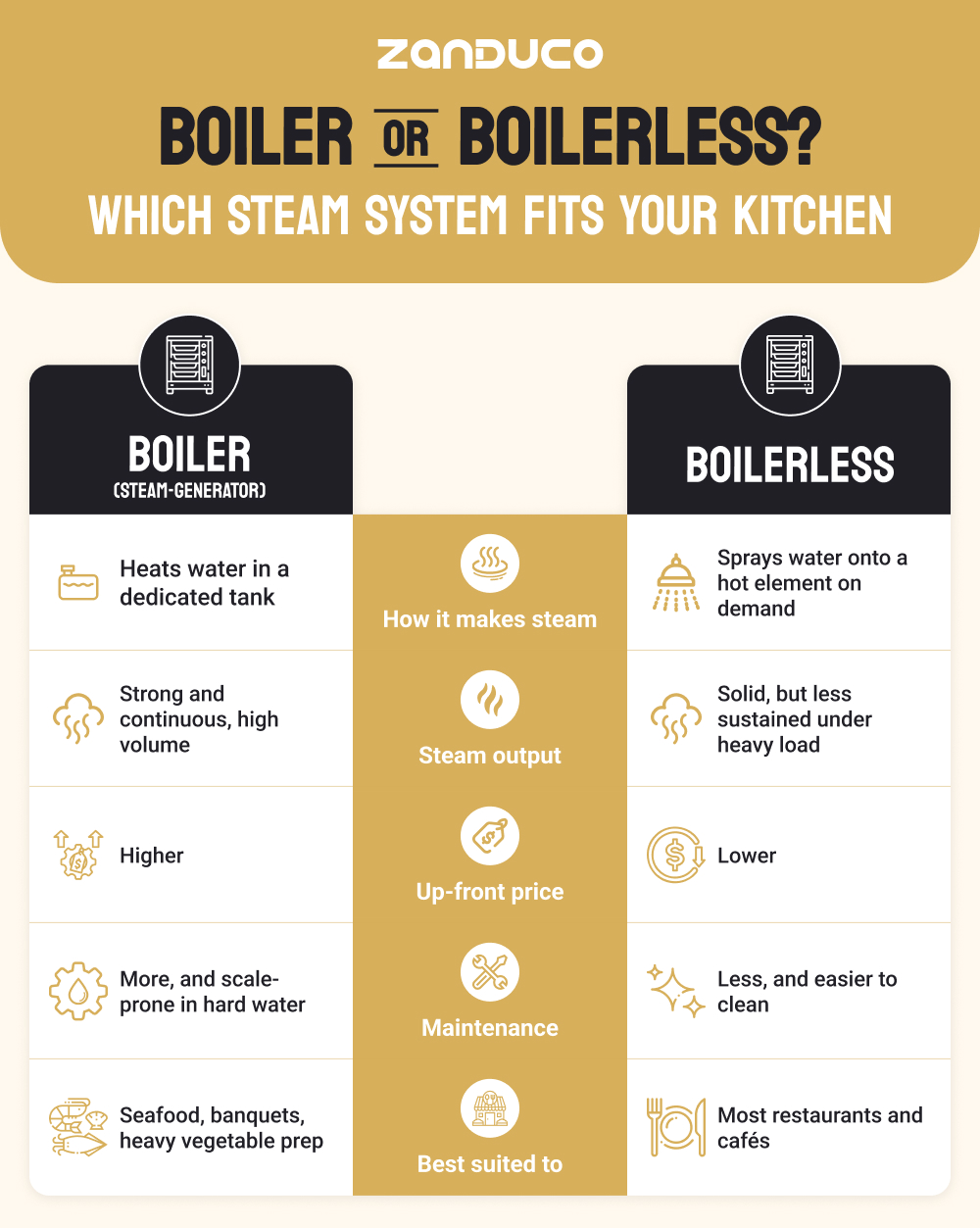
For most Canadian restaurants and cafés, boilerless is the sensible default. Run a hotel banquet kitchen or a production operation that steams all day, and the boiler model earns its keep.
Common mistake: buying the boiler model because it reads as the premium choice, then paying for descaling calls on steam capacity you never use. Buy the steam system your menu needs, nothing more.
How Many Pans Does Your Kitchen Need?
Size to your peak hour. The daily average will lie to you. An oven that copes on a slow Tuesday but jams every Friday night was bought too small.
A rough guide by kitchen type:
| Kitchen type | Combi size | Why |
|---|---|---|
| Café, food truck, ghost kitchen, small bakery | 6-pan (GN 1/1) countertop or compact | Fits tight spaces, covers lower volume |
| Mid-size restaurant | 6- or 10-pan floor unit | Keeps service moving without stalling |
| Hotel, banquet kitchen, caterer, institutional | 20-pan floor or roll-in, sometimes double-stacked | Handles volume and large-tray work |
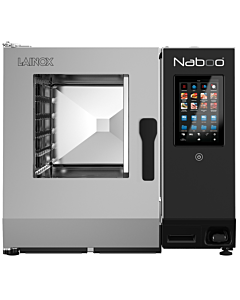
For the compact end, the Lainox Naboo electric combi is a good smart unit in that class.
Plan the room around it too. Leave clearance for the door swing, service access, and a landing surface beside the oven. Think one step downstream as well, because a combi paired with a blast chiller is the spine of a cook-chill program if batch prep is where you are heading. The full combi oven range lets you line up pan counts side by side.
Gas or Electric, and the Venting You Can't Skip
Electric models install more simply wherever you have the panel capacity, hold steady heat, and work in kitchens with no gas line. Gas models suit high-output kitchens and can run cheaper depending on local energy rates, though they bring gas-line work and extra certification into the job.
Then comes venting, the step that catches Canadian buyers off guard. Most combi ovens have to sit under a commercial hood to meet code, and that hood is a budget line of its own. Ventless electric models exist, but never assume you can skip the hood on the strength of a spec sheet. Get the requirement in writing from your local health and building authority first, because it shifts by municipality and by province.
What a Combi Oven Costs You in Canada
The oven price is only where the budget starts. Installation, venting, water treatment, and servicing all belong in the total. The ranges below are approximate CAD figures to plan against. The equipment tiers move with brand, configuration, and market, and the install lines move with the state of your site, so treat everything here as a planning bracket rather than a quote.
| Line item | Typical CAD range | Notes |
|---|---|---|
| 6-pan combi (compact / half-size) | ~$14,000 to $22,000 | A compact electric model such as the Lainox Naboo lists from roughly $14,550 at Zanduco |
| 6-pan combi (full-featured floor unit) | ~$18,000 to $30,000+ | Premium brands run higher; Rational combis are quote-based, with financing from roughly $490/mo and up |
| 10-pan floor combi | ~$25,000 to $45,000 | Rational 10-pan gas financing sits around $1,150 to $1,475/mo |
| 20-pan floor / roll-in combi | ~$45,000 to $80,000+ | Large Rational units finance from roughly $1,490 to $2,070/mo |
| Installation (gas, electrical, plumbing, drain) | ~$2,000 to $8,000+ | Highly site-dependent; gas conversions add cost |
| Ventilation hood (if required) | ~$3,000 to $12,000+ | Often the surprise cost; confirm code first |
| Water filtration / treatment | ~$300 to $1,500 | Needed in hard-water regions |
| Annual servicing and descaling | ~$500 to $1,500 / year | Boiler models trend to the higher end |
Two honest notes on this table. The compact tier is anchored to a live Zanduco price. The larger equipment tiers and the install lines are general Canadian-market planning estimates, because premium brands like Rational are sold on a request-a-quote basis rather than a fixed shelf price, with published monthly financing figures instead. Use the table to size your budget, then pull a real quote for your exact model and site.
Kitchen planning tip: work out the full installed cost before you fall for a model. An $18,000 oven can turn into a $28,000 project once a new hood and a gas line go in. Financing spreads that load, and Zanduco's equipment financing is set up for purchases like this.
Certification, Rebates, and the Canadian Fine Print
Two things to lock down before the truck arrives: certification and rebates.
Certification first. The oven needs a safety mark from a body accredited by the Standards Council of Canada, and CSA is not the only one that qualifies. Marks like cULus and cETL carry the same legal weight, and gas units also have to meet the CSA B149 installation code. If that is new territory, our guide to how SCC-accredited certifications work in Canadian kitchens spells out what to check on the spec sheet so a missing "c" doesn't cost you an inspection.
Rebates are money most owners walk away from. In Ontario, Zanduco flags qualifying high-efficiency natural gas combi ovens as eligible for a local energy rebate tied to Enbridge Gas, which is worth confirming before you buy since it comes off the cost of an ENERGY STAR unit. Check the current terms and eligible models on Zanduco's energy rebate page, and confirm you sit inside Enbridge Gas service territory. A high-efficiency combi also earns its keep on running costs over the years, which is the quieter half of the rebate argument.
Outside Ontario, ask your own utility. In British Columbia, FortisBC runs commercial foodservice efficiency offers worth checking before you buy gas equipment. In Quebec, build in the province's tighter gas inspection regime under the RBQ, which can stretch install timelines. Programs change, so confirm what is current with your utility before you count on it.
Why Water Quality Decides How Long It Lasts
Combi ovens rise and fall on water quality. Steam creates scale, and scale is what takes out boilers, elements, and probes. It hits harder in hard-water regions, and a lot of the country sits on hard or very hard water.
Cold provinces add a second catch. In Alberta, Saskatchewan, and Manitoba, incoming municipal water in winter can fall to around 4°C (39°F) or lower, which drags out how long a steam generator takes to reach temperature and can nudge cook times along with it. Not a dealbreaker, just something to expect when you are dialling in a new unit through a prairie January.
The fix is cheap and mandatory: fit water treatment sized to the unit, stay on top of descaling, and run a filtration cartridge matched to the manufacturer's spec. Look after a combi and it will work hard for 10 to 12 years. Neglect the water and you can be booking a major service call inside the first two.
Who Should Buy One, and Who Should Wait
Straight recommendation.
| Buy the combi if | Hold off or skip it if |
|---|---|
| You run steady volume | You run a low-volume café |
| Your menu leans on proteins, vegetables, and baked goods that reward humidity control | Your menu is fryer-heavy or built around a pizza oven |
| You want to consolidate equipment and reclaim space | A combi would force a utility upgrade you cannot justify yet |
| Your site can carry the power, gas, water, and venting | The volume to pay it back is not there yet |
For a busy restaurant, a caterer, a hotel kitchen, or a bakery running steady production volume, a combi tends to pay for itself in consistency, yield, and saved labour. If you land in the skip camp, a strong convection oven plus a dedicated fryer or steamer where the menu calls for it gets you most of the way for a fraction of the spend.
Land somewhere in the middle? Start with a compact 6-pan unit instead of overbuying. Adding a second oven once the volume proves out is the easier problem to have.
Six Combi Ovens Worth Shortlisting at Zanduco
A spread of combi ovens available at Zanduco Canada, from a compact smart unit to high-volume floor models, across electric and gas. Use it as a starting shortlist, then match a model to the size you landed on above.
| Model | Type and capacity | Best suited to | Approx. cost | Energy rebate eligibility |
|---|---|---|---|---|
| Lainox Naboo Electric Direct Standard Combi | Electric, compact smart combi (6-pan and up) | Cafés, bakeries, and tight kitchens wanting cloud-connected cooking | From roughly $14,550 outright | FortisBC rebate (BC) |
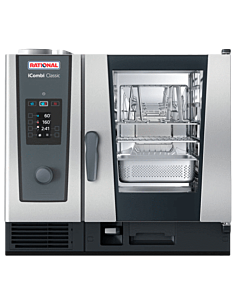
| Rational iCombi Classic 6-Half Electric (LM200BE) | Electric, 6 half-size pans | Small kitchens starting with Rational on a tighter budget | Financing from roughly $492/mo, quote-based | FortisBC rebate (BC) |
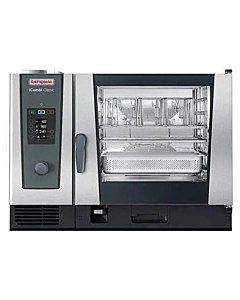
| Rational iCombi Classic 6-Full Natural Gas (CC2GRRA.0000273) | Natural gas, 6 full-size pans | Mid-size restaurants that prefer gas | Financing from roughly $872/mo, quote-based | Enbridge rebate (ON) and FortisBC rebate (BC) |
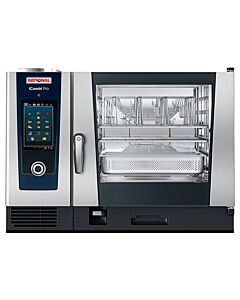
| Rational iCombi Pro 6-Full Electric (CC1ERRA.0000218) | Electric, 6 full-size pans, touchscreen Pro | Kitchens wanting intelligent cooking and self-clean, 60 to 160 meals a day | Financing from roughly $956/mo, quote-based | FortisBC rebate (BC) |
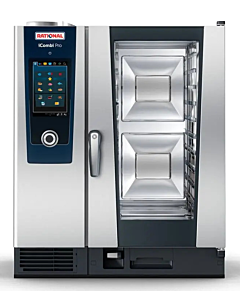
| Rational iCombi Pro 10-Full Natural Gas (CE1GRRA.0000240) | Natural gas, 10 full-size pans, touchscreen Pro | Higher-volume restaurants and caterers | Financing from roughly $1,474/mo, quote-based | Enbridge rebate (ON) and FortisBC rebate (BC) |
| Rational iCombi Pro 20-Half Electric (LM100FE) | Electric, 20 half-size pans, touchscreen Pro | Hotels, banquet kitchens, and institutional volume | Financing from roughly $1,487/mo, quote-based | FortisBC rebate (BC) |
The monthly figures are Zanduco's published financing payments. Outright Rational pricing is quote-based, so request a quote for a firm number. Every model above is ENERGY STAR certified. Natural gas units qualify for the Enbridge rebate in Ontario and FortisBC rebates in British Columbia; electric units qualify for FortisBC rebates in British Columbia. Confirm the current rebate amount with your utility. For more options, browse the full combi oven range.
Not Sure Which Combi Fits? Let's Talk Volume and Budget.
That is the whole decision: how a combi works, boiler versus boilerless, sizing, and the installed cost in Canada with venting and water counted in. What is left is matching a specific model to your menu, your space, and your utility setup, and that part is worth a short conversation before you commit five figures. Browse the full combi oven range at Zanduco, or request a quote and we will help you spec the right unit, sort out the rebate if you qualify, and get the install right the first time.