Free Shipping (On select items & orders)
  Track My Order


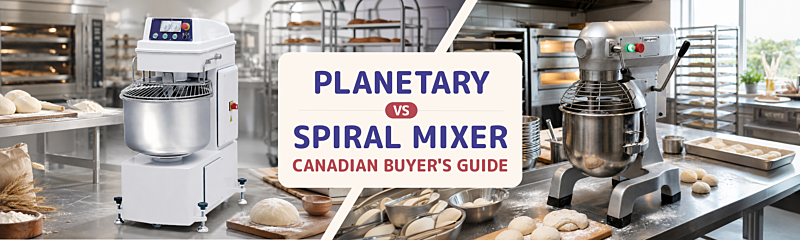
You are standing in your kitchen with a quote in one hand and a floor plan in the other, and the same question keeps circling back. Spiral or planetary? Both knead dough. Both cost real money. Both will sit in your prep area for the next decade and shape the texture of every loaf, crust, and bun you sell.
Here is the part nobody tells you up front: these two machines are not really competitors. One is a versatile all-rounder that happens to knead dough. The other is a dough specialist that does nothing else and does it beautifully. The right answer depends almost entirely on what comes out of your kitchen at volume, not on which machine has more horsepower or a bigger price tag.
So before you sign anything, let's break down how each one works, where each wins and loses, what it actually costs over five years, and the Canadian details that quietly decide the outcome.
Quick answer: For a dough-first operation like an artisan bakery or a pizzeria pushing high volumes of bread or pizza dough, a spiral mixer is the better buy. It develops gluten gently, keeps the dough cool, and handles heavy batches all day. For a kitchen that makes a bit of everything, cakes, batters, cookie dough, and only moderate amounts of bread dough, a planetary mixer is the smarter, more flexible choice. Many busy bakeries eventually run both. Your daily dough volume and product mix are what should decide it.
Spiral vs Planetary: The Real Difference Is How the Dough Moves
The whole comparison comes down to one thing: what moves and what stays still.
- Planetary mixer: the bowl stays put, and a single attachment orbits around it like a planet circling the sun. Swap the attachment and the same machine whips, beats, or kneads. That stationary bowl is what makes it so flexible, but the hook only touches part of the dough at a time, so it has to run longer and push harder. More friction means more heat.
- Spiral mixer: the spiral hook stays fixed while the bowl rotates, often in both directions. The dough is drawn past the hook in a gentle, folding motion. The bowl does most of the work, so gluten develops evenly with far less friction and far less heat. That cooler action is the single biggest reason serious bread and pizza makers reach for a spiral.
Worth noting: heat is not a minor detail in a dough program. Warm dough ferments faster and less predictably. If you proof by the clock and your dough is running hot, your whole schedule drifts. A spiral gives you a cooler, more stable dough temperature to build a routine around.
If you want a broader primer on mixer types and attachments first, Zanduco's rundown on choosing the best commercial kitchen mixer pairs well with this comparison.
What a Planetary Mixer Is Genuinely Great At
Versatility is the planetary's whole reason for existing. Change the attachment and the same base unit does the lot.
Where it shines:
- Cake batter, buttercream, meringue, choux, mashed potato, cookie dough, and yes, bread and pizza dough too
- Optional hub attachments on many floor model planetary mixers that grind meat, slice vegetables, and grate cheese from one footprint
- Easy cleanup, with bowls that lift out and drop straight into the sink
- Compact bench options that fit on a counter instead of eating floor space
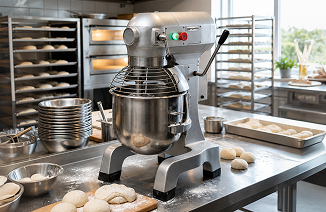
Solid all-purpose picks: a unit like the Zanduco 30 qt planetary with guard gives you a 2 HP motor, three speeds, and a removable stainless bowl with whip, beater, and dough hook included. For tighter prep areas, the Zanduco 20 qt heavy-duty planetary with guard and timer covers most light and medium dough work plus everything else on the menu.
Best for: cafés, diners, catering kitchens, and any menu that swings across pastry, dessert, and savoury prep. Watch out for: dough quality at volume. A planetary can make pizza dough and bread, but on heavy or high-volume batches it works harder, heats more, and is likelier to overmix. Recipes mixed in a planetary often lean on a little oil or sugar to compensate.
What a Spiral Mixer Does Better Than Anything Else
A spiral has one job, and that focus is its strength: it mixes dough thoroughly, gently, and at scale, with minimal heat.
Where it shines:
- Artisan bread, sourdough, bagels, focaccia, and pizza dough across the full hydration range, from firm Neapolitan to wet, long-fermentation doughs
- Even gluten development, because the dough is folded rather than beaten
- Heavy, repeated dough loads through a long production day without the motor straining
- Cooler dough that holds a steadier fermentation schedule
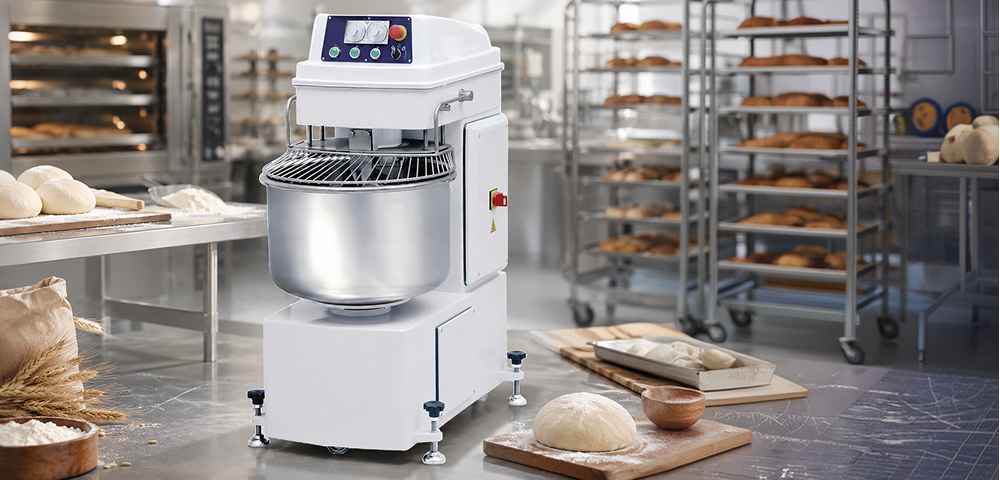
Sizing it to your shop: Zanduco's spiral dough mixer range runs from compact single-phase units to large three-phase floor machines.
- Small shop: the Eurodib LM20T 20-quart spiral runs on standard 110V for modest daily volumes
- Mid volume: the Eurodib LM40T 40-quart spiral handles around 16 kg (35 lb) of dough per batch
- Heavy producer: step up to a unit like the Trento 66 lb capacity spiral
Best for: pizzerias and bread-focused bakeries where crust and crumb are the brand. Watch out for: it does dough and only dough. The machines are usually heavier floor units, and some models use a fixed bowl that is slower to clean than a lift-out planetary bowl.
What Each Mixer Nails and What It Misses
Here is the honest scorecard, side by side.
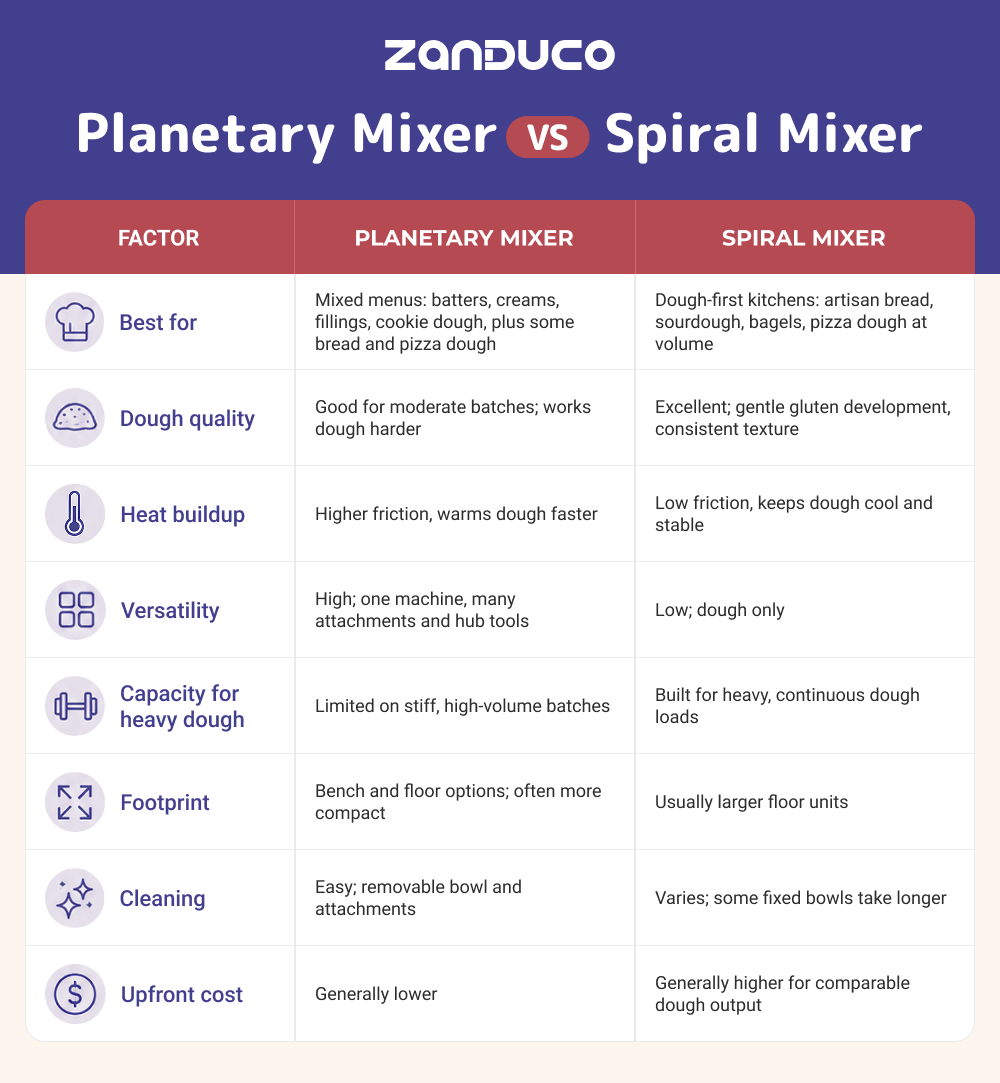
Common mistake: buying a big planetary "so it can do everything" when 80 percent of your output is pizza or bread dough. You end up with a versatile machine doing its weakest job all day, fighting heat and overmixing, when a focused spiral would have cost less to run and produced better dough.
Still mapping out your full kitchen? Zanduco's essential pizza shop equipment list puts the mixer decision in context alongside ovens, prep tables, and the rest of your line.
The Canadian Details That Quietly Decide It
This is where a generic comparison stops being useful and a Canadian one starts to matter.
Winter water temperature is a real variable.
Bakers control dough temperature partly through water, and a Canadian winter can drop incoming cold water to 4 to 8°C in much of the country, while a summer line in Ontario or BC might run 15 to 20°C. A planetary adds more friction heat, so in a hot summer kitchen you may find yourself chilling water or adding ice to hit your target dough temperature. A spiral's lower friction makes that far easier to hold steady year round. In colder provinces like Alberta, Manitoba, and Saskatchewan, the gentler spiral action also helps you avoid dough that never quite wakes up.
Electrical and phase matter before you order.
Smaller mixers, roughly 20 to 30 qt, often run on single-phase 110V or 220V, which most kitchens already have. Larger floor mixers, particularly spirals and planetaries above about 60 qt, commonly need 208 to 240V three-phase power. Adding a three-phase circuit is an electrician's bill you want to know about in advance, not on delivery day.
Certification is non-negotiable for inspection.
Look for CSA certification, and treat ETL, UL, and NSF as equally valid marks from accredited testing bodies. NSF in particular signals the unit meets sanitation standards for food contact, which matters when an inspector is standing in your kitchen. Provincial health codes vary in enforcement, with Quebec and BC known for rigorous inspections, so confirm the certification on the spec sheet rather than assuming.
One honest note on energy and rebates.
Mixers are not a major energy line item the way refrigeration or a gas range is, and they are not typically covered by ENERGY STAR Canada ratings or by gas utility rebate programs such as Enbridge Gas in Ontario or FortisBC in British Columbia. Do not let anyone sell you a mixer on a rebate that does not exist. Focus on motor quality and the duty rating, light, medium, or heavy, matched to your real daily output.
Buyer tip: match the mixer to your stiffest, heaviest dough at your busiest hour, not to your average batch. A machine that breezes through a quiet Tuesday but bogs down on Friday night is the wrong machine.
The Real Five-Year Cost of Your Mixers
Sticker price is the smallest part of the story. Here is a realistic five-year picture for two common starting points. All figures are hedged ranges in Canadian dollars and are illustrative. Pricing shifts with brand, capacity, and configuration, so confirm current numbers on the product page or with a Zanduco rep.
| Cost line | 30 qt floor planetary (mixed menu) | Entry spiral, ~18 to 24 qt / 40 lb dough (dough-first) |
| Equipment (approx.) | Around CAD $2,500 to $3,500 | Roughly CAD $2,500 to $5,000 |
| Extra bowl, attachments, accessories | Roughly CAD $300 to $900 | Roughly CAD $150 to $500 |
| Delivery and electrical setup | Around CAD $200 to $700 | Around CAD $300 to $900 (often heavier, 220V) |
| Maintenance and parts (5-year total) | Approximately CAD $500 to $1,250 | Approximately CAD $500 to $1,500 |
| Estimated 5-year total | Roughly CAD $3,500 to $6,750 | Roughly CAD $3,500 to $7,900 |
The takeaway in one line: a planetary often costs less up front, but for a dough-heavy shop the spiral usually pays back its higher landed cost in dough quality, consistency, and a motor that is not being overworked every shift. A planetary asked to knead heavy dough all day simply wears faster, and that shows up as maintenance later. If you need spare capacity, an extra mixer bowl is one of the cheapest ways to keep production moving.
Kitchen planning tip: leave clearance around a floor mixer for the bowl to wheel in and out and for the guard to swing open. Spiral units are heavy, so confirm your floor can take the load and that the path from the loading door actually fits the machine.
How to Choose by the Kind of Shop You Run
Strip away the theory and it usually comes down to your business type.
If your menu also leans on chopping, pureeing, or sauce work, it helps to know where a mixer stops and other prep equipment starts. Zanduco's guide on choosing between a food processor and a blender for Canadian kitchens helps you avoid buying one machine to do another's job.
A Quick Gut-Check Before You Buy
Run through this before you commit:
- ☐ Is dough more than half of what I produce? (Yes leans spiral.)
- ☐ Do I also need to whip, beat, or run batters daily? (Yes leans planetary.)
- ☐ What is my heaviest single batch on my busiest day, in kilograms?
- ☐ Does my panel have the voltage and phase this model needs?
- ☐ Does the unit carry CSA, ETL, UL, or NSF certification?
- ☐ Is there clearance for the bowl, the guard, and delivery access?
So, Spiral or Planetary? Here Is What I Would Put on Your Floor
If I were spending my own money and dough was more than half of what my kitchen produced, I would buy the spiral every time. The cooler dough, the steadier fermentation, and the ability to push heavy batches without cooking the gluten are worth more day to day than a fistful of attachments I would rarely use.
If my menu was genuinely mixed, with cakes and batters sharing the spotlight with some bread, I would buy the planetary, because one flexible machine beats two specialists I can only half justify. And if I was scaling a shop that does serious volume on both fronts, I would stop choosing and buy both.
Bottom line:
- Dough-first shop → spiral
- Mixed menu → planetary
- High volume on both → run both
Buy for the dough you make most, at the volume you make it, in the kitchen you actually have. Get that right and the machine quietly does its job for a decade. You can browse Zanduco's full commercial dough mixer selection to compare sizes and configurations, and the team can help match a unit to your space, your panel, and your output.
Stop Fighting Your Dough. Get the Right Mixer in Your Kitchen This Week
You have done the homework. Now put a machine on your floor that actually fits the way you bake. Whether your dough demands a hard-working spiral mixer or your menu calls for a do-it-all planetary, Zanduco has the size, voltage, and certification your kitchen needs, ready to ship across Canada.
- Free shipping on select orders, coast to coast
- Financing available so you can spread the cost instead of stalling the build
- Real specialists on the line, not a chatbot, to match the machine to your space and panel