Free Shipping (On select items & orders)
  Track My Order


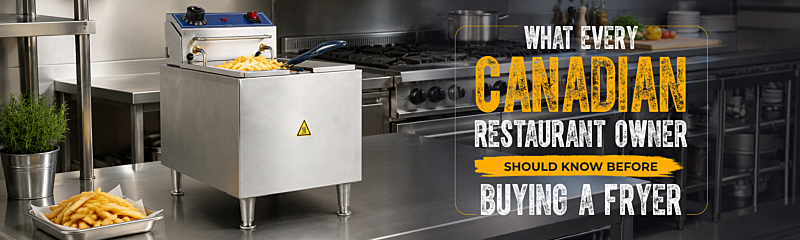
A fryer is one of the few pieces of kitchen equipment that pays you back every single shift. Fries, wings, spring rolls, fish, churros, the basket never stops moving during a rush, and the margins on fried items are some of the friendliest on the menu. That is exactly why the wrong fryer hurts so much. Buy too small and your line backs up at 7 p.m. on a Friday. Buy too big and you are heating oil you never use and paying for gas or hydro you did not need.
We have had this conversation with restaurant owners across Canada more times than we can count. First-timers opening a café, seasoned operators on their third location, and a steady stream of people calling because the fryer they bought eighteen months ago is already letting them down on Friday nights. The pattern in those last calls is almost always the same, and it has very little to do with the brand on the cabinet. The fryer that fails you is rarely the one that was poorly made. It is the one that was poorly matched to your kitchen, your menu, and the building you operate in.
So this guide walks through the decisions in the order they actually come up, with Canadian pricing in mind, the compliance marks you will be asked about, and a five-year cost view so nothing blindsides you six months in.
Quick answer: For most Canadian restaurants frying as a core part of the menu, a single or twin-vat gas floor fryer in the 18 to 23 kg (40 to 50 lb) oil range is the workhorse choice, because gas recovers heat fast during a rush. Choose electric countertop units for cafés, food trucks, and low-volume sides. The right pick depends on your peak-hour volume, your existing gas or electrical hookups, and whether you already have a ventilation hood. Look for a CSA, ETL, UL, or NSF mark, and check ENERGY STAR Canada models for rebates in Ontario and B.C.
Countertop or Floor: Match the Fryer to How Hard You Fry
Before fuel type, settle the format. A countertop fryer and a floor fryer solve different problems, and the buyers who get this wrong feel it within weeks.
Countertop fryers are compact, sit on a sturdy bench, and make sense when frying is a side act rather than the headliner. Think a café doing afternoon fries, a food truck with limited footprint, a bar plating wings on weekends, or a bakery dropping the occasional batch of doughnuts. They heat up when you need them and cool down when you do not. Capacity is modest, usually around 4.5 to 11 kg (10 to 25 lb) of oil, and recovery time slows once you load a few baskets back to back.
Floor fryers are built to run all day. If your menu leans on fried food, a pizzeria adding a full appetizer program, a fish and chip shop, a busy diner, a fried chicken concept, this is your category. They hold more oil, recover heat faster, and most accept built-in or add-on filtration. A standard single vat usually holds around 18 to 23 kg (40 to 50 lb) of oil, and twin-vat cabinets let you keep fries and fish apart so flavours do not cross.
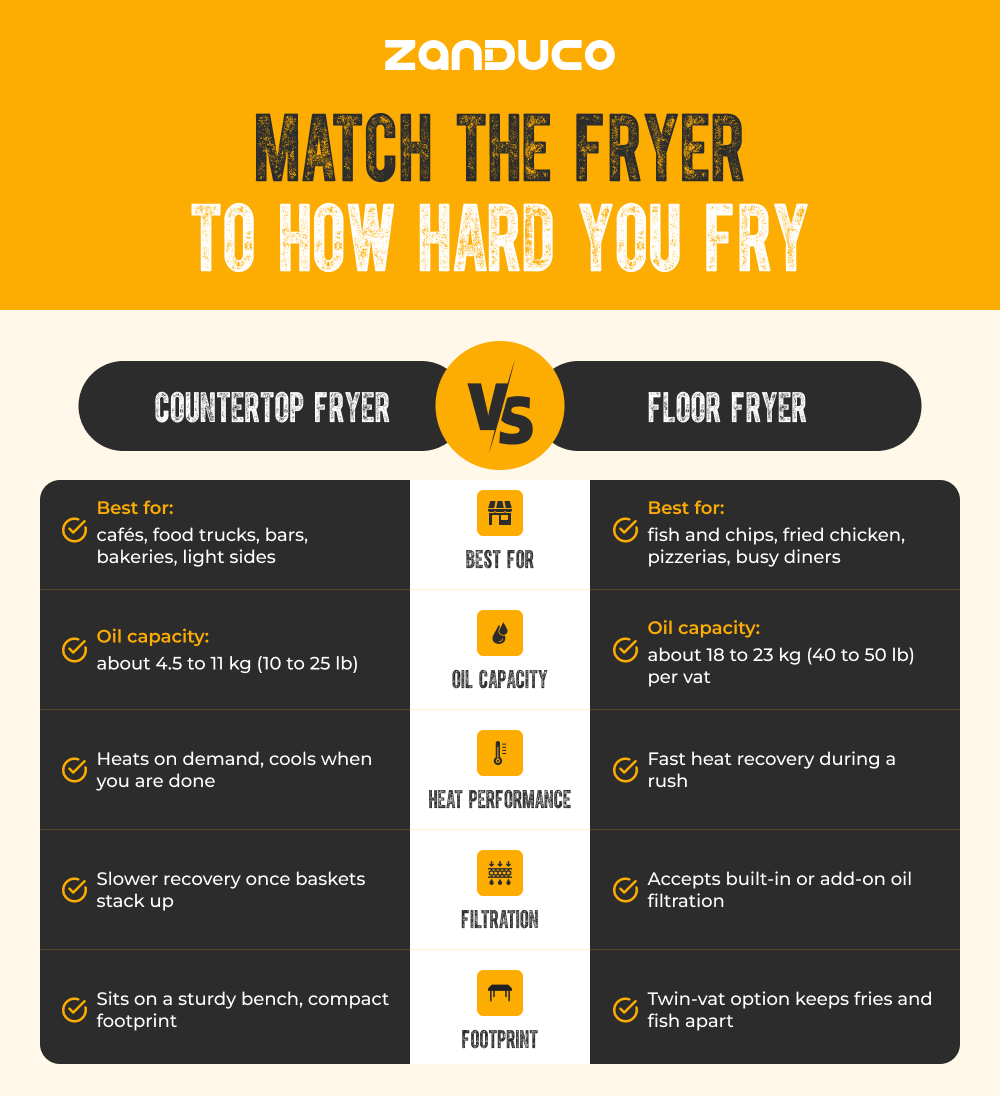
Rule of thumb: fry as a side act, go countertop. Fry as the main act, go floor.
Buyer Tip: Two smaller vats often beat one big one. This is the recommendation owners thank us for most often later. A twin-vat setup lets you separate allergens and flavours, keep frying during an oil change, and scale output without overheating a single giant tank during slow periods.
Gas or Electric: It Comes Down to Your Hookups, Not Hype
Here is the part people overthink. The first thing nearly everyone asks us is whether to buy gas or electric, and it honestly is not the big decision it feels like, at least not at the start.
Gas and electric fryers both cook food beautifully. Gas heats fast and recovers fast, which matters most in high-volume kitchens where baskets drop constantly and you cannot afford the oil temperature to crater between loads. Electric runs steady and precise, installs more easily where there is no gas line, and transfers heat efficiently into the oil. Neither is better in the abstract. They are answers to different questions.
The question that actually decides it is quieter: what does your building already give you, and how hard do you fry?
- If you have a natural gas line at the cookline and you fry heavily, a gas floor fryer is the safe call. High BTU output means quick recovery during your rush.
- If you are in a space without gas, in a food court, or running a gas countertop unit on propane in a truck, match the fuel to what is available rather than forcing a renovation. We have watched owners spend thousands running a new gas line to feed a fryer that an electric unit would have handled for a fraction of the cost.
- If consistency matters more than raw speed and you have the panel capacity, an electric floor fryer gives you tight temperature control.
The same logic governs your whole cookline, which is why so many buyers face this exact decision again with their range. Reading the trade-offs once on the range side often clarifies the fryer choice too, since both come down to your utilities and your peak demand.
Worth Noting: A serious electric floor fryer can draw more power than a tired old panel can carry. Confirm your electrical panel before you fall for a model. A panel upgrade can quietly cost more than the fryer itself, and finding that out after delivery is a bad afternoon.
Sizing It Right: Capacity, Recovery, and Oil Volume
Capacity is measured by how much oil the vat holds, and it drives everything: how much food you can fry at once, how fast the oil bounces back to temperature, and how consistent your product stays during a rush.
Size to your busiest hour, not your average day. This is where owners slip up most. The kitchen does not break on a normal Tuesday. It breaks at 7:40 on a Friday when every table wants fries at once and the oil temperature is crashing because the vat is too small to recover. As a rough starting point:
- Light volume (café, bar sides, small truck): around 6 to 11 kg (15 to 25 lb) per vat.
- Steady mid-volume (diner, pub, pizzeria appetizers): around 14 to 18 kg (30 to 40 lb) per vat.
- Heavy volume (fish and chips, fried chicken, fast casual): around 18 to 23 kg (40 to 50 lb) per vat, often twin vats.
Two specs deserve more attention than buyers give them. Recovery time is how quickly the oil returns to your target temperature after you drop a cold basket, usually somewhere around 175 to 190°C (350 to 375°F). Slow recovery means greasy, undercooked food during exactly the moments you need speed. The oil-to-product ratio matters too: overload the basket and you drag the temperature down and shorten oil life.
Kitchen Planning Tip: Measure your doorways, hallways, and cookline gaps before you order a floor fryer. A 50 lb cabinet that will not clear the back door is a frustrating and expensive lesson. Confirm the install path, not just the floor space.
Tube, Open-Pot, or Flat-Bottom: Which Vat Design Fits Your Menu
The vat design is a quiet but real performance decision tied to what you fry.
Open-pot vats have a clean, open frypot with the heating elements outside the tank, which makes them easy to clean and well suited to lightly breaded or non-breaded foods like fries and onion rings.
Tube-style gas fryers run heating tubes through the oil, creating a cold zone at the bottom where breading crumbs and sediment settle out of the active cooking area. That cold zone keeps oil cleaner longer, which is why tube fryers are popular for heavily breaded chicken and fish.
Flat-bottom vats suit delicate, floating foods like doughnuts, funnel cakes, and tempura, where you do not want product catching on tubes.
Match the vat to your highest-volume fried item and you will fight oil quality far less often.
Oil Filtration: The Hidden Cost That Decides Your Actual Budget
Oil is one of the largest ongoing costs in any frying kitchen, and almost every first-timer underestimates it badly. Fresh oil is not cheap, and a busy fryer can go through it fast if you are not filtering.
Daily or shift-based filtering pulls out the crumbs and sediment that break oil down, and it can meaningfully extend how long each batch lasts. Some floor fryers come with built-in filtration; for others, a standalone oil filtering machine handles a bank of fryers. The math is simple. Filtration has an upfront cost, but stretching oil life even modestly across a high-volume kitchen often pays for the machine inside a year, while also giving you crisper, better-tasting food.
You will also want the right fryer baskets and accessories on hand from day one. For the wider list of line tools that keep a frying station moving, our rundown of essential smallwares for restaurants is a useful companion when you are placing the full opening order and do not want to be making three emergency trips in opening week.
Common Mistake: Pushing oil too far to save money. Tired oil fries slower, tastes off, and smokes at lower temperatures. The cost of a few extra litres of fresh oil is almost always cheaper than the customers you lose to greasy, dark fries.
What CSA, ENERGY STAR Canada, and Your Inspector Want to See
Compliance in Canada is not optional, and it is one of the first things to confirm before clicking purchase.
Look for a recognized safety certification mark. In Canada, that means the equipment has been tested by an accredited Nationally Recognized Testing Laboratory. CSA is the mark most Canadians recognize, and ETL, UL, and NSF marks are equally valid NRTL certifications you will see on reputable commercial fryers. A certified unit signals it has been tested to Canadian safety standards, and your inspector and insurer will both expect to see one. NSF in particular speaks to sanitation and cleanability, which is worth prioritizing for any equipment that touches food.
Health code requirements vary by province and municipality, so check your local public health authority on placement, cleaning, and grease handling. Quebec, in our experience, runs a notably thorough inspection process, so if you operate there, build in extra lead time and keep your documentation tidy.
On the efficiency side, ENERGY STAR Canada certified fryers are independently tested to use less energy than standard models, with faster recovery and more accurate thermostats. Beyond the lower energy bills, that certification is often the key that unlocks provincial rebates, which we get to below.
Ventilation and Fire Suppression: The Cost Nobody Budgets For
This is the line item that surprises new buyers most, so it is better you hear it from us now than from a contractor later. A commercial fryer produces grease-laden hot air, and in nearly every Canadian jurisdiction it must sit under a commercial Type 1 ventilation hood with a fire suppression system. This is a fire-code and insurance requirement, not a nice-to-have.
If your space already has a properly rated hood with capacity to spare, you are mostly set. If you are adding frying to a kitchen that was not built for it, budget seriously for kitchen hood and fire suppression, because a new hood and suppression install can rival or exceed the cost of the fryer itself. You will also want a grease trap sized to your output to stay onside with municipal sewer rules.
None of this is meant to scare you off frying, fried food carries some of the kindest margins on a menu. The point is to let the surprise land now, on paper, where it is cheap. If you are outfitting from scratch and want the full picture of what a compliant kitchen needs alongside the fryer, our guide to the must-have commercial kitchen equipment for a Canadian restaurant maps out the supporting cast so the fryer is not the only thing you have budgeted for.
The Real Cost of a Fryer Over Five Years
Sticker price is the smallest part of the story. Here is a realistic five-year view for a single mid-size gas floor fryer in a steady-volume Canadian kitchen. All figures are approximate, in CAD, and will swing with your menu, your hydro or gas rates, and your province.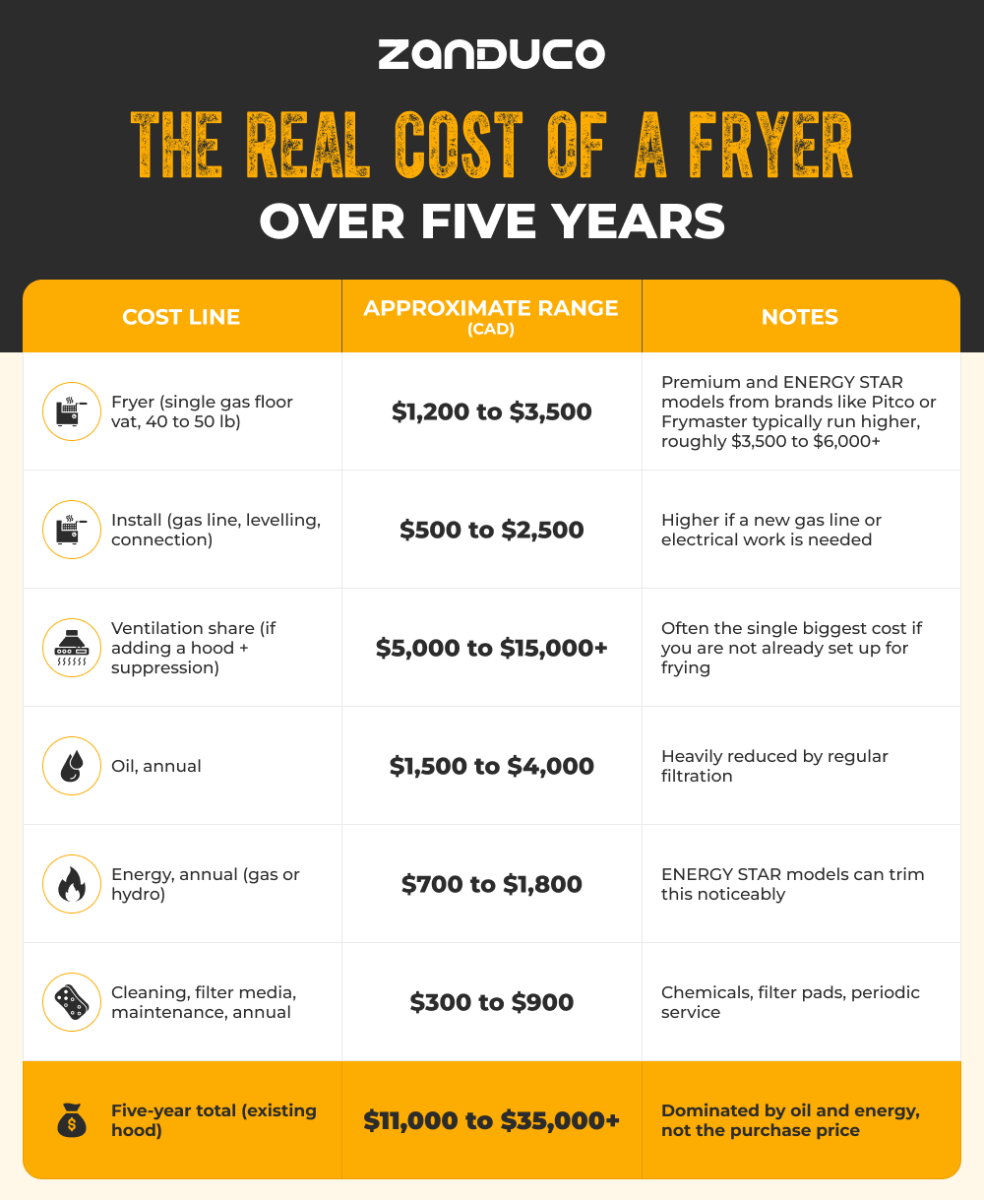
The takeaway is blunt. Across five years, what you spend on oil and energy dwarfs the price tag. A slightly pricier fryer that uses less oil and recovers faster is frequently the cheaper machine by year three, which is why we will happily steer an owner toward efficiency over a low sticker price.
Frying in a Canadian Climate: Rebates and Regional Realities
This is where buying in Canada genuinely differs from buying anywhere else, and where a little homework puts real money back in your pocket.
In Ontario, Enbridge Gas runs a Distributor Discount Program that applies instant point-of-sale discounts on eligible ENERGY STAR commercial kitchen equipment, including fryers, for commercial customers in its service area. There is no application and no waiting, the discount comes off at checkout through a participating distributor. Zanduco participates in this program, so you can see eligible models and how the savings apply on our energy rebate information page.
In British Columbia, FortisBC offers rebates on high-efficiency natural gas kitchen equipment, with per-appliance amounts that have run from roughly $200 to $3,500 depending on the equipment. Fryers that hold an ENERGY STAR certification at the time of purchase are eligible, you generally need to be a FortisBC commercial customer, and installation must be done by a Technical Safety BC licensed installer, so confirm the current terms before you buy.
Climate matters in the colder provinces too. In Alberta, Manitoba, and across the Prairies, incoming water and ambient kitchen air run cold for much of the year, which can lengthen warm-up and recovery times on a fryer placed near an exterior wall or a frequently opened back door.
We have seen a perfectly good fryer struggle simply because it was parked beside a back door opening every ninety seconds in January. Position the unit away from cold draughts, and size with a little recovery headroom if you are in a genuinely cold-climate kitchen.
If We Were Advising You Today, Here Is How We Would Decide
Stripping away the noise, here is the plain recommendation, the same one our team would give you on the phone.
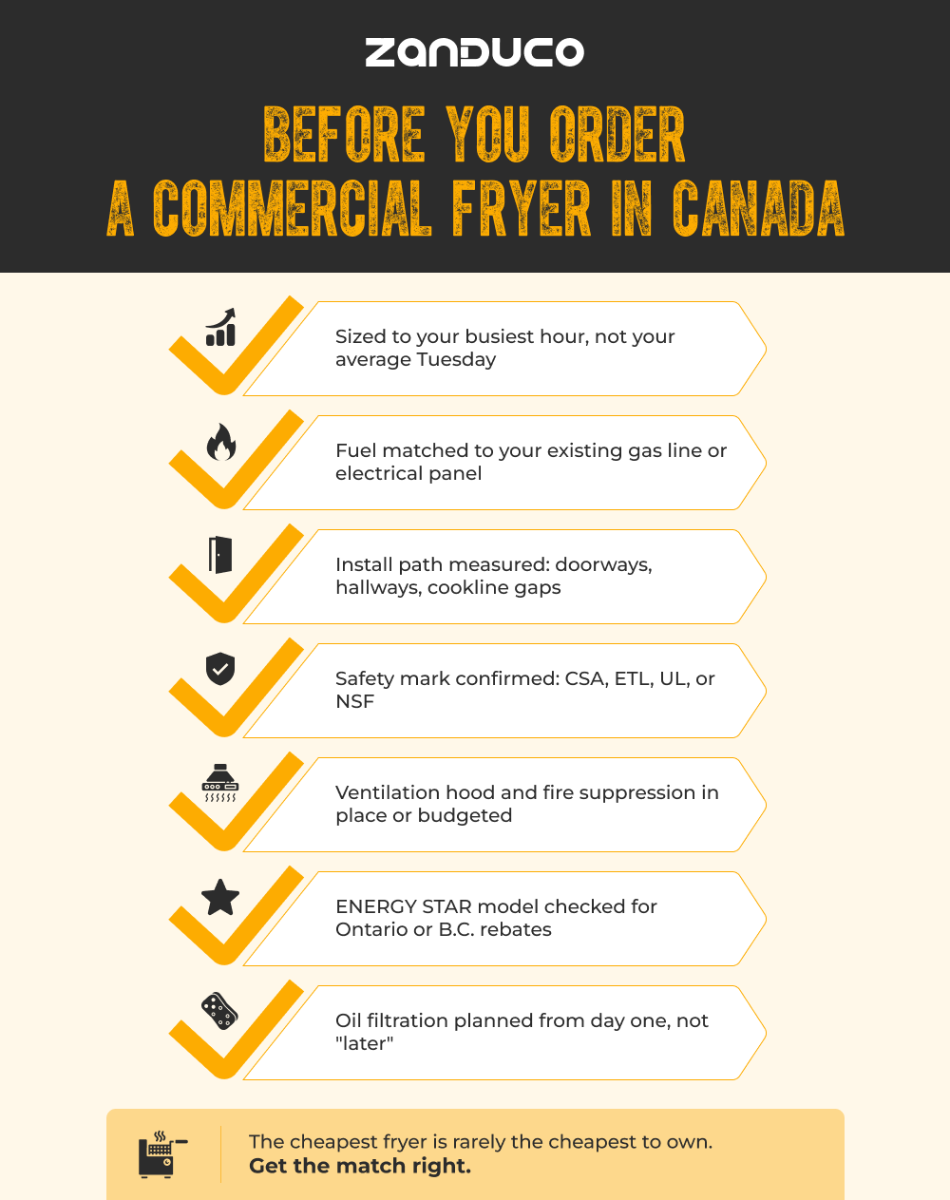
If frying is core to your menu and you have a gas line, go with a twin-vat gas floor fryer in the 40 to 50 lb range, choose an ENERGY STAR Canada model so a rebate is on the table where you operate, and budget for filtration from day one rather than promising yourself you will add it later. If you run a café, a truck, or a low-volume side program, a quality electric countertop unit will serve you well and install almost anywhere. Whatever you pick, confirm three things before you order: the safety certification mark, the ventilation, and the install path through your doorways and halls.
The cheapest fryer on the page is almost never the cheapest fryer to own. Spend where it lowers your oil and energy bills, get the building basics right, and the machine becomes one of the quiet, dependable earners in your kitchen. Browse the full commercial deep fryer range, and if you are unsure which size fits your peak, talk to the Zanduco team before you commit.
Ready to Fry Smarter, Not Harder?
You know your menu and your rush better than anyone. Bring that to the table and let us match it to the right vat, the right fuel, and the right rebate for your province. Explore Zanduco's full range of commercial deep fryers, or reach out to our team for a recommendation built around your kitchen, your volume, and your budget. We would rather talk you into the right size than sell you the biggest one. Get the fryer right once, and it pays you back every single shift.