Free Shipping (On select items & orders)
  Track My Order


Posted in: Commercial Restaurant
Every few weeks a buyer sends over a photo of their menu and asks which grill to get. That is the right instinct, because the menu is the answer. The problem is that most people walk into the decision already convinced they are picking between three different machines. They are picking between two, and the third word is mostly there to confuse them.
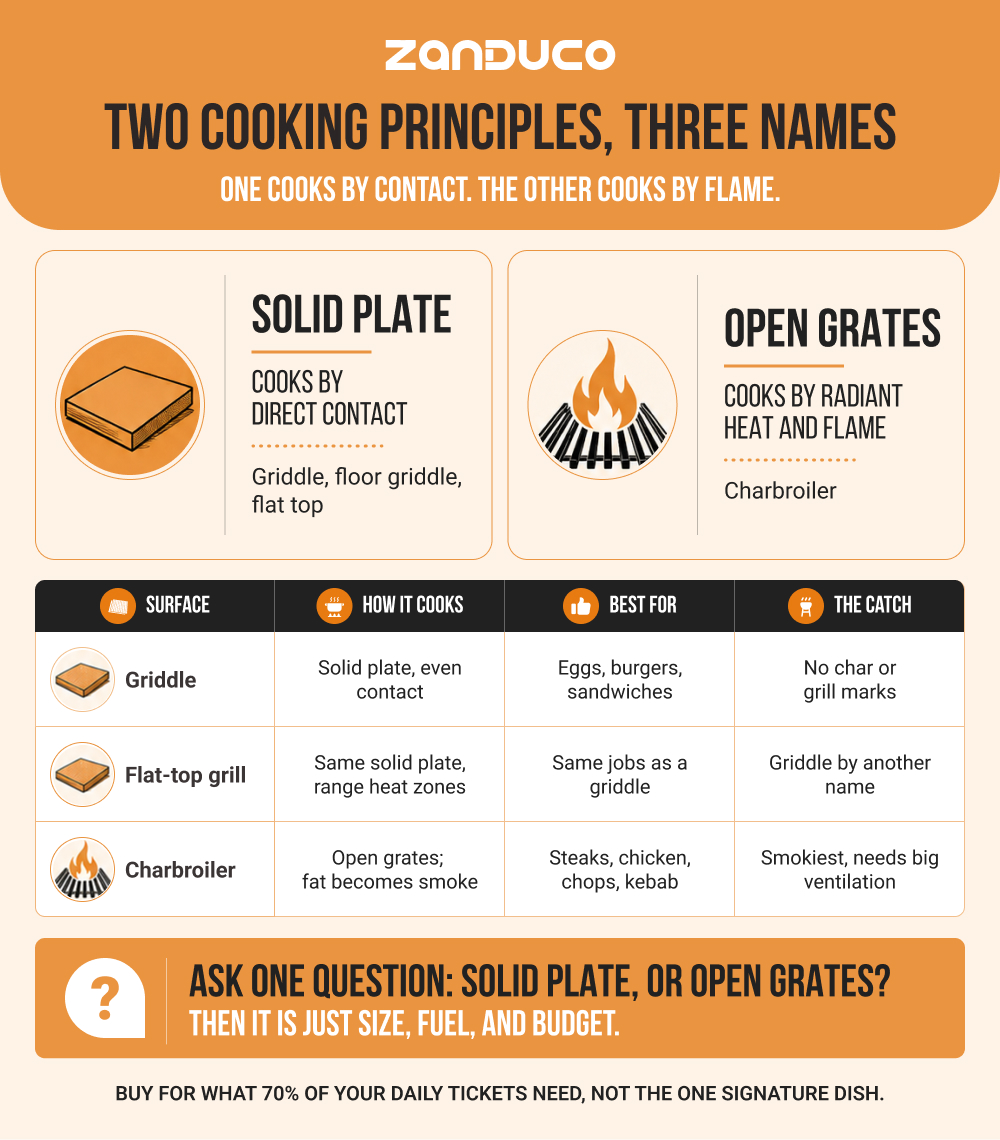
Charbroiler, griddle, flat-top grill. On a line those three get used like they mean the same thing, and once in a while two of them genuinely do. Underneath the names there are only two ways these surfaces cook. A solid steel plate that cooks by contact, and open grates over a heat source that cook by radiant heat and a little flame. Sort out which of those your menu leans on, and the rest of this is just sizing and budget.
What follows is the way an experienced restaurant buyer would talk it through with another buyer, based on how these surfaces behave through a real service rather than how they read on a spec sheet.
Quick answer: A griddle and a flat-top grill are the same idea, a solid flat plate that cooks by contact, and both are your friend for eggs, pancakes, smash burgers, and sandwiches. A charbroiler cooks on open grates, so you get sear marks, smoke, and fat runoff for steaks, chops, flame-forward burgers. Pick by what roughly 70 percent of your daily tickets need, not by the one dish you are proud of. Breakfast and sandwich and burger volume points to the flat plate. Grilled flavour and grill marks as your brand points to the charbroiler.
Sort The Names Before You Spend A Dollar
Three words, two ways of cooking. Before the definitions, here is the whole category at a glance.
What is a Griddle?
A griddle is a solid flat plate, usually steel, heated from below by gas burners or electric elements. It cooks by direct contact across the whole surface, which is why it owns breakfast and anything that needs even, edge-to-edge heat: eggs, pancakes, hash browns, bacon, smash burgers, and grilled sandwiches.
The one spec that changes how a griddle performs is plate thickness:
- 13 mm (1/2 inch): heats fast in the morning, then sulks the moment cold product hits it. Fine for low volume.
- 19 mm (3/4 inch): the everyday workhorse. Covers most restaurants and cafés.
- 25 mm (1 inch): slower to warm up, especially on a cold Prairie morning, but it holds heat like a bank and recovers instantly. This is the plate a smash-burger line wants, and it is what you get on a heavy-duty unit like the Southbend HDG-48M. Load six cold patties onto a thin plate and they steam. Load them onto a heavy plate and they sear.
Controls matter too. Manual valves are cheaper and work well in experienced hands, while thermostatic controls hold a set temperature for consistency and for newer cooks.
What is a Flat-top Grill?
In nearly every commercial catalogue, a flat-top grill is a griddle with a different label on the box. Same solid plate, same contact cooking. The one time the term means something else is the range-mounted French top, a heavy one-piece plate over ring burners where heat spreads out from the centre and you slide pots across graduated zones. That is still a solid surface, and still contact cooking. So when a listing says "flat-top grill," treat it as a griddle until the spec sheet says otherwise.
Worth noting: when a supplier lists a "flat-top grill," ask one question. Is the surface a single solid plate, or open grates? Solid plate is a griddle. Open grates is a charbroiler. That question clears up most of the confusion in this category.
What is a Charboiler?
A charbroiler cooks on open grates above a heat source. Heat radiates up through the grates, and the fat dripping onto the hot elements below flashes into smoke that climbs back through the food. That smoke is the flavour, and the grates give you the cross-hatch marks. It is the machine built for steaks, chops, bone-in chicken, flame-grilled burgers, souvlaki, and kebab.
What sits under the grates changes the flavour and the flare:
- Radiant (steel or cast radiants) burns even and controllable and behaves during a rush, which is why commissaries and consistency-driven kitchens favour a unit like the Vulcan 25 inch radiant charbroiler.
- Lava rock pushes more of that flame-grilled character, but the rocks foul, need replacing, and throw flare-ups when a fatty rush hits.
- Infrared runs hot and efficient with fewer flare-ups, as on the Vulcan VTEC36 infrared charbroiler, and you pay for that up front.
Start With The Menu, Work Back To The Machine
The costliest mistake here is buying around the dish you are proudest of instead of the dish you make three hundred times a day. A steakhouse still cracks four hundred eggs at brunch. Buy for the four hundred, then figure out the steaks. The rule of thumb: whichever surface covers roughly 70 percent of your daily tickets goes in first.
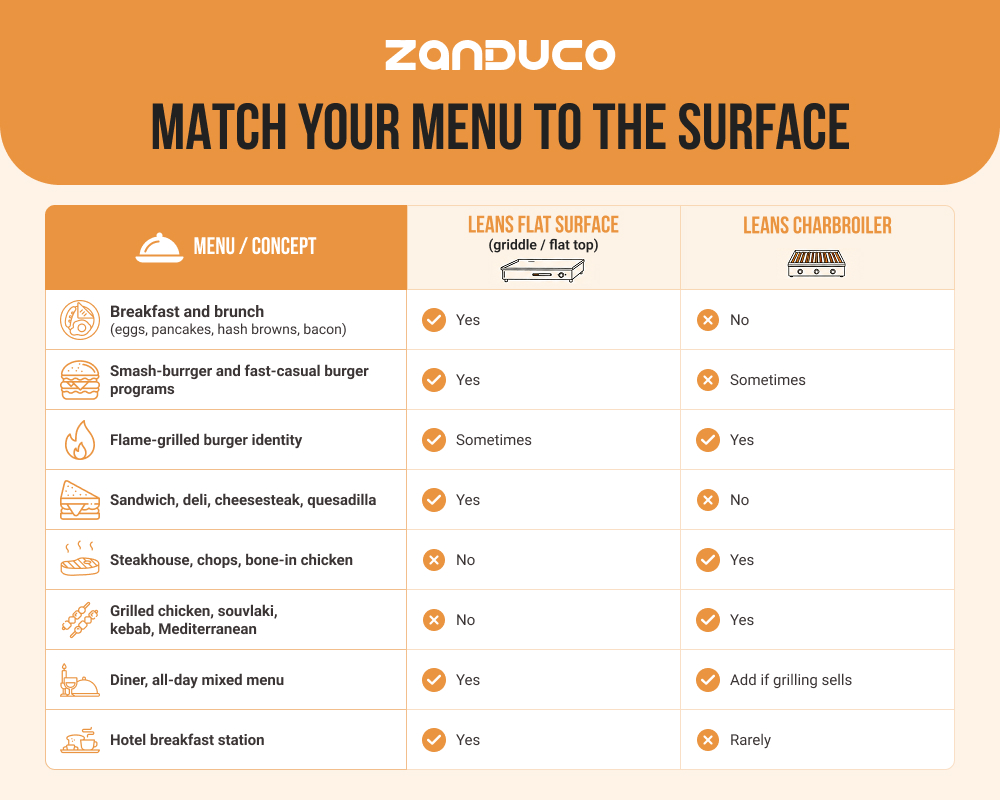
The technique usually tells you. A smash burger wants a very hot solid plate and instant recovery, so that is a griddle job. A ribeye that guests expect to land with cross-hatch marks and a smoky edge is a charbroiler job, and no griddle will fake it convincingly.
Buyer tip: write out your ten highest-volume cooked items and mark each one as "needs char or grill marks" or "needs flat contact." If a single surface covers seven of them, you have found your first purchase. The rest can wait for a second station or move to a combo unit.
If the concept is protein-forward and you are speccing prep gear at the same time, Zanduco's guide to choosing a commercial meat slicer pairs well with this piece, since a steak or deli program usually leans on grilling and slicing capacity together.
What It Is Like To Run Each One, Shift After Shift
Sticker price is the easy part. The part that shows up every service is labour, and the two surfaces are not equal there.
Griddle, the daily reality:
- Scrape down with a grill screen, wipe, and reseason
- Empty the front grease trough after service
- Learn the plate's map in about a week (hot near the back burners, cooler by the front trough)
- Never hit a hot plate with cold water, because thermal shock warps steel and cracks chrome
- A newer cook is productive on it inside a day or two
Charbroiler, the daily reality:
- Scrape the grates while they are still warm, every service
- Empty the grease tray after every service, because a full one is a fire waiting for a busy Friday
- Deep clean grates, burners, and radiants weekly, or output drops and grill marks go pale
- Work across the heat gradient on purpose (sear over the hot zone, hold toward the cooler edge)
- Shut down unused burner zones during slow afternoons to stop burning gas over empty grates
Over a full week of long shifts that gap is real money. It does not make the charbroiler a bad buy. It means the char has to earn its keep on the menu, because you are paying for it in cleaning hours on top of the purchase price.
Ventilation And Gas, The Part Canadian Inspectors Check Hardest
Both surfaces throw off grease-laden vapour, so both belong under a Type 1 commercial hood. The difference is scale. A charbroiler smokes far harder than a griddle, which usually means a bigger hood, more exhaust, and a fire suppression system sized to match. Step up from a griddle line to a charbroiler and you budget for the hood before you fall for the grill.
Run through this before you sign anything with a gas line:
- The unit is certified to the right CSA standard, and the mark carries the little "c" (a plain U.S. "UL" mark has no standing under Canadian code)
- Installation is done to CSA B149.1 by a licensed gas fitter
- Any natural-gas-to-propane conversion is done by that fitter with a manufacturer kit (a DIY swap voids the certification and is illegal to run)
- The hood and fire suppression are sized to the surface, not the other way around
- Your provincial authority signs off: Technical Safety BC out west, the RBQ in Quebec (where inspection runs especially tight), the TSSA in Ontario
The certification marks catch a lot of buyers, especially anyone tempted by a cross-border deal. Before you buy, it is worth understanding how SCC-accredited certifications really work in Canadian kitchens, because guessing wrong there ends in a failed inspection and a freight bill to send the thing back.
Common mistake: buying a charbroiler on price and then finding the existing hood and suppression cannot handle the smoke. The grill is the cheap part of a grill station. Ventilation and the gas install are where the surprise money hides.
The Real Canadian Numbers
Prices move with brand, size, plate thickness, and fuel, so treat these as planning ranges, not quotes. Everything below is equipment only, in Canadian dollars, unless the line says otherwise.
| Line item | Typical CAD range | Notes |
|---|---|---|
| Countertop gas griddle, 60 to 90 cm (24 to 36 in) | ~$700 to $3,500 | Entry Zanduco-brand units low, Garland and Southbend heavy-duty up top |
| Heavy-duty griddle, 25 mm (1 in) plate, 120 cm (48 in) | ~$3,000 to $6,500 | Thicker plate for batch cooking and instant recovery |
| Electric countertop griddle, ~75 cm (30 in) | ~$500 to $2,500 | Sensible where a gas line is not practical |
| Countertop gas charbroiler, 60 to 90 cm (24 to 36 in) | ~$700 to $3,500 | Radiant models; infrared and ceramic-hearth units run higher, sometimes past $10,000 |
| Floor / modular charbroiler, ~90 cm (36 in) | ~$3,500 to $9,000+ | Higher BTU, larger surface, often part of a modular line |
| Commercial hood + fire suppression, installed | ~$8,000 to $25,000+ | Charbroilers usually push toward the top of this |
| Licensed gas fitter installation | ~$500 to $2,500 | Varies by site, connection, and province |
| Annual deep clean and burner service | ~$300 to $1,200 | Charbroilers cost more here thanks to grate and radiant work |
Read that table for the second column, not the first. Two units with the same price tag can carry very different ten-year totals once the hood and the cleaning labour are counted, and the charbroiler almost always drags the heavier tail behind it. If the upfront number is the sticking point, Zanduco runs equipment financing in Canada through EconoLease, with rent-try-buy and lease-to-own terms that spread the cost.
If a fryer is going in beside the grill, and on most lines it is, the same buy-for-your-volume logic applies over there. Zanduco's rundown of what every Canadian restaurant owner should know before buying a fryer is a handy companion when you are costing the whole hot line rather than one box.
Gas Or Electric, and Why a Canadian Winter Changes the Math
Fuel choice quietly shapes the long-run bill.
Gas heats fast and hits high peak temperatures, which most grill cooks want for volume.
Electric gives very even plate heat with tight control, and it earns its place in buildings without a gas line or where local rules push toward electric.
Climate matters more than buyers expect. In Alberta and Manitoba, cold incoming product and a chilly kitchen at 6 a.m. stretch your morning warm-up on a heavy plate and lean on heat recovery all through the rush, which is one more reason high-volume Prairie kitchens spec the thicker plate and higher BTU.
Check utility rebates before you buy, because they can wipe out the efficiency premium. Ontario buyers have seen incentive programs from Enbridge Gas on high-efficiency commercial kitchen equipment, and Zanduco keeps an Enbridge energy rebate page for exactly that. In British Columbia, FortisBC runs comparable commercial rebates. ENERGY STAR Canada certification covers some cooking categories, griddles among them, so ask whether a model qualifies, since that label is sometimes the key that unlocks the rebate.
The Honest Pick For Most Canadian Kitchens
Here is the plain recommendation, the kind one buyer gives another after making this call a few dozen times.
Buy the griddle (or flat top) first if…
your menu leans breakfast, sandwiches, smash burgers, and chopped proteins. It covers more of your ticket, trains staff in a day, cleans in minutes, and carries the lighter ventilation load. It is the higher-utility box for the widest set of menus, and it will fight you the least on a bad night.
Buy the charbroiler first if…
the char is the product. Steakhouses, flame-grilled burger brands, grilled chicken programs, souvlaki and kebab houses, anywhere guests pay a premium for that grilled flavour and the marks on the plate. For those kitchens the charbroiler is the whole point, and it earns back its cleaning and ventilation cost through identity and pricing power. One tip for whoever runs it: preheat properly, lay the protein down and leave it alone, then give it a quarter-turn for the cross-hatch. Fussing with it just smears the marks.
Plenty of settled kitchens end up running both, because the griddle owns speed and versatility while the charbroiler owns flavour and presentation. If you can only buy one right now, buy the surface that covers your ten highest-volume items and add the second station when the numbers justify it. One more route worth knowing: several commercial gas ranges pair open burners with a built-in flat-top section, and the wider grills, griddles, and charbroilers lineup includes combo units, so a tighter kitchen can get contact cooking and grate space in one footprint.
Your Menu Already Picked the Grill. Let's Find It
For grilled, flame-forward concepts, browse Zanduco's Canadian charbroilers and countertop gas charbroilers. For breakfast, sandwich, and burger volume, look at the countertop gas griddles and electric countertop griddles. Everything in the lineup is sourced to meet Canadian certification requirements, and the Zanduco team can size BTU and surface width to your ticket count before you commit. Tell us what is on your menu and we will point you at the surface that fits it, not the one that looked good under the showroom lights.