Free Shipping (On select items & orders)
  Track My Order


Posted in: Restaurant Management
There is a moment, usually a few weeks after you sign the lease, when the empty space stops feeling exciting and starts feeling enormous. Bare walls, a rough-in for plumbing, a gas line capped off somewhere near the back, and an opening date that suddenly feels close. Everything you serve has to come out of a room that, right now, has nothing in it.
The equipment list is where a lot of first-time owners either save themselves a fortune or quietly bleed money. Buy in the wrong order and you end up paying rush fees and storing a walk-in cooler in a parking lot. Skip the compliance details and an inspector can hold up your opening over a missing hand sink or a gas range with the wrong certification mark. Over-buy on day one and you have tied up cash you needed for payroll in week three.
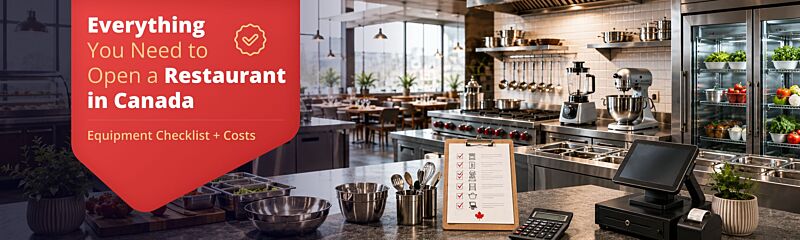
We outfit Canadian kitchens for a living, and this is the restaurant equipment checklist we would hand a friend who asked where to start. It runs station by station, in the order that makes sense to buy, with Canadian compliance built in and honest CAD ranges so your budget survives contact with reality. Whether you are opening a 24-seat café in Halifax, a pizzeria in Mississauga, or a full-service kitchen in Calgary, the bones of the list stay the same.
Quick answer: To open a restaurant in Canada you need equipment across eight stations: a cooking line (range, oven, fryer, griddle), refrigeration and cold storage, food prep, warewashing and sinks, shelving and storage, smallwares, front-of-house furniture, plus ventilation and safety. Every powered and food-contact item needs a certification mark from a Standards Council of Canada accredited body, and your build must clear a provincial health inspection before you open. Equipment alone typically runs from roughly $40,000 to $150,000 CAD for an independent restaurant, depending on menu, size, and whether you buy new or used.
Buy in This Order Because Sequencing Can Save You Money
Most equipment lists dump everything into one giant pile. Trouble is, a pile tells you nothing about what to buy first, and the order you buy in is where the money gets saved or lost.
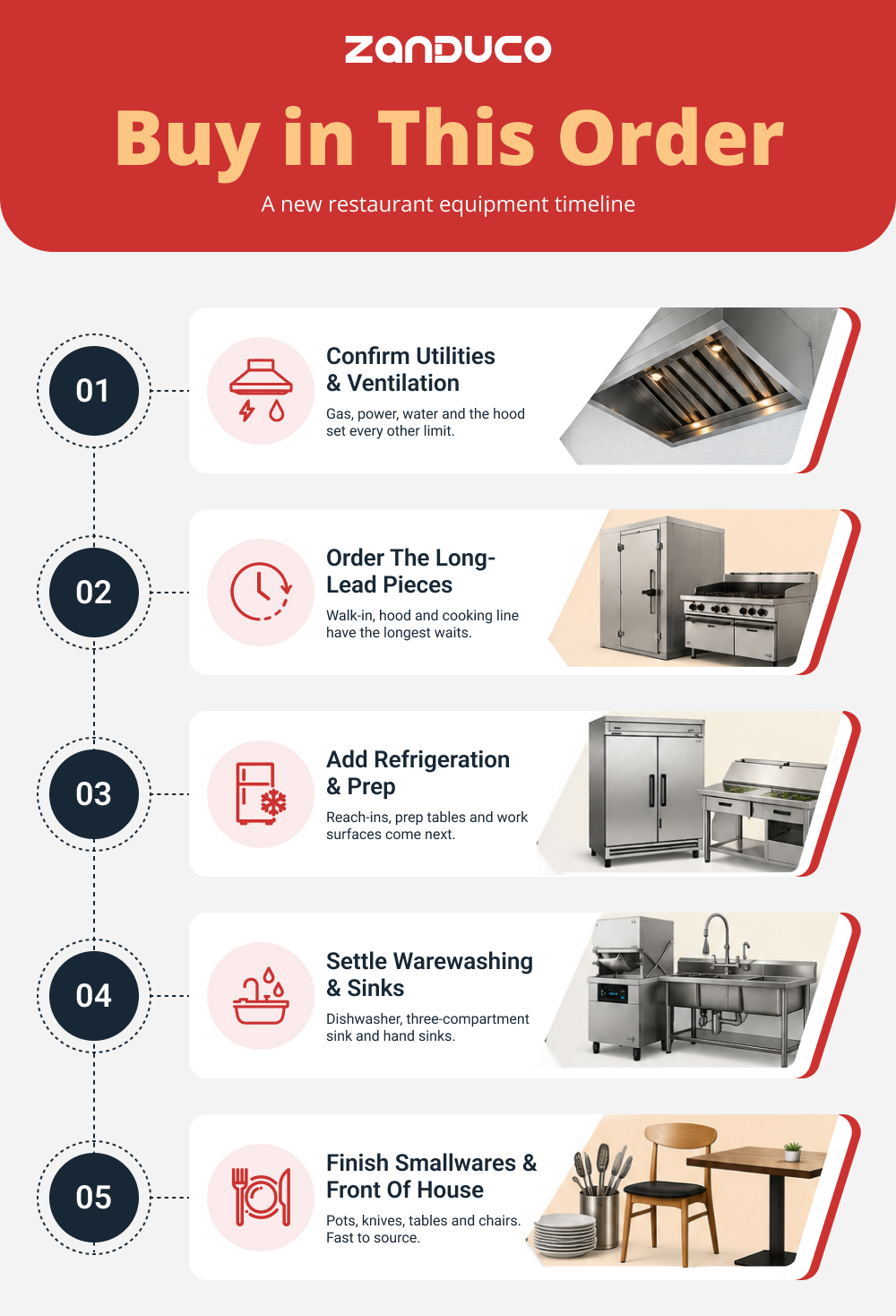
Here is the sequence that keeps a build-out moving:
- Confirm utilities and ventilation early. Your hood, gas line, electrical service, and water supply set the limits for everything else. You cannot pick a 10-burner gas range if the building only has a small gas service.
- Lock in the big, slow-to-ship pieces next. Walk-in coolers, hood systems, and large cooking lines have the longest lead times. Order these first so they are not the reason you slip your opening.
- Fill in refrigeration and prep. Reach-ins, prep tables, and work surfaces shape the flow of the kitchen.
- Add warewashing and sinks. These tie into plumbing, so they want to be settled before final inspection.
- Finish with smallwares, front of house, and the small stuff. Pots, pans, plates, chairs. Important, but fast to source and easy to adjust.
Kitchen Planning Tip: Sketch your line before you buy anything. Mark where the gas, water, drains, and electrical lines sit. Equipment that looks perfect in a catalogue becomes a headache when the drain it needs is four metres (about 13 feet) away on the wrong wall.
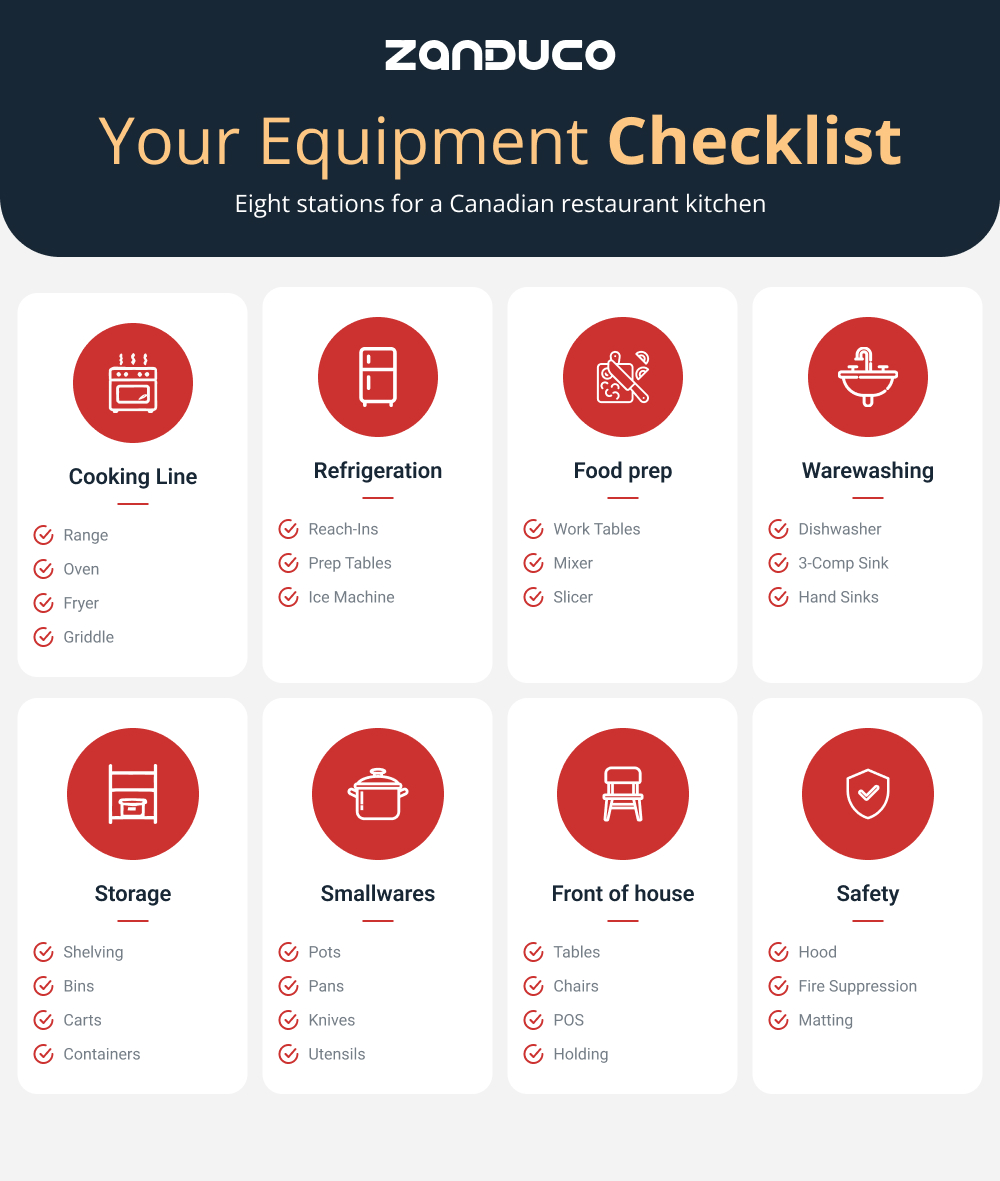
Your Restaurant Equipment Checklist, Station by Station
The Cooking Line
This is the heart of the kitchen and usually the single largest line on the budget. What you need depends entirely on your menu, so build from your dishes backward rather than buying a generic "starter kitchen."
- Range or cooktop. A commercial range covers most menus. Gas gives instant control and is the default for high-heat cooking; electric and induction are worth a look where gas service is limited or ventilation is tight. If you are torn between fuel types, our walkthrough on selecting the ideal commercial range for your kitchen breaks down the trade-offs in plain language.
- Oven. Many ranges include an oven base, but high-volume bakers and caterers usually add a standalone convection oven or a combi for steam-and-heat versatility. Browse the full commercial oven range to match capacity to your covers.
- Fryer. If anything on the menu is breaded or crisped, you need a commercial deep fryer. Size it to your busiest service rather than an average night.
- Griddle or charbroiler. Burgers, breakfast, and seared proteins live here. See grills, griddles, and charbroilers.
- Specialty cooking. Pizzerias need a dedicated pizza oven; a steakhouse leans on a charbroiler; a noodle shop needs burners that throw real heat.
Buyer Tip: Match burner count and fryer capacity to your projected peak, then add a little headroom. A line that just barely keeps up on a quiet Tuesday will fall apart on a Friday night, and replacing undersized gear in month two costs far more than sizing it right once.
Refrigeration and Cold Storage
Cold storage is the second-biggest spend and the one inspectors scrutinize most, because temperature control is food safety.
- Reach-in refrigerators and freezers. Your daily workhorses. Plan around weekly delivery frequency and prep volume. A 100-seat kitchen often runs two 48-inch (122 cm) reach-ins or one three-door 72-inch (183 cm) unit. Start with reach-in refrigeration and matching reach-in freezers.
- Refrigerated prep tables. A refrigerated prep table holds chilled ingredients below a pan rail on top, which saves wall space and speeds up the line. Sandwich, salad, and pizza shops practically run on these.
- Walk-in cooler or freezer. Higher volume kitchens benefit from a walk-in cooler. Long lead time, so order early.
- Ice machine. Easy to forget, impossible to run a bar or beverage program without. Estimate roughly 0.45 to 0.7 kg (1 to 1.5 lb) of ice per customer per day, then size your ice machine above that. In colder provinces, remember that very cold incoming municipal water in winter changes ice output, so do not size to the bare minimum.
Worth Noting: Place refrigeration at least 15 cm (6 inches) away from ovens, fryers, and flat tops. Direct heat shortens compressor life and pushes up your hydro bill every single month the kitchen is open.
Food Prep Stations
Prep equipment is where you buy back labour hours. A café can start lean; a scratch kitchen needs more.
- Stainless work tables form the backbone of prep. See work tables and shelves.
- Mixer. Bakeries and pizzerias need a dough mixer sized to batch volume.
- Food processor. A food processor handles chopping, slicing, and pureeing at volume.
- Slicer. Delis and sandwich shops want a meat slicer for consistent portions and tighter food cost.
Warewashing and Sinks
This station is half about clean dishes and half about passing inspection. Both matter.
- Commercial dishwasher. Choose between high-temp (sanitizes with about 82°C / 180°F water) and low-temp (chemical sanitizing). Each suits a different pace and budget; our guide on choosing the right commercial dishwasher lays out the call. For tighter footprints, an undercounter dishwasher fits under a prep table. In Alberta and Manitoba, winter tap water can arrive close to a few degrees C, which makes a high-temp machine's booster heater work harder, so factor that into your energy planning.
- Three-compartment sink. Wash, rinse, sanitize. A three-compartment sink is required in most jurisdictions even if you have a dishwasher. Our commercial sink buying guide for Canadian kitchens covers sizing and materials.
- Hand sinks. Dedicated hand sinks at the line and prep areas are mandatory, separate from your dish and prep sinks.
- Mop sink and grease management. A mop sink keeps cleaning water out of food zones, and many municipalities require a grease trap. See floor drains and grease traps.
Common Mistake: Counting the dishwasher as your sanitizing solution and skipping sinks. Inspectors look for a three-compartment sink and dedicated hand sinks regardless of whether you have a machine. Plan the plumbing for all of them before drywall goes up.
Shelving, Storage, and Transport
Unglamorous, but it decides whether your kitchen is calm or chaotic at 7 p.m.
- Wire and dunnage shelving for dry storage and walk-ins. See wire shelving.
- Food storage containers and ingredient bins for organized, labelled prep. Browse food storage containers.
- Carts and transport for moving product safely. The full storage and transport section covers the rest.
Smallwares and Tabletop
The long tail of small items that quietly adds up.
- Cookware: pots, pans, and cookware sized to your batches.
- Knives: a solid set of chef knives and knife sets for the team.
- Utensils, pans, and food pans for service and holding.
- Beverage gear: cafés will want espresso machines and coffee makers from the beverage equipment range.
Front of House and Furniture
Your guests judge the room before they taste the food.
- Seating and tables. Restaurant seating and restaurant tables set the tone and the turn rate. Browse the full furniture range.
- Holding and warming. A heat lamp or food holding and warming unit keeps plated food at temperature during a rush.
- POS and payment. Budget for hardware and a monthly software fee. This sits outside Zanduco's catalogue, but it belongs on your checklist.
Ventilation, Fire, and Safety
Often the most expensive surprise on the whole list, because the install can cost as much as the equipment, sometimes more.
- Exhaust hood and fire suppression. A code-compliant kitchen hood and fire suppression system is mandatory over cooking equipment. Sizing, make-up air, and the suppression system all need professional design and install.
- Floor safety. Anti-fatigue rubber floor matting protects staff over long shifts.
- Sanitation supplies. Stock janitorial supplies, first aid supplies, and trash cans ahead of opening day, while you are still setting up the kitchen.
Match the Checklist to Your Kind of Kitchen
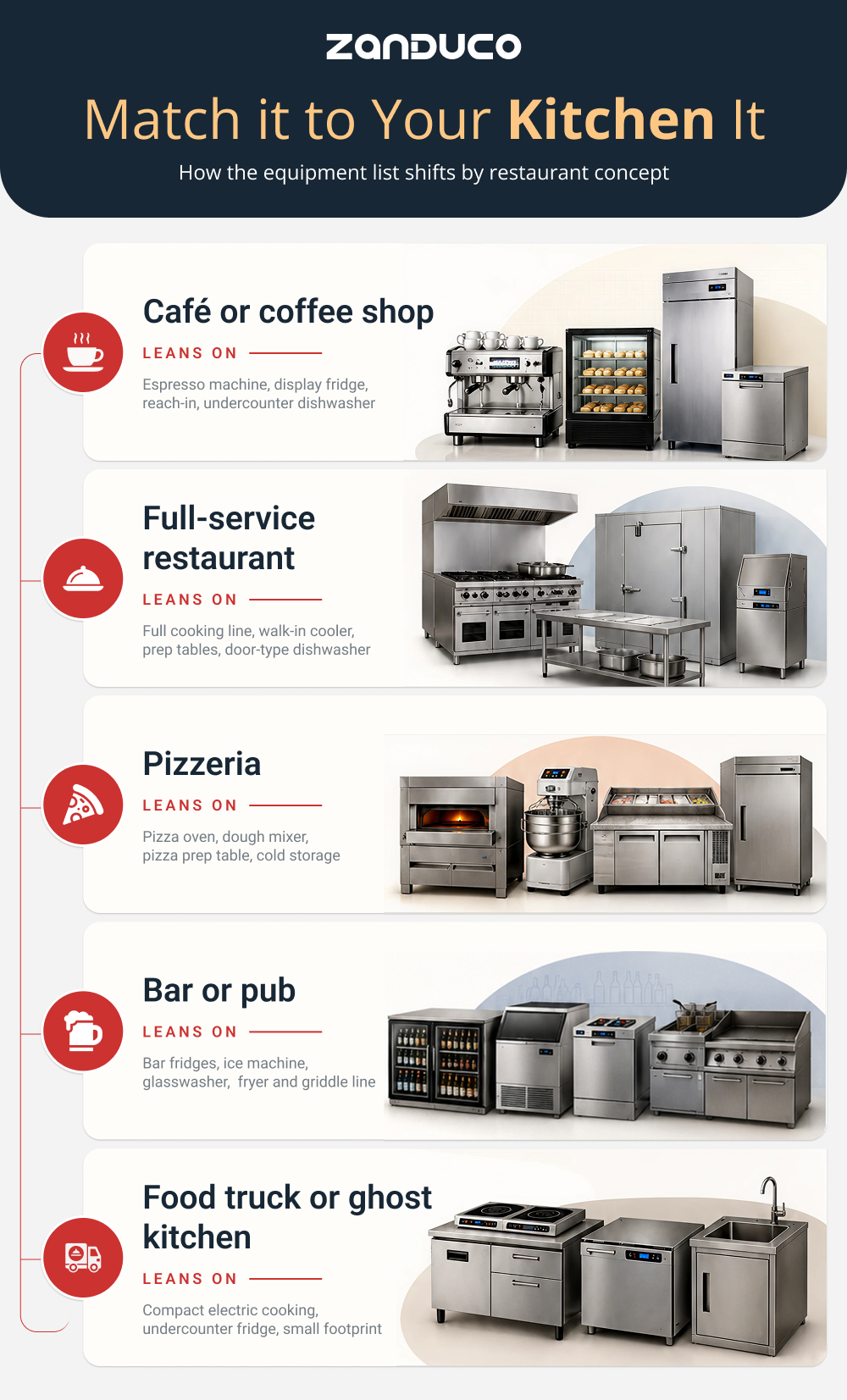
The eight stations stay the same across every concept. What changes is how heavily you lean on each one. Here is how the list scales to the most common builds.
Small café or coffee shop
Spend concentrates on beverage gear: an espresso machine, coffee makers, a reach-in refrigerator, and display refrigeration. Cooking stays light, so a compact line and a panini press often cover it, and warewashing can run on an undercounter dishwasher.
Full-service restaurant
You need the complete cooking line, serious refrigeration that may include a walk-in cooler, multiple refrigerated prep tables, a door-type dishwasher, and a full front of house.
Pizzeria
A dedicated pizza oven, a dough mixer, a pizza prep table, and plenty of cold storage for dough and toppings drive the build.
Bar or pub
Lean on bar refrigeration, an ice machine, glasswashing, and a tighter cooking line built around a fryer and griddle.
Food truck or ghost kitchen
Space and power are the limits. Favour compact, often electric cooking gear, undercounter refrigeration, and equipment that fits a small footprint while keeping every certification mark intact.
What Canadian Inspectors Look For Before You Open
This is where opening in Canada differs from opening south of the border, and where a clean equipment list still fails if you ignore the marks.
Certification marks come first
Every powered and food-contact piece needs certification from a Standards Council of Canada (SCC) accredited body. The trap most buyers fall into is assuming CSA is the only acceptable mark. It is not. cUL, cULus, cETL, QPS, and others carry equal legal weight, and for sanitation, NSF, cNSFus, and ETL Sanitation all certify to the same NSF/ANSI standards. The single most important thing to check is the small "c": a plain US-only "UL" mark with no "c" is not certified for Canada, and a CE mark from Europe does not satisfy Canadian code at all. Imported equipment is where this bites hardest. For the full picture, read how SCC-accredited certifications really work in Canadian kitchens before you buy anything from outside the country.
Gas equipment is Canada's stricter half
Gas appliances must be certified to the relevant CSA standard and installed in compliance with CSA B149.1. Provincial safety authorities enforce this: the Electrical Safety Authority and TSSA in Ontario, Technical Safety BC in British Columbia, and the Régie du bâtiment in Quebec. If a piece of gas equipment lacks a recognized mark, your only path is a one-time field approval under CSA B149.3, which is slower and pricier than buying pre-certified the first time.
Provincial health approval gates your opening.
A public health inspector signs off before you serve a single plate, and the timeline varies by province:
- Alberta: Apply to your local Environmental Public Health office through Alberta Health Services at least 14 days before your proposed opening date. The inspector checks that all equipment is in place and the build is clean.
- British Columbia: A Health Operating Permit from the regional health authority (for example, Vancouver Coastal Health) requires a floor plan review, food safety plan, and valid food handler certification before inspection.
- Ontario: Your local public health unit inspects the premises, equipment, and processes against provincial and federal rules.
- Quebec: Inspections under MAPAQ are known for being thorough, so build in extra time and document everything.
- Saskatchewan and Manitoba: Both require a premise application and at least one certified food handler on site, with an on-site inspection before opening.
Energy and refrigerant rules quietly shape the budget too
Look for ENERGY STAR Canada certified refrigeration and warewashing to lower operating costs, and be aware that federal refrigerant rules are phasing down high-GWP HFCs, which is steering new refrigeration toward lower-impact refrigerants. Energy-efficient equipment also opens the door to provincial utility rebates that can offset a chunk of the spend, which we break down in the budget section below.
What It Really Costs to Equip a Canadian Restaurant
Nobody can give you an exact number without seeing your menu and your space, so treat the table below as planning ranges rather than firm quotes. These are approximate CAD figures for a small-to-mid independent restaurant buying mostly new equipment. Used gear can cut many of these lines by roughly 30 to 60 percent.
| Station | What it covers | Approximate cost (CAD, new) |
| Cooking line | Range, oven, fryer, griddle or charbroiler | ~$8,000 to $35,000+ |
| Ventilation and fire suppression | Hood, make-up air, suppression (install-heavy) | ~$8,000 to $30,000+ |
| Refrigeration and cold storage | Reach-ins, prep tables, possible walk-in | ~$6,000 to $30,000+ |
| Ice machine and bin | Production unit plus storage | ~$2,000 to $7,000 |
| Warewashing and sinks | Dishwasher, 3-compartment sink, hand sinks | ~$4,000 to $15,000 |
| Food prep | Work tables, mixer, processor, slicer | ~$3,000 to $12,000 |
| Smallwares | Pots, pans, knives, utensils, food pans | ~$3,000 to $10,000 |
| Shelving and storage | Wire shelving, bins, carts | ~$1,500 to $6,000 |
| Front of house | Tables, chairs, POS hardware | ~$5,000 to $25,000 |
| Safety and sanitation | Matting, janitorial, first aid | ~$1,000 to $4,000 |
| Approximate equipment total | ~$40,000 to $150,000+ |
A few honest caveats. These figures cover equipment only. They do not include your lease and deposits, renovation and build-out, permits and licensing, opening inventory, or the working capital you need to cover the first few months. Industry estimates for total restaurant startup in Canada commonly land anywhere from roughly $100,000 to $800,000 depending on size and concept, and equipment is only one slice of that. Ventilation and refrigeration are the line items most likely to blow past your first guess, so price those early.
New, Used, Financed, or Rebated: How to Stretch Your Opening Budget
You do not have to buy everything new, and you do not have to pay for everything up front.
Used works well for the durable, simple stuff: stainless work tables, shelving, sinks, and basic prep gear hold up and rarely justify new pricing. Inspect for dents that trap food, confirm certification marks are intact, and check that anything powered still runs cold or hot to spec.
Buy new for the complicated and the critical: refrigeration compressors, anything gas-fired, and your dishwasher. A used compressor that dies in month two costs you spoiled product and a service call at the worst possible time. New units also come with warranties, which matter most on the gear you cannot afford to lose mid-service.
Financing keeps cash in the business. Leasing or financing lets you spread equipment cost over time so your opening capital goes toward payroll and inventory instead of being locked in steel. Plenty of Canadian owners finance the big cooking and refrigeration lines and pay cash for smallwares. If that fits your plan, you can request a quote and discuss financing on a full opening order.
Tap utility rebates before you place the order
Two provinces currently run rebate programs that knock real money off energy-efficient kitchen equipment, and both are easiest to capture as an instant discount at the point of sale rather than chasing paperwork after the invoice clears.
| Province | Program | What it covers | The basics |
| Ontario | Enbridge Gas Distributor Discount (Foodservice) | Instant per-unit discounts on ENERGY STAR and high-efficiency commercial kitchen equipment, applied right at purchase | Applied at the point of sale through a participating distributor, no application. For commercial customers in the Enbridge Gas (or former Union Gas) area or within IESO territory. Current per-unit amounts are listed on the program page. |
| British Columbia | FortisBC Natural Gas Kitchen Equipment Rebates | Per-appliance rebates that vary by equipment type, with the largest on combination, rack, and conveyor ovens | FortisBC commercial gas customer, installed by a Technical Safety BC licensed installer, with the application filed within 365 days. Some foodservice rebates apply instantly through participating suppliers. Current amounts are published on the program page. |
A few things worth knowing before you count on the money. Qualifying gear is usually ENERGY STAR certified or sitting on the program's eligible appliance list, so confirm the exact model before you buy, since a near-identical unit without the certification may not qualify.
Gas fryers and ovens are the most commonly rebated items, and a double-stack oven can sometimes earn a rebate on each deck. BC also runs electric-side foodservice rebates for ENERGY STAR equipment and demand-controlled kitchen ventilation. Rebate amounts and limited-time top-ups change, so check the current figures on the linked program pages before you order rather than relying on a number you read in a blog.
Zanduco can help you check which rebates apply to your build in BC and Ontario and apply eligible point-of-sale discounts on your order, with more provincial programs being added. When you request a quote, ask about current rebate eligibility on the equipment you are speccing.
Buyer Tip: Rebates attach to specific model numbers and certification status, so confirm eligibility before you commit. A unit that looks identical but lacks the ENERGY STAR listing can miss the rebate entirely, and the instant point-of-sale programs in Ontario and BC are the simplest savings to capture once you pick the right model.
Delivery, Installation, and What Happens After the Sale
The price tag is only part of the cost. How equipment arrives, who installs it, and what happens when something fails all belong on your checklist.
Lead times decide your opening date
Smallwares and shelving ship fast. Walk-in coolers, exhaust hoods, and large cooking lines can take weeks, sometimes longer in busy seasons. Order the slow movers as soon as your layout is final so they are never the reason you push your opening.
Delivery is heavier than a parcel
Large equipment ships by freight, and lift-gate and Canada-wide delivery options are typically available so one person can receive a unit without a loading dock. Confirm access, doorway widths, and whether you will need help moving gear into place before the truck arrives.
Gas, electrical, and ventilation need professional install
You can place a work table yourself. A gas range, an exhaust hood, and a fire suppression system need a licensed installer, and in many provinces that installer must be certified to sign off the work. Treat the install as its own line item on the budget, separate from the equipment price.
Warranty and parts support matter most on powered gear
Ask what the warranty covers and for how long before you buy refrigeration, cooking equipment, or a dishwasher. A brand with available parts and local service saves you from a dead unit and a long wait during service.
Watch for tariff surcharges
Some imported brands carry surcharges tied to current tariffs, which can move the final price. Ask for the all-in cost on your quote so the number you plan around is the number you pay.
What I'd Buy First If I Were Opening Tomorrow
If I were standing in that empty space with a fixed budget, here is how I would spend it.
First dollar goes to ventilation and the cooking line, because they have the longest lead times and the install dependencies that can delay your opening. Second goes to refrigeration, because cold storage is non-negotiable for both food safety and inspection. I would buy those new, with warranties, and not flinch at the price.
Then I would get deliberately frugal. Work tables, shelving, and sinks I would happily buy used or value-tier, as long as the certification marks are clean. Smallwares I would buy to a tight starter list and expand once I knew the menu's real rhythm, because every owner over-buys pans and under-buys the one size the line keeps reaching for.
After enough openings you start to see the pattern. The owners who open smoothly are the ones who sequenced the buy, sized each station to their real menu, and kept enough cash in the bank to ride out a slow first month. Buy the line your food needs, certify every piece correctly, and hold some powder dry for the surprises.
Ready to Build Your Opening Order?
Opening a restaurant in Canada comes down to a list, an order, and a budget that holds. Get the certification marks right, sequence the big pieces first, and size every station to the menu you are cooking. Do that, and inspection day is a formality instead of a fire drill.
When you are ready to turn this checklist into a real order, Zanduco can help you spec a complete kitchen, confirm Canadian certification, and arrange delivery across the country. Request a quote and build your opening order with a team that knows what Canadian inspectors look for.