Free Shipping (On select items & orders)
  Track My Order



Posted in: Meat Processing Equipment
In-house sausage is one of the few things a butcher counter or deli can put out that the grocery chain down the street can't match. The margin on a house blend beats anything pre-made, regulars come back asking for a specific link by name, and it gives your counter a reason to exist. The hard part is rarely deciding to make it. The hard part is what you fill the casing with, and how sore your crew is by the end of a Friday batch.
That choice tends to narrow to two machines. One is a manual stuffer you drive by hand. The other is a hydraulic stuffer driven by a motor and a knee lever. Both push meat through a spout into casing, and that is where the resemblance stops. Choose the wrong one and you either pay for capacity you never touch or chain two people to a job that should take one.
The deciding factors come down to a short list every time: how much you stuff, how often, who is running the machine, and what your provincial inspector wants to see. The sections below map those factors onto the two options so you can land on the right one before you spend.
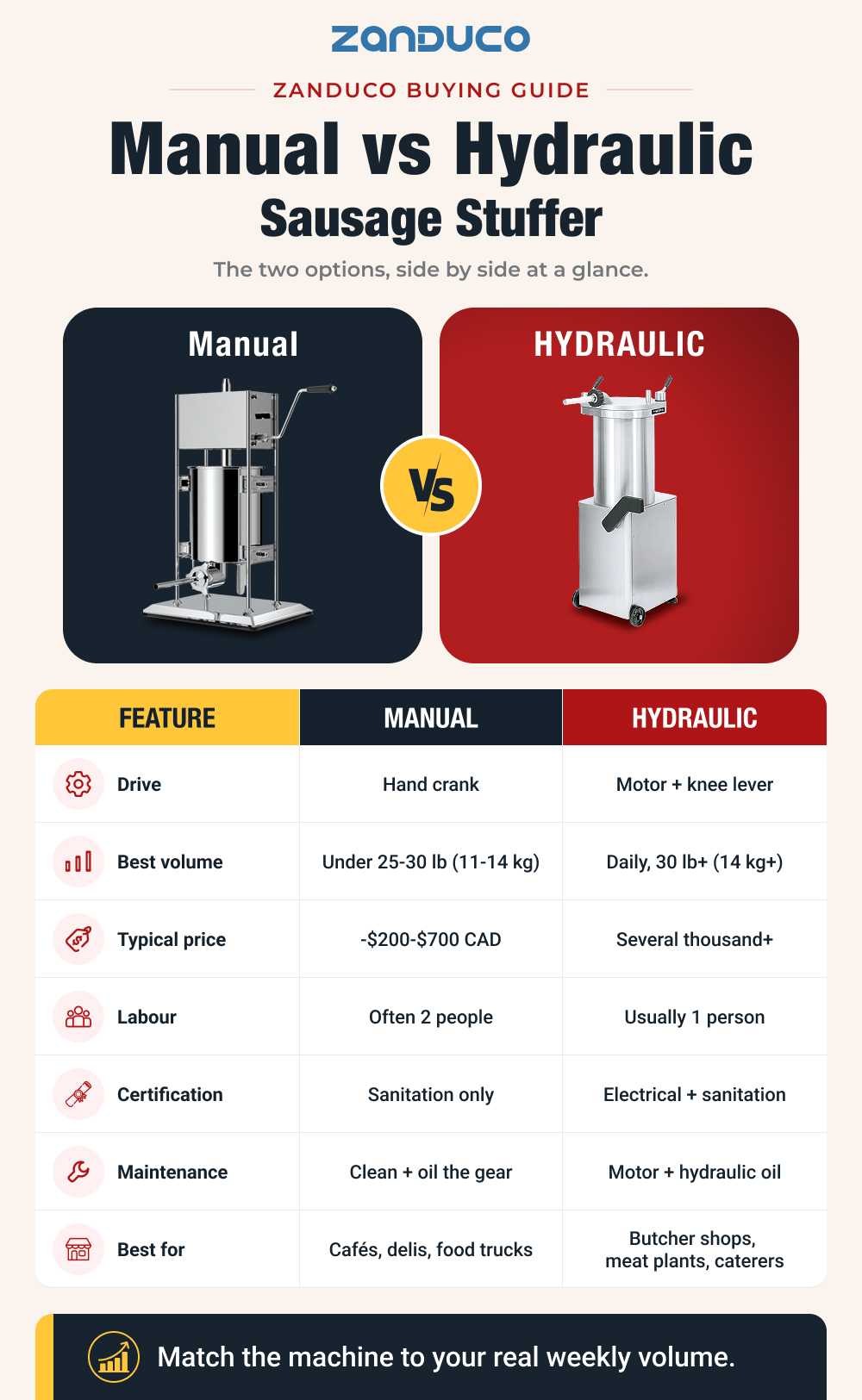
Quick answer: A manual sausage stuffer suits shops filling roughly under 25 to 30 lb (11 to 14 kg) per session, where the spend stays low (often a few hundred dollars, roughly $200 to $700 CAD) and there is no motor to certify. A hydraulic sausage stuffer earns the upgrade once stuffing becomes a daily, high-volume task, because motor-driven pressure takes the labour out of it and turns out uniform links far faster. The right pick depends on your weekly volume, your crew size, and whether stuffing is an occasional craft or a core part of production.
Manual vs Hydraulic: What's the Real Difference?
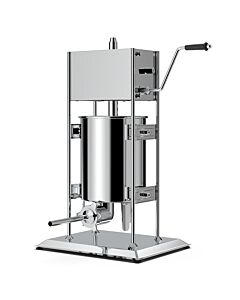
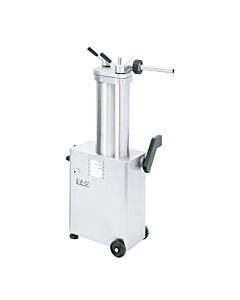
Neither machine is "better." They solve different problems. A manual stuffer is a piston you drive with a hand crank: turn the gear, the piston pushes down, meat moves through the spout. Few parts, almost nothing to break. A hydraulic stuffer uses a motor and hydraulic pressure to drive that same piston, controlled by a knee or foot lever so both your hands stay free for the casing.
A café adding a weekend breakfast link, a specialty deli running a few batches a week, a restaurant putting one signature sausage on the menu: hand-crank territory. A butcher shop selling sausage as a daily revenue line, a small meat plant, a caterer prepping for volume events: this is where cranking stops being satisfying and starts showing up on your labour bill.
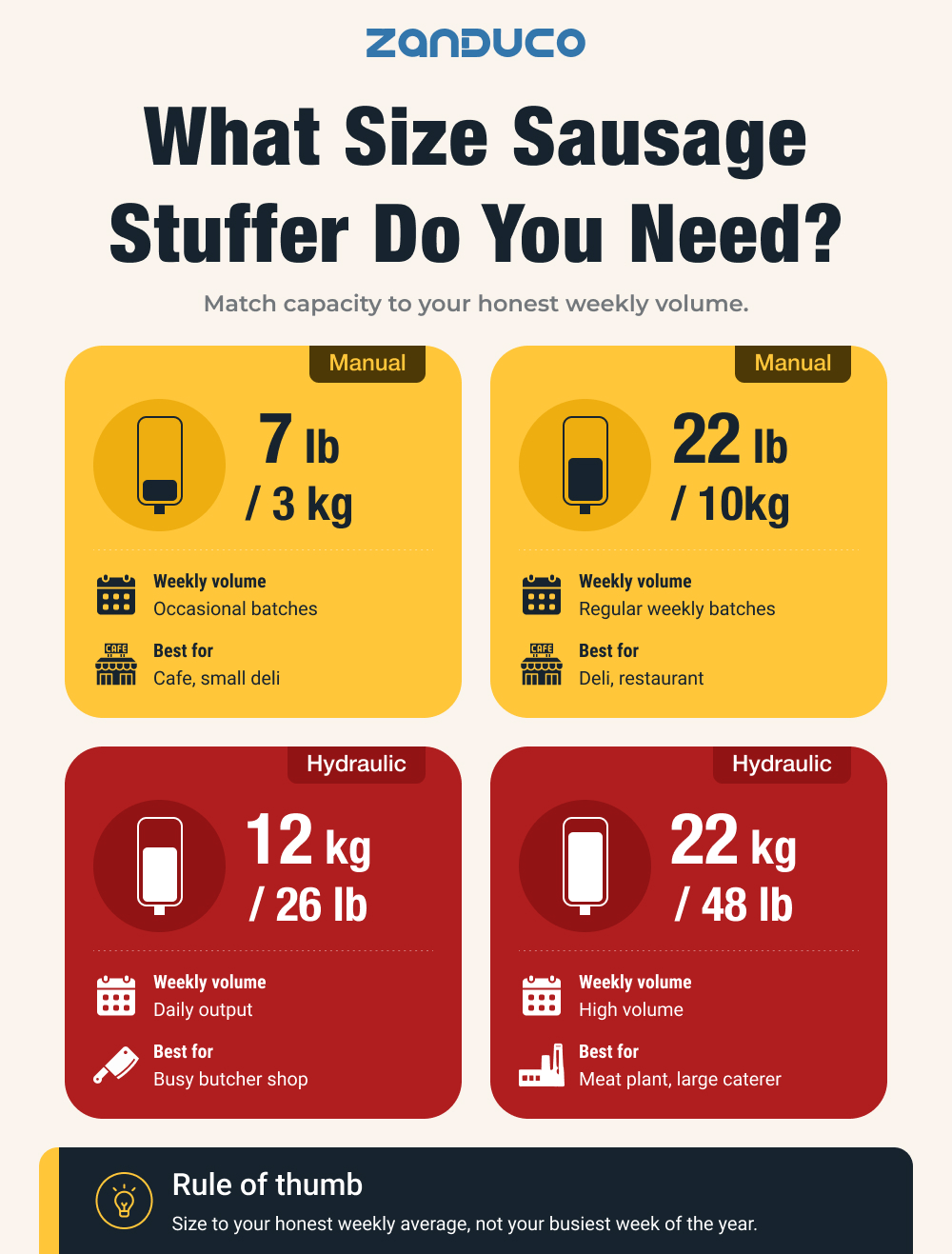
Buyer Tip: Size to your honest weekly average, not your busiest week of the year. A lot of buyers spec a hydraulic unit for a volume they hit twice a season, then spend the other fifty weeks working around a 140 kg machine they didn't need.
When a Manual Sausage Stuffer Is the Right Choice
A manual sausage stuffer is the most forgiving way to bring sausage in-house. Three things make it the smart starter.
Low cost. A vertical manual unit usually lands somewhere around $120 to $400 CAD depending on capacity and build, which is easy to justify on a hunch that house sausage will move. No power hookup, no motor, nothing on the electrical side to certify, and next to nothing to service. Stainless cylinder, a gear, a piston, a few spouts. Wipe it down, oil the gear, store it.
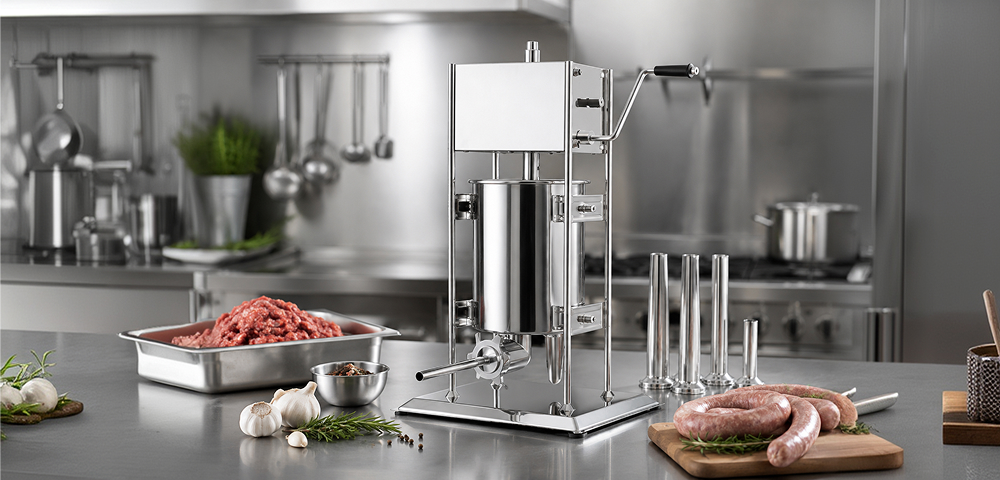
Feel. With a crank you sense exactly how the casing is filling. You can ease off on a thin natural hog or sheep casing to keep it from splitting, and you set your own pace. For small-batch and specialty work, that hand control is part of why butchers keep one on the bench long after they could afford to motorize.
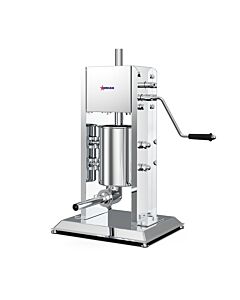
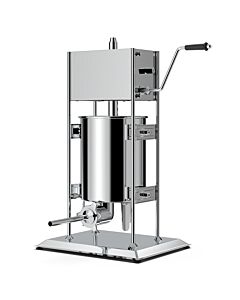
Capacity tiers that match your bench. A small vertical manual stuffer covers most delis, cafés, and specialty counters. The Omcan 7 lb vertical gear-driven stuffer suits a kitchen that fills casing now and then. Step up to the Omcan 22 lb / 10 kg vertical gear-driven stuffer for regular weekly batches, or the Omcan 33 lb / 15 kg vertical gear-driven stuffer when you want the most a hand crank can comfortably handle. Gear-driven models give you better leverage on stiff, cold mixes than a basic direct-drive unit, which earns its keep on longer runs.
A manual stuffer is the right tool when:
- You stuff occasionally or in small, specialty batches
- A typical session stays under roughly 11 to 14 kg (25 to 30 lb)
- You want to prove house sausage sells before committing real capital
- You run a food truck or mobile setup with no dependable power
- You want close, hands-on control over delicate natural casings
The honest limit: a manual stuffer tires whoever is turning the handle, and a sizeable batch usually needs two people, one driving the piston and one feeding casing and linking. That trade is fine for a few pounds. It becomes a daily grind once you are regularly past 25 to 30 lb in a sitting.
When a Hydraulic Sausage Stuffer Is Worth It
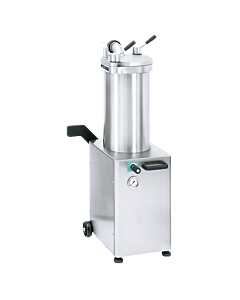
A hydraulic sausage stuffer turns stuffing from manual labour into supervision. The motor drives the piston, the knee lever feeds pressure, and you keep both hands on the casing the whole run. Steady pressure gives you a steady fill, which gives you links that match each other in length and weight. For any shop selling by the link or by the kilogram, that consistency is how you cost a product accurately and keep it honest at the scale.
The Trento hydraulic line is built for daily output. The 26 lb / 12 kg hydraulic piston stuffer handles a busy butcher counter on standard 110V power, with a pressure gauge, speed control, a thermal-protected motor, and a knee-lever lock for safety. When volume climbs, the 48 lb / 22 kg hydraulic piston stuffer moves bigger batches with the same controls and a wheeled base, because nobody is lifting a 140 kg machine.
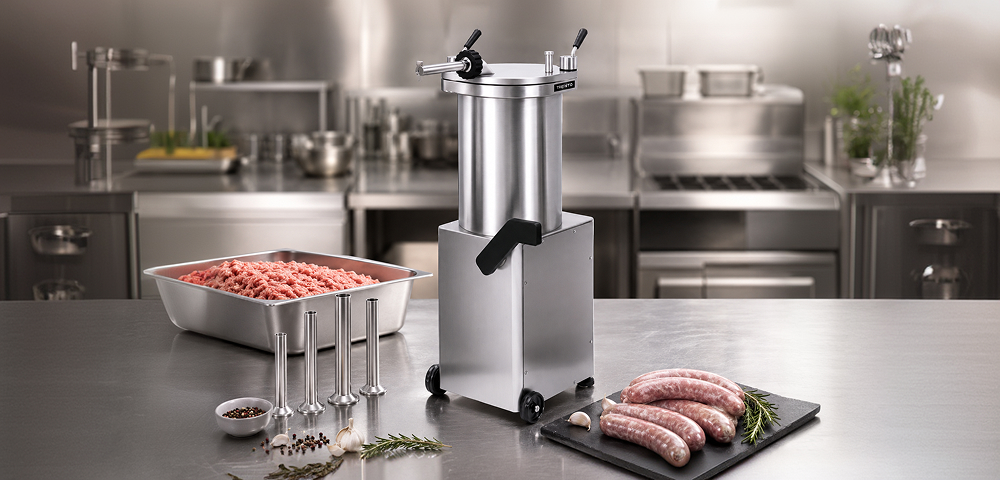
What you buy is time and repeatability. One person can run a hydraulic stuffer through a full shift without burning out, the fill rate climbs sharply, and every link looks like the last one. What you pay for it is a real number. Hydraulic units sit in the heavy-equipment tier, so budget for that and confirm current pricing before you commit. You also take on a motor, which brings electrical certification and a little more upkeep, mainly the hydraulic oil reservoir and keeping the motor from being overworked into its thermal cutout.
Worth Noting: These mid-tier hydraulic stuffers fill the casing, but twisting and clipping stay manual. If a seller hints the machine does the whole job end to end, slow down and ask exactly which steps are automated before you sign anything.
The Real Cost of Manual vs Hydraulic Stuffers
Sticker price is the easy part. The number that decides whether you made the right call shows up over a few years: labour, casings, spouts, electrical, and how long the machine lasts. Below is a hedged comparison. Treat every figure as an approximate range, not a quote, and verify current pricing before you order.
| Cost line | Manual stuffer | Hydraulic stuffer |
| Upfront purchase (CAD) | Roughly $200 to $700 | Typically several thousand dollars, into five figures for high-capacity models; confirm current pricing |
| Electrical install | None (no motor) | Standard 110V on the units above; verify your circuit and amperage |
| Certification concern | Sanitary / NSF design only | Electrical (CSA or equivalent) plus sanitation |
| Labour per large batch | Often two people; tiring | Usually one person; supervisory |
| Spouts / casings | Ships with 3 to 4 spouts (about 15 to 38 mm) | Ships with multiple tubes; same casing types |
| Maintenance | Minimal; clean and oil the gear | Motor plus hydraulic oil reservoir to maintain |
| Best-fit volume | Up to about 25 to 30 lb (11 to 14 kg) per session | Daily, high-volume production |
| Practical lifespan | Long; very few failure points | Long with upkeep; more parts in play |
The line that quietly drives the whole decision is labour. Two people spending an hour hand-cranking three times a week adds up faster than most buyers expect. Cross a certain volume and the hydraulic unit becomes the cheaper option per kilogram once you count those hours honestly.
How to Match a Stuffer to Your Volume
Match the stuffer to your real weekly average and the choice mostly makes itself:
- Under about 11 kg (25 lb), occasional or specialty: a 3 L to 7 L manual stuffer. Keep the cash for other gear and lose nothing in quality.
- Around 11 to 14 kg (25 to 30 lb), a few times a week: a 7 L manual or a horizontal gear-driven manual buys a bit more headroom. If you expect to grow, this is the moment to think hard about jumping to hydraulic instead.
- Daily production, or batches consistently over 14 kg (30 lb): go hydraulic. The 26 lb / 12 kg unit covers most active butcher counters; the 48 lb / 22 kg unit handles meat-plant and high-volume catering work.
Do not forget the front half of the line. Stuffing starts with grinding, and balancing the grinder to the stuffer keeps the whole bench moving. A #22 unit from the meat grinders range pairs well with a mid-size stuffer for a small butcher shop. If you already run a planetary mixer, some accept a grinder hub attachment, which our breakdown of commercial bakery mixers and their attachments covers in detail. A dedicated stuffer still gives you far better casing control than any attachment, so treat the hub as a backup, not the plan.
Common Mistake: Pairing a big stuffer with an undersized grinder. Bolt a 22 kg hydraulic stuffer onto a line fed by a grinder that maxes out at a few pounds a minute and the stuffer just waits. Balance the two stages to the same throughput.
Sausage Stuffer Certification Rules in Canada
Here is where shoppers trip, so it is worth being precise.
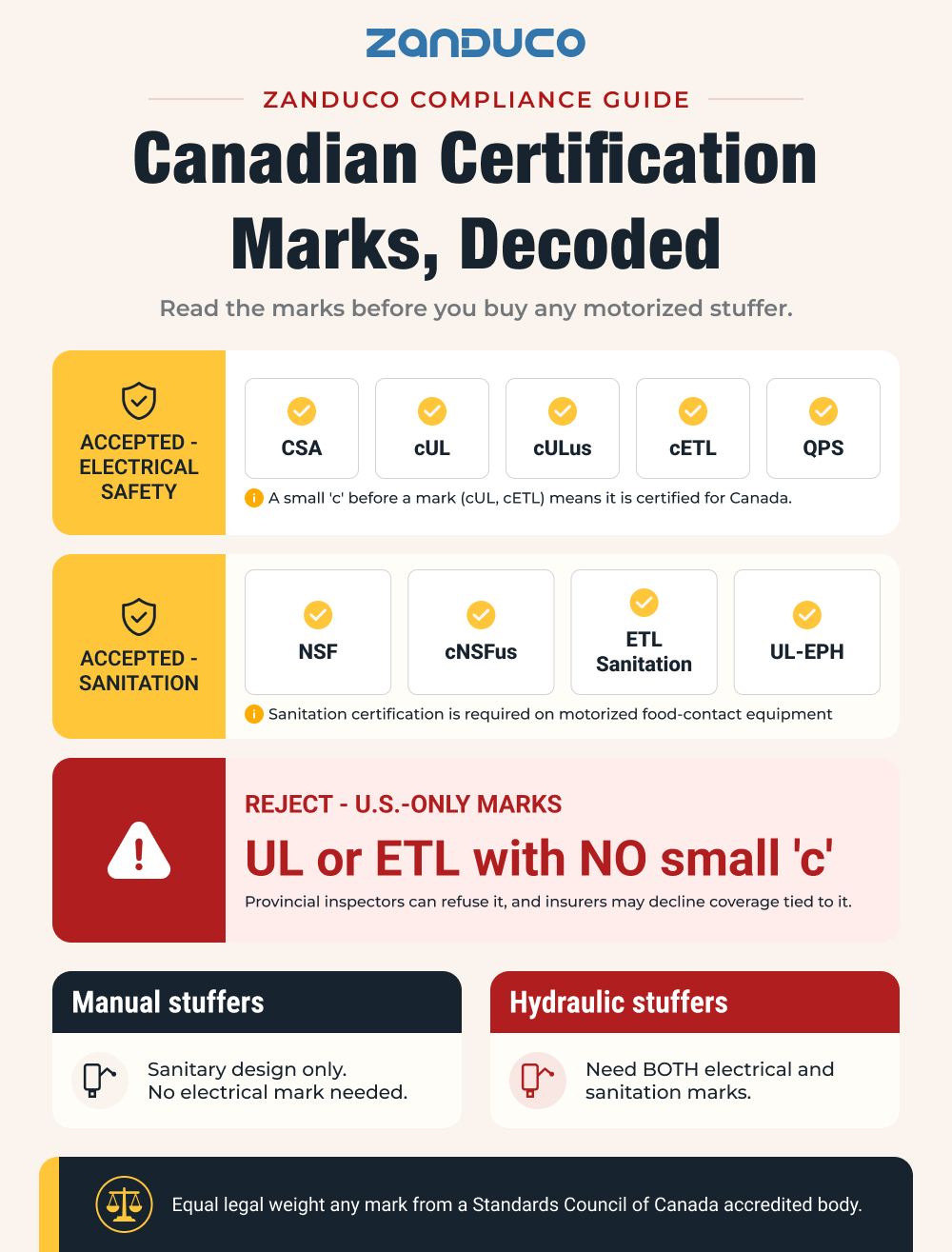
A manual stuffer has no motor, so there is no electrical safety mark to chase. What still matters is sanitary design: stainless contact surfaces, a piston seal and air-release valve you can take apart and clean, and no seams that trap meat. Those features line up with the NSF food equipment sanitation standards a health inspector checks against, so look for clean, fully removable construction even on a hand-crank unit.
A hydraulic stuffer has a motor, so it needs a valid electrical safety certification. CSA is the mark most Canadians know, and it is not the only one accepted. Any mark from a Standards Council of Canada accredited body carries equal legal weight, which includes cUL, cULus, cETL, and others. On the sanitation side, NSF and equivalent marks such as ETL Sanitation and cNSFus all certify to the same standards. The error that genuinely bites is buying a unit with a U.S.-only mark (a plain UL or ETL with no small "c"), because provincial inspectors can reject it and insurers may decline coverage tied to it. Our Canadian kitchen certification guide lays out which marks are interchangeable and which ones get equipment turned away, and it is worth five minutes before any motorized purchase.
What Changes Province to Province
Certification standards are national, but enforcement and meat licensing vary, and that matters once you scale a sausage program.
Quebec runs a notably strict inspection regime under MAPAQ, so a shop selling house sausage there should expect close attention to sanitary design and traceability. Ontario, British Columbia, Alberta, and the rest each layer their own provincial meat licensing and health-unit expectations on top of federal food safety rules. Confirm with your local health authority what your specific product and sales channel require before you commit to volume. None of this changes which stuffer you buy, but it does shape how carefully you document your process once you are producing daily.
One cold-climate note for the manual crowd: through an Alberta or Manitoba winter, keep your mix properly chilled (around 0 to 2°C is the sweet spot) but not so cold that it stiffens past what a hand crank can comfortably move. A near-frozen blend is exactly when a manual stuffer feels like a workout and a hydraulic piston barely notices. Too warm and the fat smears instead of staying defined, so temperature control earns its place either way.
So, Which One Should You Buy?
If you are just starting house sausage and you are not yet sure it will stick, buy manual. A 7 L vertical or a horizontal gear-driven unit lets you prove the product sells while you keep capital for the grinder, the mixer, or the refrigeration you genuinely cannot run without. Plenty of well-regarded specialty counters never need more than a good hand-crank.
If sausage is already a daily revenue line, or you can see it becoming one, buy hydraulic and move on. The labour you reclaim and the link-to-link consistency you gain repay the machine faster than the spreadsheet suggests, and a one-person stuffing station frees a second pair of hands for the counter. The 26 lb / 12 kg Trento is the sweet spot for most active butcher shops; size up to the 48 lb only when your volume truly calls for it.
Choose manual if you stuff occasionally, sessions stay under about 14 kg (30 lb), budget is tight, or you need portability.
Choose hydraulic if you stuff daily, sell by uniform link or weight, run batches over 14 kg, and want one person handling the whole job.
The trap is buying hydraulic on ambition for a volume you do not have yet, or clinging to manual on thrift while your crew burns two-person hours three times a week. Match the machine to your real average, check the certification before you pay, and build the rest of the line, from grinder to mixer to casing storage, around it. The full lineup sits in butcher equipment and supplies if you are outfitting a counter from scratch.
Recommended Sausage Stuffers to Compare
Once you know which side of the manual-versus-hydraulic line you sit on, here are the models worth shortlisting, grouped by how much you stuff and how often. Pricing shifts with stock and promotions, so check the current figure on each product page before you commit.
| Model | Type | Capacity | Best for |
| Omcan 7 lb vertical gear-driven | Manual | 3 kg (7 lb) | Occasional small batches, cafés, side menus |
| Omcan 22 lb / 10 kg vertical gear-driven | Manual | 10 kg (22 lb) | Regular weekly batches, delis, restaurants |
| Omcan 33 lb / 15 kg vertical gear-driven | Manual | 15 kg (33 lb) | The most a hand crank handles comfortably, busy counters |
| Trento hydraulic piston, 26 lb | Hydraulic | 12 kg (26 lb) | Daily output at a busy butcher counter |
| Trento hydraulic piston, 48 lb | Hydraulic | 22 kg (48 lb) | High volume, meat plants, large caterers |
Want the full set side by side, including spouts and accessories? Browse the manual sausage stuffers and hydraulic sausage stuffers collections.
Ready to Fill Your First Casing?
Whichever way your volume points, Zanduco Canada carries both sides of this decision, from compact manual stuffers to heavy-duty hydraulic piston units, plus the grinders, spouts, and butcher gear to round out your line. Compare capacities, check the specs against your weekly batch, and build a sausage program that pays its own way. Browse the full sausage stuffer range or talk to the Zanduco team about matching a machine to your shop's volume.