Free Shipping (On select items & orders)
  Track My Order


Posted in: Commercial Kitchen Equipment
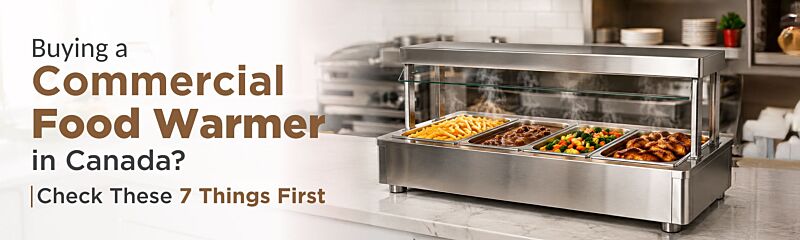
A great plate can fall apart in the last ten minutes before it reaches the table. Chicken dries at the edges. Gravy skins over. Fries go soft. None of that happens on the range. It happens in the gap between "cooked" and "served."
Closing that gap is the entire job of a commercial food warmer. Most first-time buyers treat it as an afterthought, grab the cheapest unit that fits the counter, then spend two years fighting cold spots and dried-out pans.
So let's do this properly. Types, heat styles, sizing, controls, power, Canadian certification, energy, and real prices pulled from live listings. By the end you'll know which format fits your service and roughly what to budget.
Quick answer: The right commercial food warmer depends on how long you hold food and how wet that food is. Short holds of saucy or steamed items suit a wet-heat countertop warmer or steam table. Long holds of bulk trays belong in an insulated holding cabinet. Fried and crisp items want dry heat or a heat lamp. Whatever you choose, it must hold at or above 60°C (140°F) and carry a safety mark from a Standards Council of Canada accredited body.
If you read nothing else…
- Hold at 60°C (140°F) or hotter. Below that is the bacterial danger zone.
- Wet heat for sauces and stews. Dry heat for anything crispy.
- Size by pans at peak, not by counter space.
- A plain "UL" mark with no "c" is not certified for Canada.
- Steam table pans are usually sold separately. Budget for them.
Your Warmer Holds Food. Cooking Happens Somewhere Else
A food warmer keeps already-cooked food at a safe serving temperature. Push raw or half-cooked product into one and you get two problems at once: a food safety risk, and a texture disaster, because holding heat slowly dries whatever sits in it.
Health Canada is specific about the numbers, and every provincial health inspector works from them.
| What | Temperature | Why it matters |
|---|---|---|
| Hot holding | 60°C (140°F) or hotter | Above the bacterial danger zone |
| Danger zone | 4°C to 60°C (40°F to 140°F) | Bacteria can double roughly every 20 minutes |
| Max time in danger zone | 2 hours cumulative | After that, discard |
| Reheating before holding | 74°C (165°F) | Reheat on the range, then transfer |
Source: Health Canada, general food safety tips
Two habits separate clean inspections from ugly ones. Use a probe thermometer at the unit instead of trusting the dial, because dials drift. And never use a warmer to bring cold food up to temperature. British Columbia's food safety guidance warns that loading cool product into a hot-hold unit parks it in the danger zone while it slowly climbs, which is where pathogens multiply fastest.
Common mistake: cranking the thermostat higher to "hold longer." Extra heat buys you no extra time. It only accelerates drying. Hold at the safe temperature and manage the clock instead.
Six Types of Commercial Food Warmer, and What Each One Is For
"Food warmer" names a category rather than a single product. The food holding and warming equipment range splits into formats built for different jobs.
| Format | Heat style | Realistic hold time | Suits |
|---|---|---|---|
| Countertop chamber / bain-marie | Wet | Medium | Soups, sauces, stews, steamed sides |
| Steam table / food well | Wet or dry | Medium to long | Buffet and catering lines |
| Glass display warmer | Dry, humidified | Medium | Bakeries, grab-and-go, convenience |
| Holding and proofing cabinet | Controlled temp and humidity | Long | Batch cooking, high volume |
| Warming drawer | Gentle dry | Medium | Breads, rolls, plated staging |
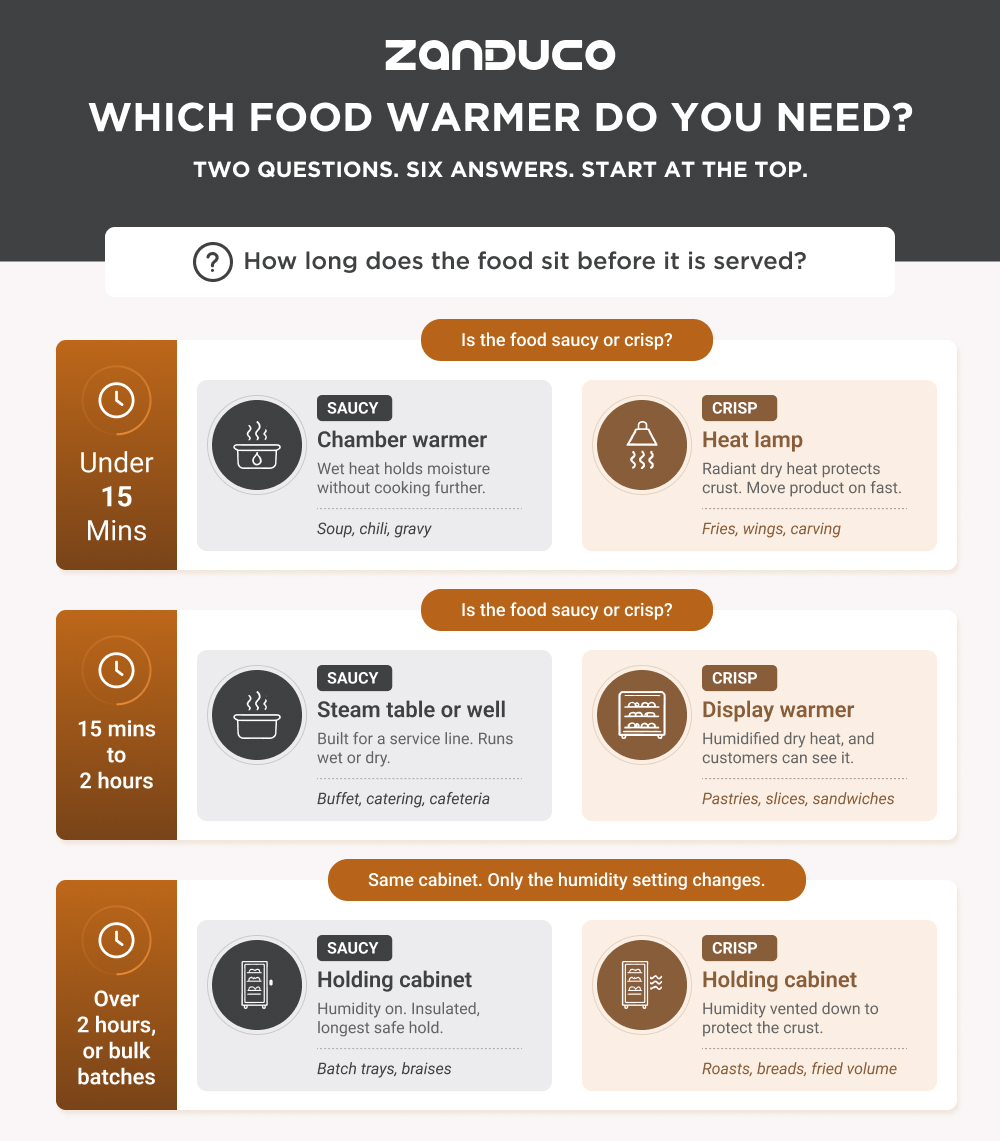
| Heat lamp / strip warmer | Dry radiant | Short, under ~15 min | Pass windows, carving, fries |
Most kitchens end up running two formats rather than one. A café pairs a soup warmer with a pastry case. A dinner service pairs a holding cabinet in the back with lamps at the pass.
For single-item holding, a compact Omcan single chamber food warmer covers a lot of ground at 1,200 W with a 30°C to 90°C thermostat. The two chamber version holds 8 litres per container and lets you run two items at different settings side by side.
Wet Heat or Dry Heat? Your Menu Already Decided
This is the call that determines whether your food arrives the way the kitchen intended. It comes down to what you hold.
Choose wet heat if you hold:
- Soups, chowders, and stews
- Sauces, gravies, and cheese dips
- Steamed vegetables and rice
- Braised proteins and curries
Choose dry heat if you hold:
- Fried chicken, fries, and onion rings
- Breaded and battered items
- Pastries, breads, and pizza
- Anything with a crust you want to keep
Wet heat surrounds food with moisture from a water bath, which is why a bain-marie or a food well and steam table is the buffet standard. That same moisture destroys anything crisp within minutes.
Dry heat protects texture and slowly desiccates food over long holds. Heat lamps sit at the extreme end. Zanduco's own heat lamp category guidance puts sensible lamp holds at under about 15 minutes before product should move to a humidity-controlled cabinet. If you want the bulb-versus-strip breakdown, the guide on choosing the right heat lamp for your restaurant covers it.
Plenty of steam tables run dry with the option to add water for wet holding, so a dual-capable unit earns its keep on menus that swing between crispy and saucy.
Buyer tip: a pizzeria holding cheese sauce and a fish-and-chip shop holding fried cod need opposite heat styles, even sitting on identical counters. Match the heat to the food.
Size It in Four Steps (The Pan Math)
Capacity is where buyers overspend or under-buy. Both hurt. Work through this in order.
Step 1 - Count your held items at peak.
List every dish you hold hot during your busiest 30 minutes.
Step 2 - Assign a pan fraction to each.
Warming gear is built around standard pans. A full-size pan runs about 305 by 508 mm (12 by 20 in). Everything else is a fraction: half, third, sixth.
Step 3 - Convert to volume.
A full-size pan at 100 mm (4 in) deep holds roughly 13 litres (about 14 quarts). Deeper 150 mm (6 in) pans hold closer to 20 litres.
Step 4 - Add 20% headroom, then measure your counter.
A three-pan warmer that overhangs your line is an expensive paperweight.
Here’s a worked example. A café holds soup, chili, and a vegetable side at lunch. Soup takes a full-size pan, chili a half, veg a half. Total: two full-size pan equivalents. A two-well countertop bain-marie handles it with room to spare. A five-well steam table would burn energy heating empty water.
Worth noting: "full size" is not one standard. North American 12 by 20 in pans and European GN 1/1 pans (530 by 325 mm) look similar and do not swap. Zanduco stocks units built for both, so confirm which standard your unit takes before you order pans. Getting this wrong is the single most common reorder we see.
Dial or Digital? Choosing Food Warmer Controls
Two control styles dominate the market.
Rheostat (infinite dial, often marked 1 to 10)
- ✅ Cheaper to buy and cheaper to replace
- ✅ Fine for short, supervised holds
- ❌ You monitor temperature yourself
- ❌ Drifts as room temperature and load change
Thermostat (digital or capillary)
- ✅ Self-corrects as the load changes
- ✅ Clear readout for inspectors and staff
- ✅ Better for multi-hour food safety holds
- ❌ Costs more upfront
Higher-end wells add practical touches worth paying for. Vollrath's ServeWell hot food stations, for example, use capillary tube thermostats that supply power only when needed, plus a low-water indicator light that removes guesswork from wet holding.
If you hold food for hours, buy the thermostat. If you hold for twenty supervised minutes, the dial is fine.
Run the Power Check Before You Check Out
Installs go sideways at this step more than any other. Small countertop warmers run on a standard 120 V outlet. Larger steam tables and holding cabinets often want a dedicated circuit, and some pull 208 V or 240 V. Zanduco's 44-inch single-tank steam table, for instance, is a 208 V, 3 kW unit, which means a specific receptacle and likely an electrician.
Confirm all four before you buy:
- Voltage (120 V, 208 V, or 240 V)
- Amperage and whether the circuit is dedicated
- Plug configuration (a NEMA 5-20P plug will not fit a 5-15R outlet)
- Physical clearance for the cord exit and door swing
Retrofitting a circuit after delivery is a cost that never makes it into the budget. The same homework applies to any heavy line equipment, and the guide on selecting the right commercial range walks through identical electrical checks if you are speccing more than one piece.
Does a Commercial Food Warmer Need CSA Certification in Canada?
This is the section the American buying guides cannot help you with. A persistent myth says only a CSA mark is legal here.
| Myth | Fact |
|---|---|
| Only CSA-certified gear is legal in Canada | Any mark from an SCC-accredited body carries equal legal weight: CSA, cUL, cULus, cETL, QPS, and others |
| A "UL" sticker means it passed | Plain UL with no "c" is a US-only certification |
| A CE mark is close enough | CE is European and satisfies nothing in Canada |
| One safety mark covers everything | Food-contact equipment also needs an NSF/ANSI sanitation mark |
Health Canada's electrical product safety guidance puts it plainly: products that plug into an outlet must be certified by an accredited certification body, and buyers should look for CSA, cUL, or cETL. The Standards Council of Canada publishes the recognized marks, and provincial authorities including Ontario's Electrical Safety Authority and Technical Safety BC work from that list.
Before you buy, verify:
- Safety mark with the "c" (CSA, cUL, cULus, or cETL)
- Sanitation mark to NSF/ANSI standards (NSF, cNSFus, ETL Sanitation, or UL-EPH)
- The exact model listed in the certifier's public directory
Worth noting: warmers bought from US-only sellers are the number one certification trap. Cheap at checkout, expensive at inspection. If a unit arrives uncertified, your options narrow to a field evaluation by an SCC-accredited inspection body, or a return.
Zanduco's breakdown of how SCC-accredited certifications really work in Canadian kitchens is the reference to keep bookmarked, including the exact wording to use when an inspector questions a cETL mark.
Energy Bills and the Rebate Reality
Warmers run for hours, so efficiency shows up on the bill rather than the invoice. Insulation is the biggest lever, and the federal numbers are strong.
By the numbers: Natural Resources Canada reports that an ENERGY STAR certified hot food holding cabinet uses about 70% less energy on average than a standard model, saving roughly $300 a year in electricity and over $2,800 across the product lifetime. The gains come from better insulation, more even temperature from top shelf to bottom, and a cooler exterior. Source: NRCan
NRCan's practical advice for holding cabinets:
- Buy insulated models rather than uninsulated ones
- Shut cabinets down overnight on a fixed schedule
- Keep door gaskets and auto-closers sealing properly
Now the honest part about rebates. Most commercial food warmers are electric, so gas utility programs such as Enbridge Gas in Ontario and FortisBC in British Columbia generally target gas cooking equipment rather than warming gear. Your realistic path is your electric utility's commercial efficiency program, and ENERGY STAR certified holding cabinets are the category most likely to qualify. Check before you assume, and check before you buy.
One cold-climate note. In Alberta and Manitoba, prep areas and incoming product run genuinely cold through winter, and every door opening on an uninsulated cabinet costs you recovery time. Alberta Health Services holds the same 60°C line as the rest of the country, so a cabinet that recovers slowly is a compliance problem as much as an energy one.
What a Commercial Food Warmer Costs in Canada
Prices below were observed on zanduco.com/ca while writing this guide. Treat them as planning ranges in Canadian dollars. Equipment pricing moves, so confirm on the product page.
| Format | Typical range (CAD) | Real example |
|---|---|---|
| Countertop chamber warmer | ~$180 to $600 | Omcan two-chamber, 8 L per container, around $279 |
| Bain-marie with pans | ~$450 to $600 | Omcan 1.5 kW, three half-size pans, around $465 |
| Open-well electric steam table | ~$900 to $1,500 | Zanduco 44" three-pan, around $969 |
| Tank steam table (208 V) | ~$2,000 to $2,500 | Zanduco 44" single tank, 3 kW, around $2,449 |
| Glass countertop display warmer | ~$1,100 to $2,000 | Zanduco 34" square display, around $1,131 |
| Portable heated-base warmer | ~$1,000 to $1,600 | Hatco Ultra-Glo UGFFBL, around $1,520 |
| Multi-well hot food station | ~$3,500 to $4,800 | Vollrath ServeWell four-well, around $4,586 |
The unit price is only part of the bill. A mid-size buffet setup breaks down like this.
| Line item | Estimated cost (CAD) | Notes |
|---|---|---|
| Steam table or warmer | ~$900 to $1,500 | The base unit |
| Steam table pans and lids | ~$60 to $200 | Commonly sold separately |
| Spillage or water pans | ~$30 to $120 | Required for wet holding |
| Probe thermometer | ~$20 to $80 | Non-negotiable for compliance |
| Dedicated circuit (208 V units) | Varies by site | Budget for a licensed electrician |
| Shipping | Varies | Free shipping applies on select items and orders |
Kitchen planning tip: Zanduco's open-well steam table listings state plainly that pans are not included. Buyers discover this the morning of a catering job and pay for rush shipping. Add pans to the same cart.
Which Warmer Suits Your Kind of Kitchen?
| Your business | Start with | Add later |
|---|---|---|
| Café or coffee shop | Countertop wet warmer for soup | Small display case |
| Pizzeria | Sauce warmer for cheese and dips | Heated slice display |
| Caterer or banquet | Steam table plus portable heated warmer | Second mobile unit |
| Bakery | Display and merchandising warmer | Proofing cabinet |
| Hotel or institutional | Insulated holding cabinet | Heat lamps at the pass |
| Food truck | One right-sized countertop unit | Nothing, space wins |
Pizzeria owners speccing a full station will find the companion rundown on buying the right pizza supplies in Canada useful for everything sitting around the warmer.
Five Mistakes Canadian Buyers Keep Repeating
- Buying US-only certified gear. No "c" on the safety mark risks a failed inspection.
- Mismatching heat style to menu. Wet heat ruins crisp food. Dry heat dries sauces.
- Trusting the dial. Keep a probe thermometer at the unit and spot-check pans.
- Forgetting pans. Pans, lids, and spillage pans are frequently sold separately.
- Sizing for the average hour. Size for the busiest 30 minutes.
What I'd Buy, and In What Order
No single unit does everything well, so stop hunting for one. For a typical Canadian restaurant on a sensible budget, I would buy two purpose-built pieces.
Start with an insulated holding cabinet for back-of-house bulk holding. That is where food quality and the 70% energy saving both live. Then add whichever front-of-house format matches your menu: a wet-heat steam table for a saucy buffet, a glass display warmer for grab-and-go, or lamps at the pass for a fried menu.
For a café or a food truck tight on space and cash, skip the cabinet. Buy one well-sized countertop warmer matched to your most-held item, run it for a season, then add a second unit once volume proves the case. Buying the biggest unit "to be safe" leaves you heating empty water and paying for it every shift.
Ready to Warm Up Your Service Line?
Pick the format that matches how long and how wet you hold. Confirm the safety mark carries a "c." Add the pans to the same cart. If you want a second opinion on sizing, browse the full food holding and warming equipment range or call the Zanduco team with your menu and your counter measurements. Sixty years in Canadian kitchens means we have seen which units survive a Friday night and which ones do not.