 Free Shipping (On select items & orders)
  Track My Order


Posted in: Commercial Kitchen Equipment
Browse any bakery supply catalogue or any commercial baking accessories supply catalogue and you will quickly discover that "oven mitt" no longer means one thing. The heat-protection category has expanded significantly like terry cloth oven mitts, silicone gloves for kitchens, neoprene options, rotisserie gloves for restaurant use, and cut-and-heat combo gloves, and the choices can feel overwhelming if you are not sure what separates them.
The answer is simpler than it looks. Each type of heat protection is designed for a specific combination of temperature, task, and kitchen environment. Buying the wrong type is not just a waste of money. It is a safety gap.
This guide breaks down every major category of commercial kitchen heat protection gloves and maps them directly to the tasks they are built for, so you can equip every station correctly.
The Core Distinction of Mitt vs. Glove
This is the first decision point when choosing heat resistant gloves for a commercial kitchen. A traditional oven mitt encloses the entire hand without separating the fingers. A heat-resistant glove functions more like a regular glove, with individual finger slots that allow for greater dexterity and precision handling.
Mitts offer better overall insulation because there is no need to accommodate finger separation, so the material sits denser and more consistently across the palm and back of the hand.
Gloves offer better grip and control, which matters when you are handling oddly shaped items, adjusting grip on a hot pan mid-service, or working with equipment that requires fine motor input.
CORE RULE
Use mitts when maximum insulation and forearm coverage is the priority. Use gloves when you need dexterity for precise handling at high temperatures.
Browse all Oven Mitts & Pads at Zanduco Canada →
Terry Cloth Oven Mitts
For the majority of standard commercial kitchen tasks like pulling sheet pans, rotating trays in a convection oven, handling hotel pans during service, terry cloth oven mitts remain the most practical everyday choice. The cotton or poly-cotton construction provides solid insulation for short-contact, moderate-to-high heat tasks, and the natural contouring of the fabric gives a reliable grip on cookware surfaces.
The weakness is moisture. Terry cloth absorbs liquid, and a wet mitt becomes a heat conductor rather than an insulator. For dry-heat environments like convection ovens and standard ranges, commercial terry cloth oven mitts are excellent. For steam-heavy applications, you need a moisture barrier, which is exactly what the silicone-lined version delivers.
FEATURED PRODUCT
13" Terry-Cloth Oven Mitts with Silicone Lining

Silicone Gloves for Commercial Kitchens
Silicone lining transforms a standard terry cloth mitt into a moisture-resistant commercial oven mitt. The silicone acts as a vapor barrier, so if steam or liquid contacts the exterior, it does not penetrate the insulation layer underneath. This is critical in kitchens operating combi ovens, steamers, or any station where pots of liquid are regularly handled.
Full silicone gloves for kitchen use take this further. The entire exterior is silicone, making them waterproof, easy to clean, and resistant to grease. They typically withstand up to 400°F–450°F of dry heat, and because they are non-porous, maintenance is almost effortless, a quick wipe or rinse between uses. The trade-off is breathability. Silicone gloves can make hands sweat during extended wear, and they tend to be less comfortable for tasks requiring prolonged handling.
When to Choose Silicone Over Cloth
- Steam-injected combi oven operations
- Stations with regular liquid handling like soups, stocks, sauces
- High-sanitation environments requiring frequent glove cleaning
- Any task where a wet mitt would otherwise become a burn hazard
MOISTURE SAFETY NOTE
Never use a wet terry cloth mitt on a hot surface. Steam transfer through damp fabric causes burns faster than direct pan contact. Silicone-lined mitts eliminate this risk at moisture-heavy stations.
Flame-Retardant Oven Mitts
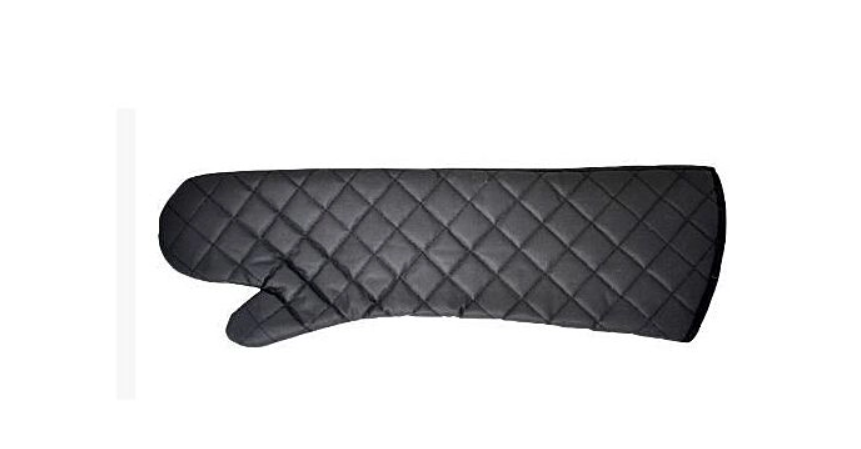
If your kitchen runs a charbroiler, wood-fired oven, rotisserie, or any open-flame cooking surface, standard mitts are not appropriate. Flame-retardant oven mitts for commercial kitchens are treated with materials that resist ignition when exposed to direct flame. They will not catch fire, melt, or degrade under conditions that would compromise standard cotton or terry cloth in seconds.
The ANSI/ISEA 105 standard which is widely referenced across Canadian foodservice, classifies heat protection from Level 1 (basic) to Level 5 (extreme). For open-flame environments, targeting ANSI Level 3 to Level 4 heat resistant gloves with inherently flame-resistant materials is the professional standard. This is not over-engineering. A mitt failure near an open flame is a serious burn incident.
FEATURED PRODUCT
24" Flame-Retardant Oven Mitts
Rotisserie Gloves
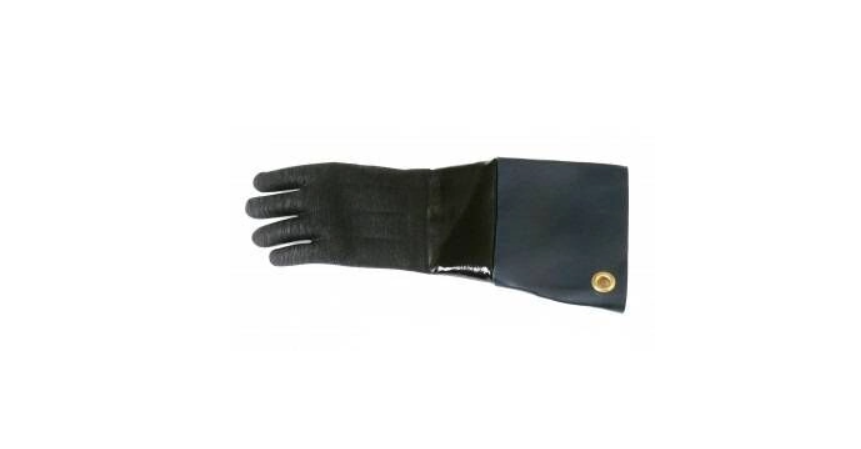
Rotisserie gloves are engineered for a very specific set of tasks: handling skewers, adjusting product on rotating spits, reaching into rotisserie oven cavities, and working around the sustained radiant heat these units produce. They are typically longer than standard mitts like 18" to 24" and made from materials combining flame resistance with structural durability suited to the mechanical demands of rotisserie work.
The geometry of rotisserie work creates exposure scenarios a standard mitt handles poorly. Reaching in at angles, gripping metal skewers, adjusting product under live heat and these motions expose the wrist and forearm in ways that a 13" mitt leaves entirely unprotected. If your operation includes a commercial rotisserie unit, proper rotisserie gloves with full forearm coverage are not optional.
FEATURED PRODUCT
https://www.zanduco.com/ca/san-jamar-rotissi-glove-17-length-t1217.html
Neoprene and Specialty Gloves
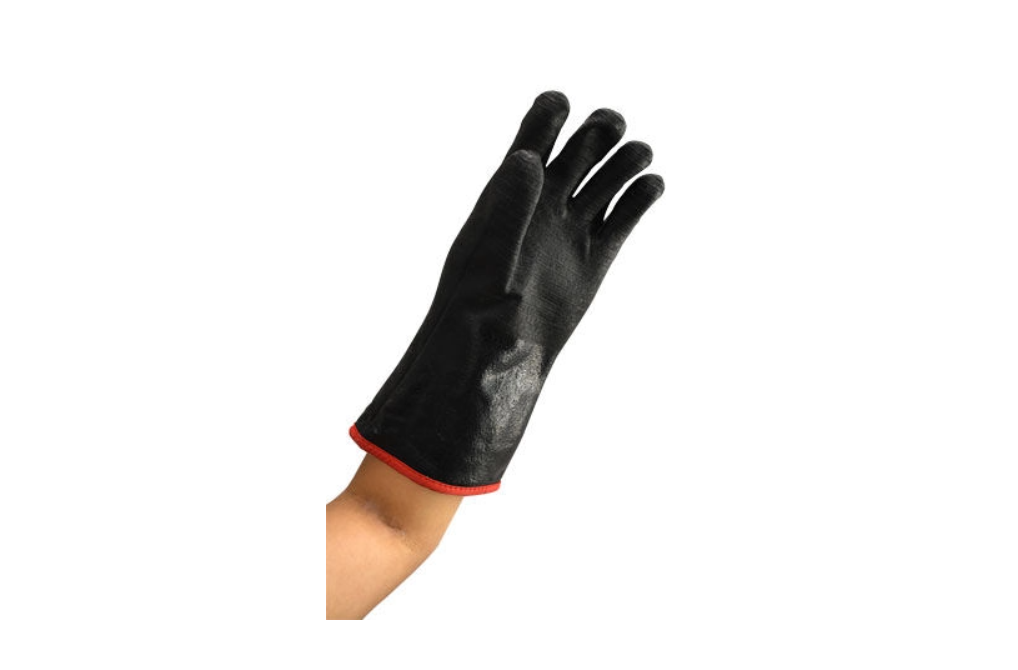
Neoprene gloves offer a fundamentally different set of properties from fabric-based mitts. They are waterproof, chemically resistant, and provide good thermal insulation against both heat and cold. In foodservice environments, they are the standard choice for dishwashing and pot-scrubbing stations where staff face high-temperature water and cleaning chemicals simultaneously, conditions that would degrade most standard gloves within a single shift.
Some neoprene gloves are also appropriate for fryer station heat protection, offering resistance to oil splash and the kind of sustained low-immersion heat that conventional mitts are not designed for. Their waterproof exterior also makes them practical for cold storage and freezer stations, a versatility that makes them valuable in kitchens where staff rotate between stations with very different thermal conditions.
REGULATORY NOTE
Canadian employers are required under provincial occupational health and safety legislation to provide appropriate PPE for all heat and chemical hazards. Oven mitts and heat-resistant gloves are PPE. Document your selection process and train staff on correct use.
FEATURED PRODUCT
Omcan 12" Heavy-Duty Heat-Resistant Neoprene Gloves
The Bakery Station Needs
High-volume baking creates demands that differ from a restaurant line. Bakers pull sheet pans, loaf pans, and hotel pans in rapid succession throughout a shift and sometimes dozens of times per hour. The best oven mitts for bakery kitchens need to be comfortable for extended wear, durable enough for constant use, and flexible enough for the quick repositioning that baking demands.
Baker's mitts are typically heavier-duty terry cloth or blended fabric, built for sustained baking operations. They prioritize grip consistency and comfort over extreme heat resistance, since baking temperatures, while high, are more predictable and sustained than the explosive bursts of a grill or fryer. The ambidextrous design is particularly valuable in bakery environments where one baker is often pulling pans with both hands in rapid succession throughout an uninterrupted baking sequence.
FEATURED PRODUCT
Baker's Oven Mitt 17" (Pair)
Match Your Protection to Your Station
Use this table to identify the right heat protection type for each station in your kitchen. The right match depends on three factors: temperature profile, moisture exposure, and task-specific dexterity requirements.

Build a Complete Heat-Protection Setup for Your Kitchen
The right oven mitt or heat-resistant glove is one layer of a broader kitchen safety and equipment setup. Once you have the right heat protection at each station, the next step is ensuring your overall commercial smallwares inventory is equally well-matched to your operation.
Browse all Oven Mitts & Pads at Zanduco Canada →
Explore the full Smallwares catalogue →
Shop Bakery Supplies and baking accessories →
View commercial Cookware and kitchen tools →
See all Commercial Kitchen Equipment →
There is no single "best oven mitt for commercial kitchens". There is only the right mitt for the specific job being done. A kitchen equipped with purpose-matched heat protection at every station is a safer, faster, and more operationally sound kitchen. The difference between the right mitt and the wrong one is measured in burns, in service speed, and ultimately in the wellbeing of the people who run your kitchen every day.
Zanduco has been supplying Canadian commercial kitchens for over 60 years. The oven mitts and heat protection range is built for real commercial demands with the product depth to equip every station correctly.


