Free Shipping (On select items & orders)
  Track My Order


Posted in: Restaurant Management
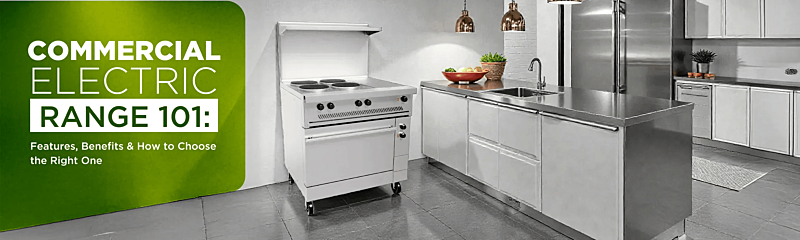
Most operators do not question their commercial kitchen range until something goes wrong.
It might be a failed inspection, a renovation that suddenly gets expensive, or a service where the line just cannot keep up. At that point, the choice between a commercial gas cooking range and a commercial electric cooking range stops being theoretical. It becomes a real operational decision that affects safety, energy costs, and how reliably the kitchen performs every day.
This guide looks at those decisions through a practical, Canadian lens.
The Range Is the Heart of the Line
Every kitchen has a centre of gravity. In most operations, that is the commercial cooking range.
It is where sauces live, proteins finish, pans stack up, and timing decisions get made. When the range is right, service feels controlled. When it is wrong, everything backs up.
In Canadian kitchens, operators typically work with:
- Commercial electric cooking ranges
- Commercial gas cooking ranges
- A mixed setup supported by specialty equipment
Electric ranges are becoming more common, especially in urban locations, shared buildings, and renovated spaces where gas and ventilation upgrades are expensive or restricted.
Why More Canadian Kitchens Are Choosing Electric
Electric ranges used to have a reputation problem. Many operators still picture slow heat-up times and weak output.
Modern commercial electric ranges are a different story.
Operators are switching because electric makes sense in today’s regulatory and operational reality:
- Easier Compliance: Simpler adherence to fire and electrical codes.
- Reduced Requirements: Lower ventilation and make-up air needs.
- Staff Comfort: Lower ambient kitchen heat.
- Cleaner Operation: No open flame or combustion gases.
- Quality Control: More consistent temperature control for sauces and baking.
For many kitchens, electric is not just an alternative. It is the path of least resistance to opening on time and staying compliant.
What to Look for in a Commercial Electric Cooking Range
Specs matter, but context matters more. These are the features that actually impact daily performance.
| Feature Area | Key Considerations |
| Cooking Surface | Solid hot plates (steady heat), Coil elements (quick response), Heavy-duty plates (constant use). |
| Oven Function | Temperature accuracy/recovery, Interior capacity, Convection availability. |
| Electrical Compliance | CSA certification, Voltage/phase compatibility, Load requirements for your building. |
Cooking Surface Options That Match Your Menu
Electric ranges are not one-size-fits-all. Surface styles include:
- Solid hot plates for steady heat and durability
- Coil elements for quicker responsiveness
- Heavy-duty plates designed for constant use
If your menu relies on sauces, reductions, or controlled simmering, stability matters more than raw output.
The Oven Is Doing More Work Than You Think
Many kitchens underuse or misuse the oven portion of the range.
Pay attention to:
- Temperature accuracy and recovery
- Interior capacity
- Whether convection is available
A reliable oven keeps prep moving during service instead of creating backups.
Electrical Requirements You Cannot Ignore
In Canada, this is critical.
Always confirm:
- CSA certification
- Voltage and phase compatibility
- Load requirements for your building
This is where inspectors focus, and where mistakes get expensive.
Compliance Is Not a Checkbox. It Is Operational Insurance.
Inspections do not just determine whether you open. They affect insurance coverage, liability exposure, and future renovations.
Commercial electric ranges often simplify compliance because they remove:
- Gas piping concerns
- Combustion air requirements
- Flame-related fire risks
Inspectors will still check:
- Clearances
- Electrical disconnects
- Grounding
- Manufacturer certification
When equipment aligns with code, inspections become predictable instead of stressful.
The Most Common Range Buying Mistakes
These issues show up again and again:
- Buying based on power ratings alone.
- Ignoring the building’s electrical limits.
- Expecting one range to handle every task.
- Overcrowding the hot line during service.
- Forgetting how inspectors actually evaluate kitchens.
Heavy boiling, for example, should not live on your main range. This is where a Stock Pot Range earns its keep and protects your core equipment.
A Real Kitchen Example You Will Recognize
A mid-sized restaurant in Ontario renovated its space and planned to reinstall a commercial gas cooking range. The ventilation upgrades triggered by gas nearly doubled the renovation budget.
They pivoted to a commercial electric cooking range, paired it with a Stock Pot Range, and added Countertop Gas Hot Plates for flexible tasks.
The result:
- Faster approvals
- Lower build-out costs
- Cooler kitchen environment
- Better line balance during service
The equipment worked with the space instead of fighting it.
Building a Cooking Line That Actually Flows
The smartest kitchens design around roles, not just equipment.
A well-balanced line might include:
- A primary commercial electric range
- A Stock Pot Range for batch cooking
- Countertop Gas Hot Plates for quick, flexible tasks
- Dedicated fryers or griddles to offload volume
This approach reduces congestion and extends equipment life.
Zanduco’s commercial kitchen equipment selection supports this modular mindset, which is especially important for Canadian kitchens with space and power constraints.
Electric vs Gas: A Direct Comparison
| Consideration | Electric Range | Gas Range |
| Temperature control | Consistent and precise | Immediate response |
| Ventilation | Lower demand | Higher demand |
| Kitchen heat | Cooler | Hotter |
| Compliance | Often simpler | More complex |
| Maintenance | Fewer combustion parts | Burner upkeep |
Neither is “better” universally. The right choice depends on context.
How to Choose the Right Range Without Second-Guessing Later
Ask yourself:
- What cooking tasks dominate service?
- How many pans hit the line at once?
- What does the building support?
- What will inspectors focus on?
- What equipment should support the range, not overload it?
- How will this kitchen grow?
If the answers are unclear, that is your signal to pause and plan.
Smart Compliance Leads to Stronger Kitchens
A commercial electric cooking range is not just about cooking. It is about predictability.
When your equipment aligns with code, workflow, and menu demands, you reduce friction everywhere else. Inspections go smoother. Staff work more comfortably. Energy use becomes predictable. Growth becomes easier.
Get Expert Help Choosing the Right Commercial Kitchen Range
If you are upgrading or building a kitchen in Canada, explore CSA-approved commercial kitchen ranges, Stock Pot Ranges, and Countertop Gas Hot Plates designed for real-world operations.
Talk to Zanduco’s experts to choose equipment that works with your kitchen, not against it.
FAQs
Do electric ranges cook as quickly as gas?
Yes, a commercial electric cooking range can cook just as quickly as a commercial gas cooking range in most professional kitchens. While gas feels more responsive at first, electric ranges deliver consistent heat and faster recovery across multiple pans, which matters more during real service. For sautéing, sauces, and oven-based cooking, many operators see little to no speed difference.
Can a commercial electric range handle heavy use?
A properly sized commercial electric range is built to handle continuous, heavy kitchen use. These ranges are designed for long service hours and high-volume cooking, as long as they are not overloaded. Many busy kitchens support their main commercial kitchen range with a Stock Pot Range so large batch cooking does not slow down service.
Are electric ranges more energy-efficient?
In many cases, commercial electric cooking ranges are more energy-efficient than gas. Electric heat transfers directly to the cookware instead of losing energy to open flames and ventilation. This also helps keep the kitchen cooler, which can reduce overall energy costs in Canadian commercial kitchens.
What are the electrical requirements for a commercial oven?
The electrical requirements for a commercial electric oven vary by model, but most require higher voltage and dedicated circuits. In Canada, commercial kitchen ranges must be CSA certified and matched to the building’s electrical capacity. Confirming this early helps avoid inspection delays and unexpected electrical upgrades.
How many watts is a good electric stove?
There is no single ideal wattage for a commercial electric cooking range. The right wattage depends on menu demands, volume, and available electrical capacity. Higher wattage supports faster recovery, but only if the building can support the load. Matching the stove to the kitchen matters more than choosing the highest number.